![Best Ad Trackers for Affiliate Marketing [2026 Guide]](https://mondiad.com/blog/wp-content/uploads/2026/05/Best-Ad-Trackers-for-Affiliate-Marketing-2026-Guide.webp "Best Ad Trackers for Affiliate Marketing [2026 Guide]")
Affiliate tracking in 2026 is no longer just about counting clicks. Every click, conversion, and impression needs to be tracked accurately across multiple devices, traffic sources, and privacy-restricted environments.
According to internal Mondiad traffic analysis, campaigns using server-to-server (S2S) tracking saw lower attribution loss compared to browser-only tracking setups across selected traffic formats.
At the same time, browser privacy restrictions, iOS attribution limitations, and increasingly fragmented user journeys are making traditional cookie tracking less reliable, especially for affiliates running push, native, pop, and mobile campaigns across multiple GEOs.
That’s why choosing the right ad tracker is no longer optional, it directly determines your profitability, scaling ability, and optimization speed. Choosing the right ad tracker now directly impacts: campaign profitability, attribution accuracy, optimization speed, scaling stability, and multi-source traffic management.

Keep reading to discover the best ad tracking software for your affiliate campaigns this year but nevertheless, we also break down:
- Which tracker works best for different traffic types
- The difference between S2S, pixel, and cookie tracking
- What changed after browser privacy updates
- Which trackers integrate with Mondiad traffic
- Common tracking mistakes that reduce campaign ROI
TL;DR
- S2S tracking has become the industry standard for affiliate marketers in modern days, providing more accurate attribution than cookie-based or pixel-only tracking in privacy-restricted environments.
- Leading affiliate trackers such as Voluum, BeMob, RedTrack, Keitaro, CPV Lab Pro, and ClickMagick offer different advantages depending on campaign volume, technical expertise, and traffic sources.
- Affiliates who combine reliable tracking, proper postback implementation, and data-driven optimization are better positioned to scale profitable campaigns across multiple GEOs and ad formats.
What Is Affiliate Marketing Tracking
Affiliate marketing tracking is the process of identifying where a user came from and which affiliate should receive credit for a conversion.
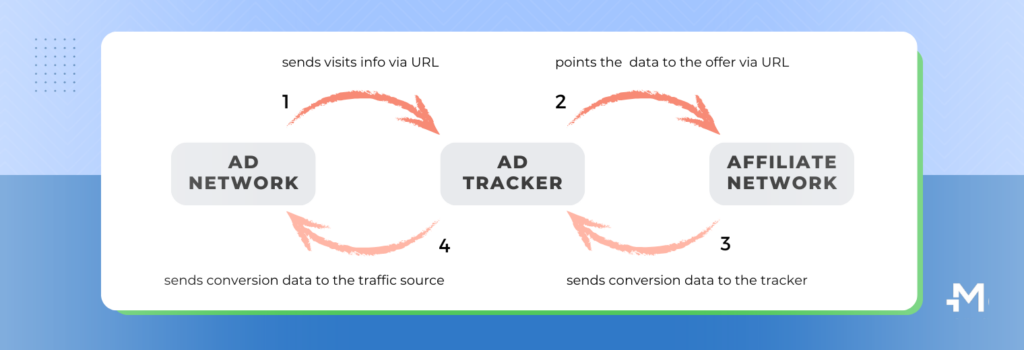
When a user clicks an affiliate link, a tracking system records key data such as:
- Traffic source
- Device and browser
- Campaign and creative ID
- Time of click
- Conversion event (signup, purchase, install, etc.)
This allows advertisers and affiliates to identify which placements, campaigns, and audiences generate profitable conversions. Without accurate tracking, media buyers cannot reliably optimize bids, cut underperforming placements, or scale profitable traffic.
In simple terms, tracking answers one critical question: “Which affiliate deserves credit for this user action?”
Affiliate Marketing Tracking Methods in 2026
There are several tracking methods used in modern affiliate marketing, each with different levels of accuracy and scalability.

Cookie-Based Tracking
This is the traditional method where a cookie is stored in the user’s browser after clicking an affiliate link. If the user converts within the cookie duration, the affiliate gets credited. It is simple but limited due to browser restrictions and privacy changes.
Pixel Tracking
Pixel tracking uses a small piece of code placed on a conversion page to fire when a user completes an action. It is commonly used for website-based tracking and retargeting.
Postback (S2S) Tracking
Postback tracking, also known as server-to-server (S2S) tracking, is the most reliable modern method. Instead of relying on browser cookies, conversion data is sent directly between servers. This reduces data loss and improves accuracy, especially for mobile and app-based traffic.
S2S Tracking vs Pixel Tracking vs Cookie-Based Tracking
| Feature | S2S Tracking | Pixel Tracking | Cookie-Based Tracking |
|---|---|---|---|
| Browser dependency | Low | High | High |
| Mobile reliability | Higher | Moderate | Moderate |
| Ad blocker resistance | Higher | Lower | Moderate |
| Implementation complexity | Moderate | Easy | Easy–Moderate |
| Privacy resilience | Higher | Lower | Lower–Moderate |
| Tracking persistence | Server-side (stable) | Session-based | Depends on cookie lifespan |
| Attribution accuracy | High | Moderate | Moderate (can degrade with cookie loss) |
S2S (Postback) Tracking, the Standard
Modern affiliate tracking relies heavily on server-side communication instead of browser-side cookies.
In a typical server-to-server workflow:
- A user clicks an affiliate tracking URL.
- The tracker records a unique click ID.
- The user lands on the offer page.
- After conversion, the advertiser or affiliate network fires a postback URL.
- The tracker matches the conversion to the original click.
This process helps reduce attribution loss caused by:
- Browser cookie restrictions
- iOS privacy limitations
- Ad blockers
- Cross-device browsing
- JavaScript blocking
Advantages of S2S Tracking
| S2S Tracking Benefits | Why It Matters |
|---|---|
| Reduced attribution loss | Less dependency on browser cookies |
| Better mobile tracking | More stable for app and mobile traffic |
| Faster optimization | More accurate conversion reporting |
| Improved scalability | Handles higher click volumes efficiently |
| Better fraud filtering | Easier click-to-conversion validation |
Why This Matters for Push & Native Traffic
Push, pop, and native ad campaigns often involve fast user journeys and high click volumes. Even small attribution losses can materially affect campaign optimization.

Based on ad network Mondiad’s internal traffic observations, mobile campaigns using incomplete postback setups experienced higher discrepancies between recorded clicks and confirmed conversions.
| Traffic Format | Acceptable Discrepancy Range* | When It Becomes a Red Flag | Common Causes of High Discrepancies |
|---|---|---|---|
| Push Notifications | 0-10% | Consistently above 15-20% | Bot filtering, click injection, ad blockers, attribution window mismatches, subscriber quality issues |
| Popunder / Pop Traffic | 5-20% | Consistently above 25-30% | Aggressive fraud filtering, accidental clicks, browser restrictions, duplicate click removal |
| Native Ads | 0-10% | Consistently above 15% | Attribution mismatches, delayed conversions, tracking script issues, viewability differences |
| Banner Display | 0-15% | Consistently above 20% | Cookie loss, view-through attribution differences, ad blockers, impression tracking gaps |
| In-Page Push | 0-10% | Consistently above 15% | Browser limitations, tracking inconsistencies, click filtering |
For affiliates scaling campaigns across multiple traffic sources, server-side tracking is no longer optional.
Selecting the Right Tracking Method
Choosing the right tracking method depends on your traffic sources, vertical, and campaign goals.
- Cookie-based tracking may still work for simple desktop campaigns, but it is no longer sufficient for modern multi-device journeys.
- If you run mobile traffic, in-app offers, or high-volume campaigns, server-to-server tracking is the most reliable option.
- For privacy-sensitive environments or cookieless browsers, hybrid tracking systems provide better resilience and reduced data loss.
The key is to balance accuracy, scalability, and compliance when selecting your tracking setup.
Best Ad Trackers for Affiliates in 2026
1. BeMob
A beginner-friendly cloud tracker designed for affiliates and advertisers looking for affordable and simple campaign tracking.
BeMob offers an easy setup process, a clean interface, and real-time analytics that make campaign management simple for beginners.
Its free plan and multiple traffic source integrations make it an accessible choice for affiliates starting out.
2. RedTrack
A cloud-based tracking and automation platform built for affiliate marketers, e-commerce brands, and agencies managing multi-channel campaigns.
RedTrack helps advertisers manage campaigns across multiple channels with conversion tracking, attribution tools, and automation features.
Its collaboration tools and extensive integrations make it especially useful for agencies and scaling teams.
3. Binom
A self-hosted ad tracking platform built for affiliate marketers and media buyers who need fast performance, detailed reporting, and complete control over their data.
Binom is known for its speed and lightweight infrastructure, allowing affiliates to process large volumes of traffic without sacrificing tracking accuracy.
Its advanced reporting, traffic distribution options, and flexible campaign management tools make it a popular choice among experienced performance marketers.
4. CPV Lab
A self-hosted tracking platform focused on giving affiliates full control over their campaign data, tracking, and split testing.
CPV Lab Pro gives users full ownership of their tracking data while offering advanced A/B testing and detailed funnel analytics.
It also supports custom campaign rules and landing page optimization for more precise performance tracking.
5. PeerClick
A cloud-based ad tracker designed for affiliates and media buyers looking for reliable campaign tracking, automation, and performance optimization tools.
PeerClick offers real-time reporting, smart traffic routing, and customizable automation features that help marketers improve campaign efficiency.
Its intuitive interface and extensive integrations make it suitable for both growing affiliates and experienced media buying teams.
6. AdsBridge
A cloud-based affiliate tracking platform focused on campaign optimization, traffic distribution, and conversion tracking for performance marketers.
AdsBridge provides advanced split testing, landing page optimization, and real-time analytics to help advertisers maximize ROI.
The platform also includes built-in traffic filtering and automation features that simplify campaign management across multiple traffic sources.
7. Voluum
A premium cloud-based ad tracker built for affiliates, media buyers, and performance marketers who need advanced optimization and automation tools at scale.
Voluum provides real-time reporting and AI-powered optimization to help advertisers scale campaigns faster.
It includes built-in anti-fraud protection, automation rules, and easy integrations with major traffic sources, all without requiring server maintenance.
8. FunnelFlux
A visual campaign tracking and funnel analytics platform built for affiliates and marketers who want deeper insights into the customer journey.
FunnelFlux combines conversion tracking with visual funnel mapping, allowing users to analyze every step of the user path and identify optimization opportunities.
Its flexible tracking setup and detailed attribution reporting make it especially valuable for complex funnels and multi-step campaigns.
9. Keitaro
A powerful self-hosted ad tracker popular among experienced affiliates for its speed, customization, and advanced traffic routing capabilities.
Keitaro is known for its fast click processing and advanced traffic distribution features that help optimize high-volume campaigns.
The platform also offers flexible redirect rules, detailed reporting, and full server-side control for experienced users.
10. Skro
A cloud-based ad tracking platform designed for affiliates and media buyers seeking accurate attribution, automation, and campaign optimization features.
Skro helps marketers monitor performance through real-time reporting, traffic segmentation, and conversion tracking across multiple traffic sources.
Its user-friendly interface and automation capabilities make it a practical solution for both independent affiliates and growing teams.
11. ClickFlare
A cloud-based tracking and attribution platform built for affiliates, agencies, and performance marketers managing campaigns across multiple channels.
ClickFlare provides detailed conversion tracking, customizable reports, and traffic quality analysis to help users make data-driven optimization decisions.
Its flexible integrations and automation features make it well-suited for marketers looking to scale campaigns while maintaining tracking accuracy.
12. ClickMagick
A cloud-based tracking platform designed for affiliate marketers, funnel builders, and entrepreneurs who want straightforward conversion tracking and optimization tools without a steep learning curve.
The platform includes link tracking, split testing, traffic quality analysis, and conversion attribution features that make it suitable for affiliates and marketers focused on landing page and funnel optimization.
Its simplified setup and reporting tools make it a popular choice for beginners and small teams looking to improve campaign performance without managing complex infrastructure.
13. MaxConv
A performance marketing tracker focused on affiliate marketers who need reliable campaign monitoring, conversion attribution, and traffic optimization tools.
MaxConv offers real-time reporting, smart traffic routing, and customizable tracking options that help affiliates improve campaign performance.
Its straightforward setup process and comprehensive analytics make it a useful solution for marketers at various experience levels.
14. AlterCPA
A cloud-based affiliate tracking platform designed to help advertisers and affiliates manage, analyze, and optimize performance campaigns.
AlterCPA provides conversion tracking, campaign automation, and detailed reporting tools that allow users to monitor results across multiple traffic sources.
Its focus on ease of use and performance analytics makes it a practical choice for marketers looking to streamline campaign management.
15. IREV
An affiliate tracking software platform created for advertisers, affiliate networks, and performance marketers seeking comprehensive campaign management capabilities.
IREV offers conversion tracking, affiliate management tools, and detailed reporting features that help users monitor and optimize partner-driven campaigns.
Its customizable infrastructure and scalability make it suitable for businesses managing affiliate programs of various sizes.
Affiliate Tracker Comparison Table
| Tracker | Best For | Key Strengths | Best Traffic Types | Free Plan |
|---|---|---|---|---|
| BeMob | Beginners & new affiliates | Easy setup, free plan, simple UI, real-time analytics | Push, pop, native, display | Yes |
| RedTrack | Agencies & scaling teams | Multi-channel tracking, automation, collaboration tools | Native, social, ecom, PPC | No |
| Binom | Advanced media buyers | High speed, detailed reporting, full control | Push, pop, native, high-volume paid traffic | No |
| CPV Lab | Funnel testers & pros | A/B testing, funnel analytics, data ownership | Search, email, landing page funnels, affiliate traffic | No |
| PeerClick | Growing affiliates | Smart routing, automation, real-time reporting | Push, native, pop, display | No |
| AdsBridge | Performance marketers | Split testing, optimization tools, traffic filtering | Pop, push, native, banner ads | No |
| Voluum | Advanced scaling teams | AI optimization, anti-fraud, strong integrations | Paid ads (PPC), native, push, social ads | No |
| FunnelFlux | Funnel-focused marketers | Visual funnel mapping, deep journey analytics | SEO, PPC, email, multi-step funnels | Yes |
| Keitaro | Experienced affiliates | Fast routing, flexible rules, deep customization | Push, pop, native, cloaking-heavy traffic | No |
| Skro | Modern affiliate teams | Real-time tracking, segmentation, automation | Native, social, push, display | No |
| ClickFlare | Agencies & scaling marketers | Attribution, reporting, traffic quality insights | Multi-channel paid traffic, affiliate traffic | No |
| ClickMagick | Beginners & solopreneurs | Simple tracking, split testing, funnel tools | Email, funnels, PPC, affiliate links | No |
| MaxConv | General affiliates | Reliable tracking, smart routing, clean analytics | Push, native, pop, affiliate networks | No |
| AlterCPA | Performance marketers | Automation, campaign tracking, reporting | Multi-source paid traffic, affiliate campaigns | No |
| IREV | Affiliate networks | Affiliate management + tracking + scalability | Affiliate networks, multi-vertical traffic | No |
Ad tracking methods for Mondiad traffic
Mondiad supports integrations with multiple affiliate tracking platforms, including:
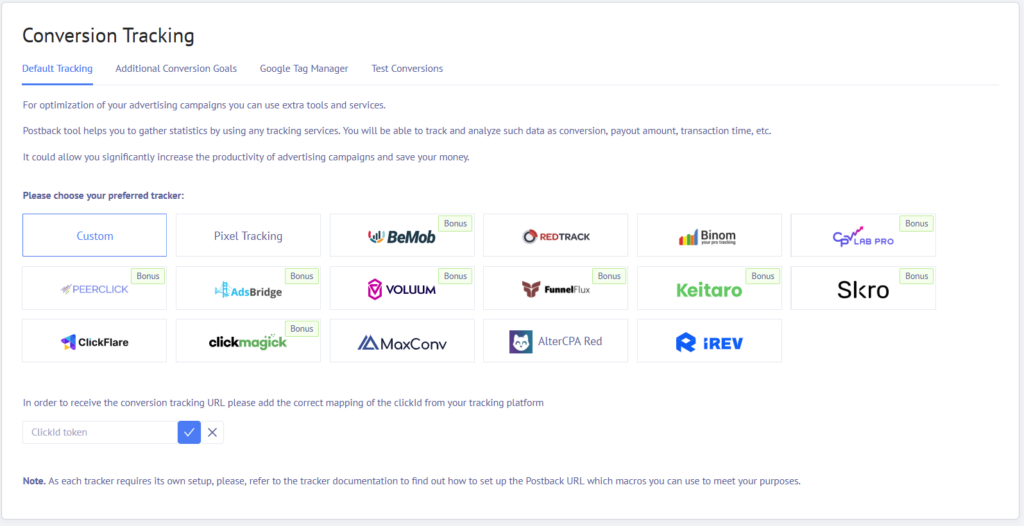
Tracking options available through Mondiad include:
- S2S postback tracking
- Pixel Tracking
- API integrations
- Tracking tokens
Which Tracker Works Best by Use Case?

– For push traffic campaigns, Keitaro and Voluum are commonly used by high-volume affiliates because they support advanced routing logic and scalable optimization workflows that handle large click volumes efficiently.
This makes them especially suitable for push arbitrage, multi-GEO testing, placement optimization, and other performance-driven setups where traffic needs to be filtered and redistributed quickly.
– For beginners, BeMob and ClickMagick are often preferred because they reduce technical setup complexity and provide a more intuitive onboarding experience.
These platforms are typically used for first campaigns, smaller budgets, and simpler funnel structures where ease of use and fast setup matter more than advanced customization.
– For agencies, Voluum and RedTrack are widely adopted due to their ability to manage multiple clients, multiple traffic sources, and shared reporting environments.
They are particularly useful for team collaboration workflows where centralized reporting and cross-account campaign management are required.
– For self-hosted infrastructure, Keitaro and CPV Lab Pro are commonly chosen by advanced affiliates who want full server control, custom routing logic, and complete ownership of their tracking data.
These solutions are better suited for flexible infrastructure scaling, complex campaign setups, and operators who prefer managing their own tracking environment.
Key Trends in Modern Ad Tracking
Ad tracking is evolving quickly due to privacy changes and automation:
- S2S tracking is increasingly adopted as browsers restrict cookies and client-side tracking becomes less reliable.
- CAPI-style integrations are widely promoted by platforms to improve attribution under privacy constraints.
- Shift toward cookieless attribution models: Major browsers and regulators are driving the decline of third-party cookies and pushing privacy-first alternatives.
- More AI-driven optimization and automation rules: Advertising platforms increasingly rely on AI for bidding, targeting, and campaign optimization.
- Growing demand for multi-touch attribution instead of last-click tracking: The industry is moving away from last-click models toward multi-touch and data-driven attribution.
The Takeaway:
Attribution is moving away from browser-based cookies and simple click tracking toward server-side data collection, privacy-safe identifiers, AI-driven optimization, and multi-touch measurement frameworks.
This is also why modern ad tech platforms (including ad trackers) are evolving into full performance marketing platforms, combining attribution, automation, optimization, and real-time decisioning rather than just logging clicks.
Ad Tracker Inconsistencies Troubleshooting
What is conversion delay? Conversion delay is the time between a user’s first click and the recorded conversion. Tracking inconsistencies often appear when the tracker’s attribution window, timezone, deduplication, or postback timing doesn’t match the traffic source or advertiser platform.
Conversion delays vary dramatically by vertical. Understanding “normal” delays by vertical helps identify whether tracker inconsistencies are caused by user behavior or technical issues.
Fast-moving offers like app installs and lead gen should convert within minutes or hours, while finance, travel, SaaS, and crypto commonly have multi-day or multi-week tails.
Aligning attribution windows and postback handling with these benchmarks is the fastest way to reduce ad tracker inconsistencies.
Common causes of ad tracking inconsistencies
Technical causes
- Postback URL misconfiguration
- Server time drift/timezone mismatch
- API rate limits or retries
- Cookie expiration before conversion
- Cross-device attribution loss
- Ad blocker or privacy restrictions
Operational causes
- Manual lead validation
- Fraud review queues
- COD call center confirmations
- Delayed advertiser reporting
- Batch processing schedules (e.g., hourly/daily uploads)
Ad Tracker Inconsistencies: Red flags by vertical
A tracker inconsistency becomes suspicious when delays fall far outside the expected range for the vertical.
| Vertical | Red Flag Delay Pattern | Possible Cause(s) |
|---|---|---|
| E-commerce | Sudden increase in average conversion delay from < 6 hours to 3+ days | Postback failures, advertiser-side batching, delayed order validation |
| App Installs | Conversion delays exceeding 24 hours | SDK integration issues, attribution mismatches, delayed MMP reporting |
| Lead Generation | Highly inconsistent delays (e.g., some conversions instant, others 5+ days) | Manual approval queues, duplicate lead filtering, advertiser review processes |
| Dating / SOI | Average conversion delay exceeds 1 hour | Callback latency, server-side tracking issues, delayed email verification |
| Crypto / Trading | Missing conversions after the expected KYC/verification window | Attribution expiration, postback loss, compliance-related processing delays |
Common Tracking Mistakes Affiliates Make
- Incomplete Postback Setup
One missing token or incorrectly mapped parameter can create attribution gaps that affect optimization decisions.
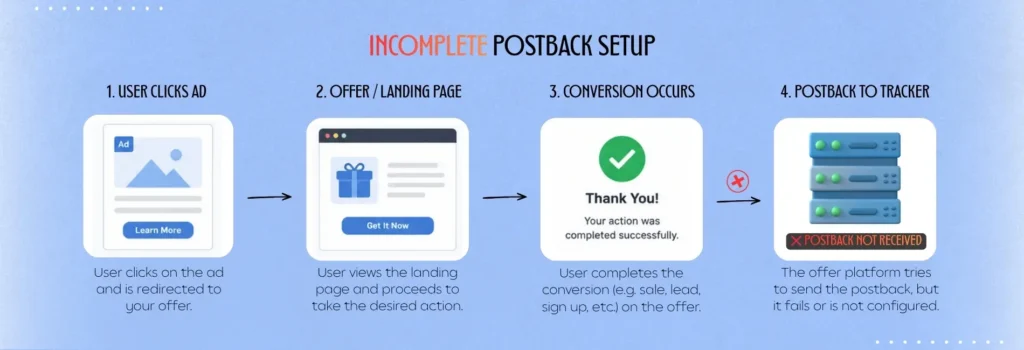
Common issues for Postback NOT properly set up.
- Wrong postback URL
- Missing click ID macro (e.g. {clickid})
- Incorrect parameter mapping
- Offer platform not whitelisted
- Postback blocked by firewall / server
- SSL / protocol mismatch (http vs https)
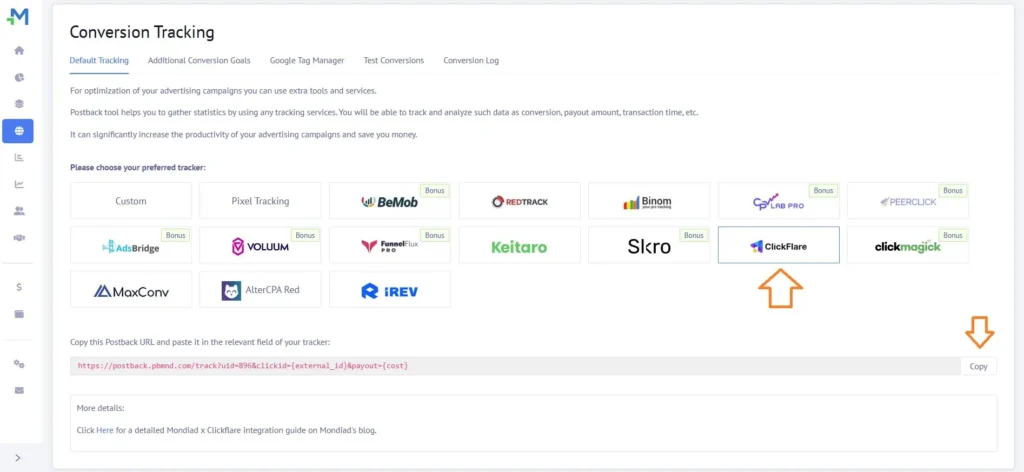
Mondiad x ClickFlare Incorrect Postback URL
Problem: payout is missing -> revenue tracking will fail
https://postback.pbmnd.com/track?uid=896&clickid=ABC123XYZMondiad x ClickFlare Correct Postback URL
A correct postback URL properly follows the structure and uses the required dynamic macros:
https://postback.pbmnd.com/track?uid=896&clickid=ABC123XYZ&payout=2.50or with placeholders (for integration setup):
https://postback.pbmnd.com/track?uid=896&clickid={external_id}&payout={cost}Why it’s correct:
- Has the correct base domain
- Includes required parameters: uid, clickid, payout
- Uses valid format for macros or real values
- No missing or broken query parameters
Consequences:
- Conversions are not recorded in your tracker
- You can’t see which campaigns, ads or sources are profitable
- Poor optimization & wrong decisions
- Loss of revenue and inaccurate reporting
- Optimizing on Incomplete Data
Some affiliates optimize campaigns before conversion data stabilizes. This becomes especially problematic for: Delayed-conversion verticals, Mobile app installs, Subscription offers, Finance campaigns.
- Ignoring Redirect Speed
Slow redirect chains can reduce landing page performance and affect user experience.
This matters more in:
- Tier-3 mobile traffic
- High-latency GEOs
- Multi-hop affiliate funnels
- Relying Only on Browser-Side Pixels
Browser-only tracking can underreport conversions in privacy-restricted environments. Affiliates increasingly combine: S2S tracking, CAPI integrations, First-party tracking, and Browser-side pixels.
FAQ: Ad Trackers for Affiliates
What is affiliate tracking?
It is the system that records where a user came from and assigns commission to the correct affiliate when a conversion happens.
What is the most accurate tracking method?
Server-to-server (S2S) tracking is generally considered more reliable than browser-only tracking because it reduces dependency on cookies and browser-side scripts. It is widely used for mobile traffic, push campaigns, app installs, and privacy-sensitive environments.
Can affiliate tracking work without cookies?
Yes. Modern systems use postbacks, fingerprinting, and hybrid tracking to operate in cookieless environments.
Do affiliate trackers integrate with ad networks and affiliate platforms?
Yes. Most major trackers integrate with:
- Push, native, pop, banner, and social traffic sources
- Affiliate networks
- Landing page builders
- Automation tools
- Analytics platforms
Integrations are usually done through:
- Postback URLs
- Tracking tokens
- API connections
What features are vital in affiliate tracking software?
Important features include:
- Real-time reporting
- Conversion/postback tracking
- Traffic source integrations
- Bot and fraud filtering
- Automation rules
- Split testing (A/B testing)
- Multi-offer routing
- Landing page tracking
- ROI and profit analytics
Is using a tracker necessary for affiliate marketing?
If you run paid traffic, a tracker is highly recommended. It helps you:
- Identify profitable placements
- Eliminate poor-performing traffic
- Optimize campaigns faster
- Scale winning ads more efficiently
- Track ROI accurately
Without tracking, campaign optimization becomes mostly guesswork.
Final Takeaway
The best affiliate tracker depends on:
- Your traffic volume
- Technical experience
- Preferred traffic formats
- Attribution requirements
- Infrastructure preferences
- Optimization workflow
For beginners, cloud-based platforms like BeMob or ClickMagick may provide a faster onboarding process.
For larger media buying teams and agencies, Voluum and RedTrack offer broader automation and reporting capabilities.
For advanced affiliates running high-volume push or native traffic, self-hosted platforms like Keitaro and CPV Lab Pro provide greater infrastructure flexibility and routing control.
As browser privacy restrictions continue evolving, accurate S2S tracking and reliable attribution setups will become even more important for campaign profitability.
Track and Guide Your Mondiad Traffic to Success!
Whether you run push, pop, native, or banner campaigns, Mondiad supports multiple affiliate tracking integrations to help advertisers and affiliates improve attribution accuracy and campaign optimization.