Singles’ Day gives advertisers two shots at the same shoppers: 11.11 and 12.12. The difference between a profitable run and an expensive lesson usually comes down to what happens before either date: tracking that works, creatives that have already proven themselves, and audiences that are warm by the time prices rise.
This guide shows you how to build that foundation, from a simple prep timeline and a starting budget split to the ad formats worth testing and a creative checklist. Take what fits your vertical and skip the rest.
TL;DR
- Singles’ Day advertising is paid promotion built around 11.11 and its follow-up, 12.12, when retailers run heavy discounts. The “double-digit” name comes from the repeated numbers in the date. In 2026, 11.11 falls on Wednesday, November 11, and 12.12 on Saturday, December 12.
- Test early, scale close to the sale. Never launch an untested creative on the biggest day
- Treat 11.11 as your learning run for 12.12. Retarget the buyers and the almost-buyers.
- Budget 11.11 and 12.12 separately. The two peaks attract different shoppers: self-purchase on 11.11, last-minute gifts on 12.12.
What is Singles’ Dayadvertising?
Singles’ Day advertising is paid promotion built around 11.11 and its follow-up, 12.12, when retailers and advertisers run heavy discounts. The “double-digit” name comes from the repeated numbers in the date.
11.11, also called Singles’ Day, began as a student tradition in China in the 1990s. Alibaba turned it into a shopping event in 2009, and it has since spread to platforms like Shopee, Lazada, and AliExpress across Southeast Asia, Europe, and beyond. 12.12 started as a follow-up sale and now works as a second chance for last-minute holiday gifts.
For advertisers, that means two peaks in 31 days. One plan won’t cover both well.
What happens on Singles’ Day? 🛍️
- Huge discounts and flash sales
- Special coupons and promotions
- Major sales across electronics, clothing, beauty, appliances, etc.
- Shopping events can start days or weeks before November 11
- It has expanded beyond China, with international retailers participating too.
So, if you’re seeing “11.11 sale” on an online store, it basically means Singles’ Day promotions.
How Does Singles’ Day Compare to Black Friday and Cyber Monday?”
To put it simply, Singles’ Day can be more efficient and higher-value for the right audience, while BF/CM generally delivers much larger, more competitive demand, especially in Western markets.
| Metric | Singles’ Day | Black Friday | Cyber Monday |
|---|---|---|---|
| Date | November 11, December 12 | Next Friday after Thanksgiving | Monday after Black Friday |
| Demand | Very high globally, concentrated in Asia/marketplaces | Very high, especially US/EU | Very high, particularly online |
| Ad competition | Usually lower in Western markets | Very high | Very high |
| CPM/CPC | Potentially cheaper outside core 11.11 markets | High | High |
| Conversion intent | High when offer/product fits | Very high | Very high |
| ROAS potential | Strong for high-AOV/self-purchase categories | Strongest at scale | Strong |
| Best audience | Existing customers, younger shoppers, premium/self-purchase | Broad prospecting + remarketing | Remarketing + high-intent shoppers |
| Creative angle | “Treat yourself”, exclusivity, premium | “Biggest deal”, urgency | “Last chance”, smart deal |
| Main advantage | Less crowded + differentiated event | Huge demand + urgency | High online purchase intent |
| Main risk | Lower awareness in Western markets | Expensive auction + margin pressure | Competition + deal fatigue |
One important caveat: Global 11.11 sales volume should not be directly compared with US BF/CM advertising performance. Singles’ Day is heavily driven by China/Asia and marketplace ecosystems, whereas BF/CM has much broader Western participation.
How does Singles’ Day fit with Black Friday and Cyber Monday?
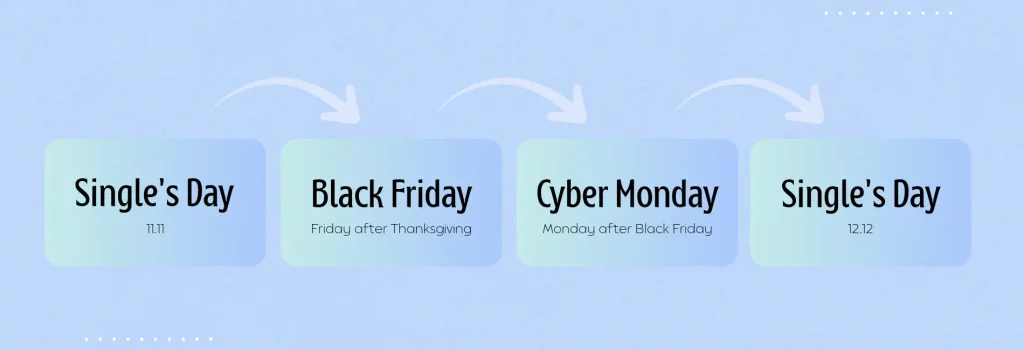
Instead of treating it as a competitor to BF/CM, I’d structure the season as: 11.11 → BF → CM → 12.12
11.11
- Test new creative and offers
- Acquire/activate high-value customers
- Focus on premium products and bundles
- Use self-gifting / “treat yourself” messaging
- Build first-party audiences for November
- Potentially benefit from lower competition
Black Friday
- Push maximum acquisition volume
- Increase budgets aggressively on proven campaigns
- Use strongest discount/offer
- Prioritize broad audiences + high-intent prospecting
- Accept higher CPMs if incremental ROAS remains profitable
Cyber Monday
- Retarget BF visitors/non-buyers
- Recover abandoned carts
- Personalize offers
- Focus on online-native products/categories
- Create urgency around the final opportunity
12.12
- Retarget 11.11, BF and CM visitors who didn’t buy
- Target last-minute gift shoppers
- Lead with fast delivery and holiday cutoff dates
- Push bundles and gift-ready offers
- Refresh creatives to fight ad fatigue
- Cut placements that didn’t convert in November
The best strategy is to run all four peaks as one connected plan. Use 11.11 to test creatives and build audiences, scale what worked on Black Friday and Cyber Monday, then retarget the leftover shoppers on 12.12.
Why do ad costs spike on double-digit sales days?
The scale of competition is significant: Alibaba reported that around 300,000 brands were participating on Tmall alone during its 2024 11.11 shopping festival, increasing the pressure on advertisers to stand out and compete for shoppers’ attention.
Ad costs spike because far more advertisers bid for the same audience at the same time. More competition for attention pushes prices up, and CPMs and CPCs typically climb in the days around the sale.
Here’s the part people miss. The expensive hours are not random. Traffic and competition build in the 48 hours before the event, then peak in the first hours of the day itself. If your campaigns only start on the 11th, you’re paying peak prices with zero learning behind you.
Black Friday works the same way, and the lessons carry over. If you want to see what went right and wrong last time, read our breakdown of Black Friday advertising lessons and to-dos. 📖
When should you start preparing campaigns?
Start at least two to three weeks before 11.11.
Here’s a timeline you can copy:
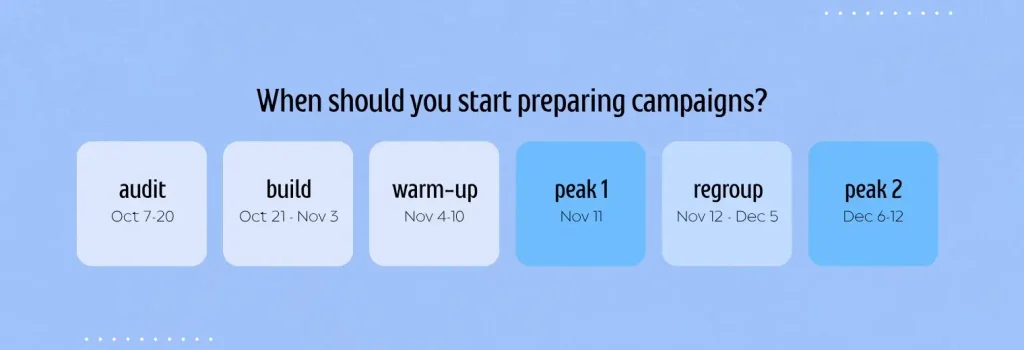
Notice that Black Friday (Nov 27) and Cyber Monday (Nov 30) land inside your Regroup phase. That’s a third peak, so plan it now instead of improvising. Our guide to Black Friday and Cyber Monday advertising 📖 shows how to handle it.
| Phase | Dates (2026) | What to do |
|---|---|---|
| Audit | Oct 7 – Oct 20 | Check conversion tracking, postbacks, pixels, and landing page speed |
| Build | Oct 21 – Nov 3 | Produce creatives, set up audiences, run small A/B tests |
| Warm-up | Nov 4 – Nov 10 | Launch teasers, raise budgets gradually, pre-load winning ads |
| Peak 1 | Nov 11 | Monitor hourly, shift budget to top performers |
| Regroup | Nov 12 – Dec 5 | Retarget buyers and cart abandoners, review data |
| Peak 2 | Dec 6 – Dec 12 | Ramp up with improved creatives, push gift angles |
Honestly, the audit phase is the one everybody skips and later regrets. A broken tracking link on 11.11 costs more than any creative mistake.
How should you split your Singles’ Day advertising budget?
A good starting split is roughly 40% for pre-launch testing and warm-up, 30% for 11.11, and 30% for 12.12 and retargeting. Adjust it to your vertical and past results.
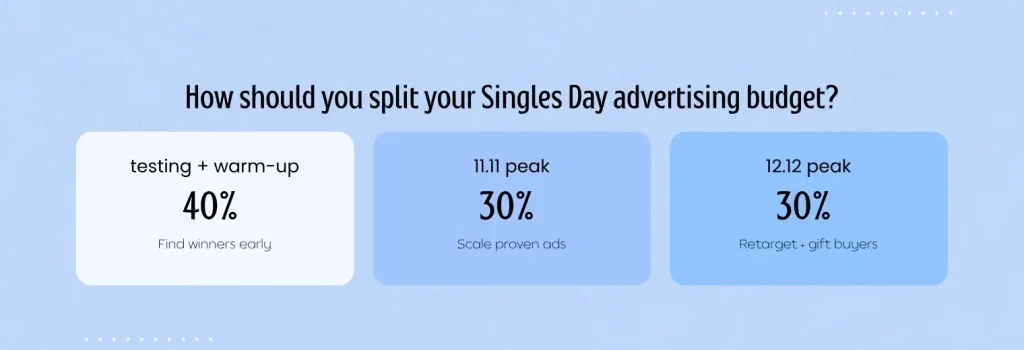
| Budget bucket | Share | Purpose |
|---|---|---|
| Testing and warm-up | ~40% | Find winning creatives and audiences before peak pricing |
| 11.11 peak | ~30% | Scale proven campaigns only |
| 12.12 and retargeting | ~30% | Re-engage buyers, capture gift shoppers |
Don’t treat this as a rule. If your product is a gift item, lean harder into 12.12, and check our Christmas paid ads guide 📖 for gift-season angles. If you sell electronics or fashion that depends on deep discounts, 11.11 might deserve more.
Where to Advertise for Singles’ Day?
Choosing the right ad formats and targeting the right audiences can make a big difference during Singles’ Day. Here’s where to focus your campaigns to reach shoppers, capture demand, and make the most of the 11.11 sales peak.
Formats
Push notifications, native ads, and popunders each serve a different job: push for urgency, native for trust, popunders for reach. The right mix depends on your goal.
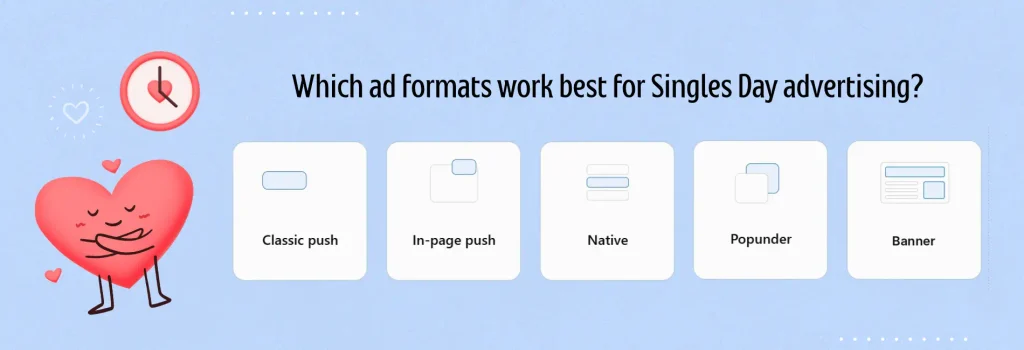
| Format | Best for | Strength | Watch out for |
|---|---|---|---|
| Push notifications | Flash deals, countdowns | Direct, instant reach | Message fatigue if you overdo frequency |
| Native ads | Product discovery, content-led offers | Blends into the page, builds trust | Needs stronger creative testing |
| Banner ads | Retargeting, brand awareness | Visual, persistent exposure for discounts and promo codes | Banner blindness, so it needs eye-catching creatives in multiple sizes |
| Popunder ads | High-volume traffic, broad reach | Large scale at lower cost | Needs tight targeting and a strong landing page |
Mondiad ad inventory has 3 additional formats in beta testing, accessible by request, namely: video pre roll, parked domain ads, telegram mini app ads.💡
Not sure which ad format is right for your campaign? Our Ad Formats Comparison: Push, Pop, Banner, Native guide breaks down the strengths, use cases, and performance considerations of each format to help you choose the best fit for your goals.
GEOs
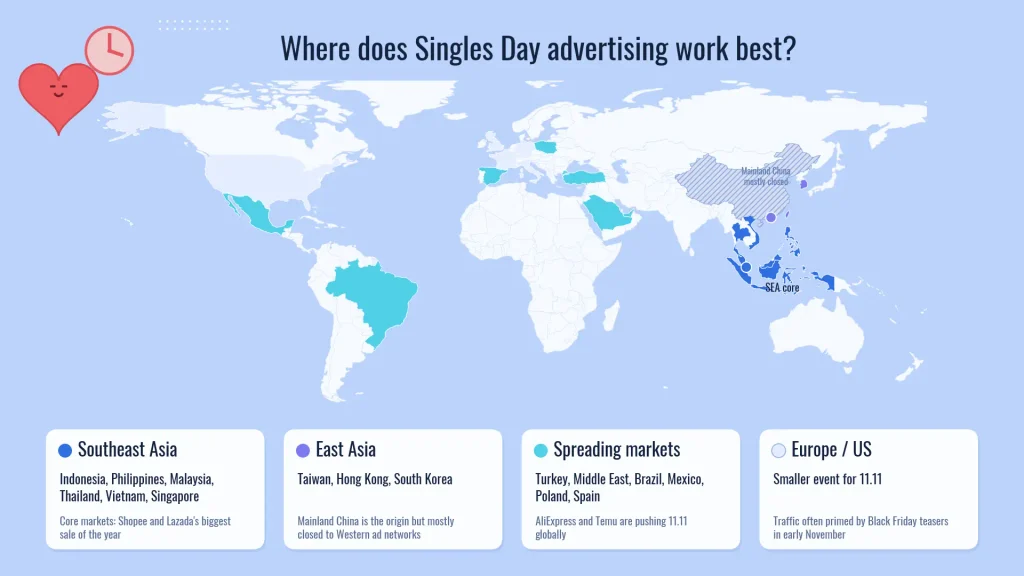
- Southeast Asia: Indonesia, the Philippines, Malaysia, Thailand, Vietnam, and Singapore are the core markets, since Shopee and Lazada treat 11.11 as their biggest sale of the year.
- East Asia: Taiwan, Hong Kong, and South Korea. Mainland China is the origin of the event but is mostly closed off to Western ad networks.
- Spreading markets: Turkey (Trendyol), the Middle East (Noon, Amazon, Namshi), Brazil, Mexico, Poland, and Spain. Part of this comes from AliExpress and Temu pushing 11.11 globally.
- Europe/US: 11.11 is a smaller event, but traffic is often primed by Black Friday teasers starting in early November.
Verticals
- E-commerce: AliExpress, Shopee, Lazada, Temu-style apps, and cashback and coupon sites.
- Electronics and gadgets, plus fashion and beauty, which are the top categories by sales volume.
- Travel, for flight and hotel deals.
- Fintech and payments: BNPL, wallets, and cashback apps.
- Mobile apps and gaming: Installs spike around in-app sales and top-ups.
- Software and VPNs: These start running Black Friday-style discounts early.
- Dating: A natural seasonal fit, given the “Single’s Day” angle.
For advertisers promoting VPN offers during major shopping events, campaign optimization is just as important as timing. In our VPN campaign case study, we show how a media buyer reduced cost per install by 37% on iOS, bringing CPA down from $8 to $5 through targeted traffic and bidding optimizations.
Timing
- Most spend starts around Nov 1–3, with presales and coupon drops, and peaks Nov 10–11.
- CPMs and CPCs rise as Black Friday campaigns overlap. Advertisers who launch before Nov 8 usually get cleaner inventory at lower prices.
- Campaigns that treat Nov 11 through Cyber Monday as one continuous push tend to reuse creatives and get better returns.
Which ad formats should you test for each vertical?
Different verticals respond to different advertising formats. While Push, Native, Banner, and Popunder ads each have their own strengths, the best starting point depends on your offer, audience, and device.
Based on Mondiad’s internal campaign data, here are the formats we recommend testing first across several popular performance-marketing verticals:
| Vertical | Ad formats to start with |
| iGaming | Popunder + Classic Push |
| Finance / Crypto | Classic Push |
| Mobile Utilities | Classic Push (Android) + In-Page Push (iOS) + Popunder |
| Sweepstakes | Push + In-Page + Native + Banner |
| Dating & Adult | In-Page Push + Push + Banner + Popunder |
| Streaming / Downloads | Push + Popunder |
These recommendations are starting points, not one-size-fits-all rules. Test formats against your target GEOs, devices, audience segments, and campaign objectives, then optimize your budget based on actual performance.
What should your creatives and landing pages include?
Your creatives should state the offer, the deadline, and the benefit within the first few words. People scroll fast on sale days, so there’s no room for a slow build-up.
A quick checklist:
- A clear discount or deal (“Up to 50% off”, not “Great savings”)
- A real deadline, like “Ends midnight” or a countdown
- One call to action per ad
- Mobile-first design, since most sale-day traffic is on phones
- A landing page that matches the ad, with the same offer and visuals
One mistake we keep seeing: the ad promises one thing and the landing page shows another. Visitors leave, and you pay for the click anyway. Also, load speed matters more than a fancy design. If the page takes more than a few seconds to open, expect a lot of bounces.
Check your numbers against the benchmarks in Google’s mobile page speed guidance before the sale starts.
How do you keep momentum between 11.11 and 12.12?
Retarget 11.11 visitors and buyers within days, not weeks, then rebuild your offer for 12.12. You already paid to find these people.
Split them into three groups:
- Buyers: show upsells or gift ideas, not the same product again.
- Cart abandoners: remind them with a fresh angle or a small extra incentive.
- Browsers: retarget with your best-performing creative from 11.11.
Then review what worked. Which hours converted? Which creative won? Use that data to adjust 12.12.
FAQ
What is the difference between 11.11 and 12.12?
11.11 is the larger, older event, rooted in Singles’ Day. 12.12 is the smaller follow-up, popular for gifts and last-minute holiday shopping.
When should I start Singles’ Day advertising?
Launch warm-up and testing campaigns at least two to three weeks before November 11. Ramp budgets gradually in the final week.
How much should I increase my ad budget for 11.11?
There’s no fixed number, but many advertisers raise budgets in stages rather than all at once. Scale only the campaigns that already show good conversion data.
Is Singles’ Day advertising only for Asian markets?
No. 11.11 and 12.12 began in Asia, but many global platforms and advertisers now run campaigns around both dates.
Can I run the same creative for both dates?
You can reuse your winning structure, but refresh the visuals and message. 12.12 audiences often respond better to gift and holiday angles.
What is the biggest mistake on double-digit sales days?
Launching untested campaigns on the day itself. Test in October, scale in November.
Ready to launch your Singles’ Day advertising?
If you’re an advertiser planning for 11.11 and 12.12, the sooner your campaigns are live and learning, the better your results on the big days. Mondiad gives you access to multiple ad formats, flexible targeting, and real-time optimization tools to test early and scale fast.