In today’s mobile-first world, apps are more than just tools or games, they’re powerful platforms for monetization. With millions of users interacting with applications daily, advertisers and developers have a unique opportunity to generate revenue through well-placed, high-performing ads.

However, not all app categories offer the same potential when it comes to ad engagement and profitability. Some drive higher retention, while others benefit from more frequent sessions or longer screen time.
Understanding which types of apps are best suited for advertising can help you refine your strategy, increase ROI, and maximize user value.
Let’s break down the top-performing app categories for ad monetization and why they consistently deliver results.
TL;DR
- In-app ad monetization turns everyday user engagement into passive, scalable revenue without charging users upfront.
- It performs best in app categories with high retention or frequent sessions: gaming, health/lifestyle, utilities, media, social, earning apps, finance, and e-commerce all see strong ad results, each for different behavioral reasons.
- Modern ad SDKs, including Mondiad’s, are lightweight and quick to integrate, and global demand sources keep fill rates and eCPMs competitive even outside Tier 1 markets.
- Revenue scales naturally with user growth, making ads one of the most accessible monetization models for Android developers.
What Is SDK Monetization, and Why Does It Matter for Publishers?
SDK monetization means embedding an advertising SDK directly into an app’s codebase so the app can request, load, and display ads from a connected ad network.
For publishers, this matters because it turns an app’s existing user base into a revenue stream without requiring any change to the app’s core product or pricing model.
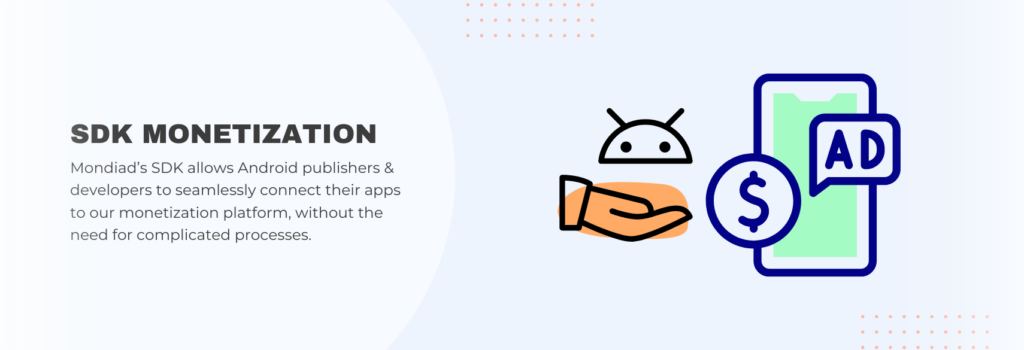
Monetizing an Android app with ads is one of the most accessible and scalable ways to turn user engagement into consistent revenue, without charging users upfront. Because the SDK handles ad requests, targeting, and delivery in the background, publishers don’t need to build their own advertising infrastructure or sales team to start earning.
How Mondiad’s In-App (SDK) Monetization Works
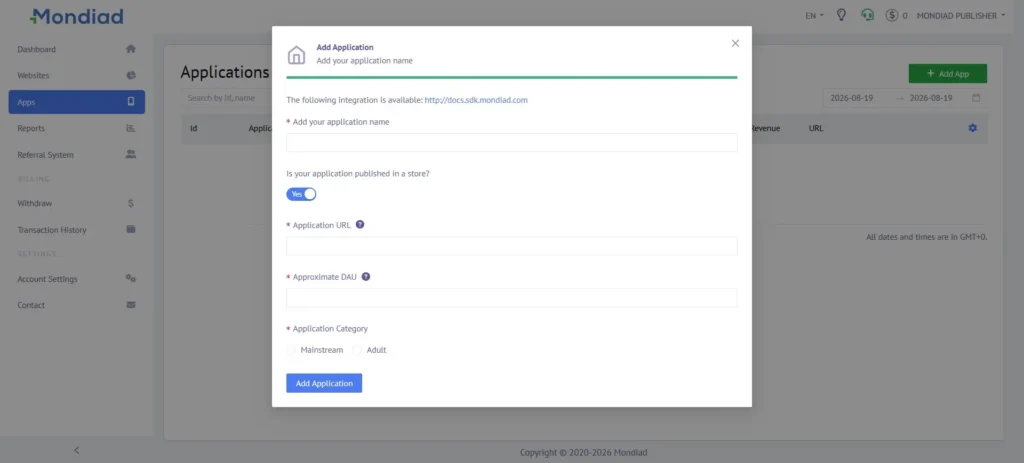
Mondiad’s SDK connects an app to global demand sources, allowing it to display ads such as banners, interstitials, and rewarded video without heavy engineering work. Integration is designed to be lightweight: most publishers can add the SDK, configure ad placements, and start serving ads without overhauling their existing codebase.
Because Mondiad taps into demand across regions, apps can maintain strong fill rates and competitive eCPMs even in markets outside the traditional Tier 1 countries (US, UK, Canada, Australia), which matters for publishers with a global, not just domestic, user base.
Is In-App Ad Monetization Right for Your App?
In-app ad monetization is a strong fit if your app is free or freemium, has a steady stream of daily or weekly active users, and doesn’t rely on a premium, ad-free experience as its core value proposition.
It’s a weaker fit for apps where ads would disrupt a paid, distraction-free experience users are already paying for (e.g., some productivity or wellness tools with a subscription model).
Key Benefits of In-App Ad Monetization for Android Developers
Monetizing with ads offers several structural advantages over purchase – or subscription-only models:
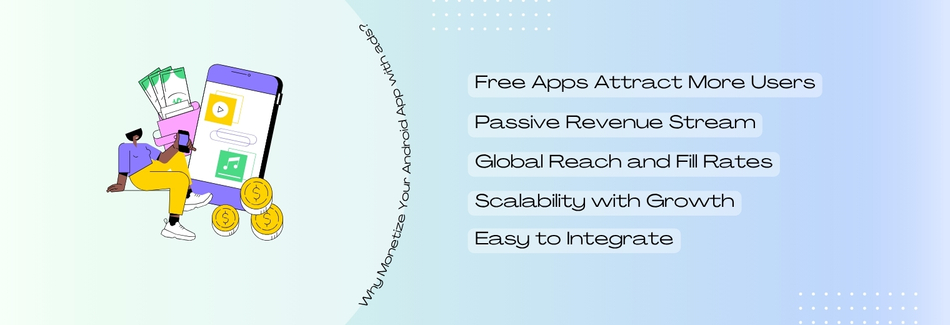
1. Free apps attract more users. Most users expect apps to be free, especially on Android. Ads let you keep your app accessible while still generating income, lowering the barrier to entry and increasing downloads.
2. Passive revenue stream. Unlike subscriptions or in-app purchases, which require a user to take action, ads generate income automatically as users interact with the app. More sessions translate directly into more impressions and more revenue.
3. Global reach and fill rates. Modern ad networks draw on global demand sources, so an app can generate revenue from users anywhere in the world, maintaining high fill rates and competitive eCPMs even outside Tier 1 countries.
4. Scales with growth. Ad revenue grows alongside your user base without requiring new monetization infrastructure. There’s no need to rebuild pricing or billing systems as the app scales.
5. Easy to integrate. Most modern ad SDKs are lightweight and well-documented, so developers can get started quickly without a major rework of the app’s codebase.
Which App Categories Perform Best with In-App Ads?
Ad performance varies significantly by category, driven by differences in session frequency, user intent, and content structure.
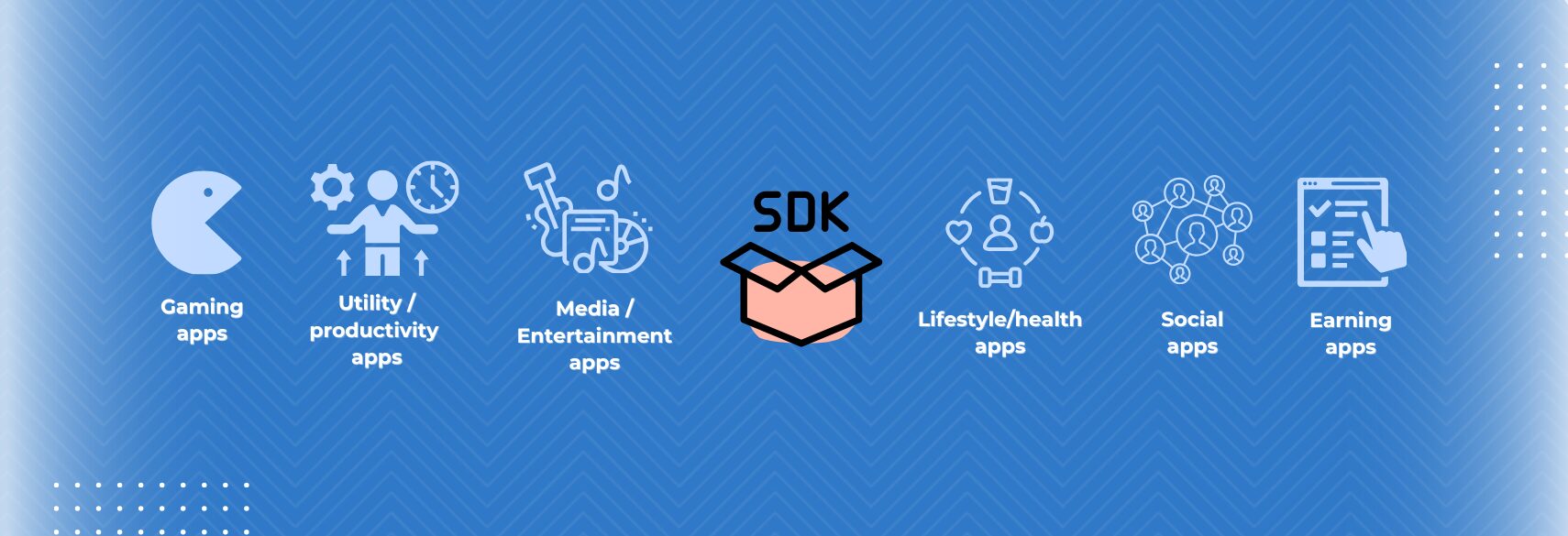
We’ve seen great success across several verticals:
🕹️ Gaming Apps
Gaming apps are among the top-performing categories for ad revenue, thanks to high user retention and frequent usage, players often return daily, increasing session frequency and total ad impressions over time.
Users are also already accustomed to in-game ad formats like rewarded video, interstitials, and playable ads, which makes them more receptive to engaging with them rather than treating them as disruptive.
🧘♀️ Lifestyle & Health Apps
Lifestyle and health apps attract a loyal, niche audience that engages consistently, tracking workouts, meal plans, or meditation sessions, which makes them well-suited to targeted ad campaigns with high interaction potential. Because these users are goal-oriented and return regularly, ad exposure compounds over time.
The global health and fitness app market is expected to reach $30 billion by 2030.
Source
🛠️ Utility & Productivity Apps
Utility apps like weather, calendar, and note-taking tools typically have shorter session lengths, but users open them multiple times per day, which keeps ad impressions consistent. Because users aren’t immersed in content the way they are in games or media apps, banner and interstitial ads tend to feel less intrusive here than in more content-heavy categories.
Some of the top downloaded Android apps globally are utilities, such as file managers and battery savers, underscoring how much daily reach this category commands.
The average mobile user opens roughly 10 apps a day out of about 34 apps used per month — meaning most of a person’s app portfolio gets touched only briefly, but the small set of apps opened daily (weather, calendar, messaging-adjacent utility tools) captures outsized impression volume relative to their session length.
Source
📺 Media & Entertainment Apps
Streaming, news, and music apps offer multiple natural ad placement opportunities, pre-roll, mid-roll, banners, and native ads, during content breaks.
Users are already conditioned to expect ads at these transition points (before a video starts, between songs, or between news stories), which reduces friction compared to interrupting active use.
💬 Social Apps
Social apps dominate daily screen time, with users checking them multiple times a day, which creates substantial opportunities for ad exposure through banners, native, and video formats. Scrollable in-feed native ads and short-form video ads tend to perform especially well here because they match the format users are already consuming.
Android users in the US spend more than two and a half hours per day on social and communication apps combined (a commonly cited industry benchmark for app-category screen time).
The average person now spends roughly 2 hours and 21 minutes per day on social media globally — around 18 hours 36 minutes per week.
Source
💰 Earning Apps
Earning apps attract highly active users who are directly motivated by rewards, making them unusually responsive to incentivized ad formats like rewarded video views, surveys, and app-install offers. Because the ad interaction is tied to a tangible reward, engagement rates with these formats tend to run higher than in categories where ads are purely incidental.
💸 Finance Apps (Budgeting, Investing, Crypto)
Finance app users are financially motivated and typically high-intent, which makes this category attractive to premium advertisers offering loans, credit products, or brokerage accounts. Users also tend to return repeatedly to check balances or monitor stock prices, driving long-term engagement.
Over 70% of Gen Z and millennials now manage finances primarily through mobile apps.
Source
🛍️ E-commerce Apps (Flash Sales, Marketplaces, Second-Hand Goods)
E-commerce app users are typically in a purchase-ready mindset, making them highly responsive to product ads and affiliate offers. Flash sale and daily deal formats add urgency that encourages daily check-ins.
Mobile commerce now accounts for over 70% of all e-commerce transactions globally.
Source
In-App Ad Monetization: Frequently Asked Questions
What is in-app ad monetization?
It’s the practice of generating revenue by showing ads (banners, interstitials, rewarded video, native, etc.) inside a mobile app, instead of relying solely on purchases or subscriptions.
Which app categories make the most money from ads?
Gaming, health/lifestyle, utility/productivity, media/entertainment, social, earning apps, finance, and e-commerce tend to perform best, each for different reasons, from session frequency to purchase intent.
Is ad monetization better than in-app purchases or subscriptions?
It’s not either/or, ads generate passive revenue without requiring user action, which makes them a strong complement to (or standalone alternative for) purchase- or subscription-based models, especially for free apps.
How hard is it to integrate an ad SDK?
Most modern SDKs, including Mondiad’s, are lightweight and well-documented, so publishers can typically integrate them without a major overhaul of their app’s codebase.
Does ad monetization work outside Tier 1 countries?
Yes, ad networks with global demand sources can deliver high fill rates and competitive eCPMs across regions, not just top-tier markets.
Does ad revenue scale as an app grows?
Yes, more users and sessions mean more impressions, so revenue scales naturally with growth without needing new monetization infrastructure.
The Bottom Line on Monetizing Your App with Ads
Ads let you focus on building great experiences while generating real income, whether you’re a solo developer or scaling a large portfolio of Android apps.