


Not all publisher traffic is worth the same to advertisers. Two websites can generate the same number of visitors and impressions yet earn dramatically different CPMs, and the difference often has little to do with traffic volume alone.
What advertisers are really paying for is the likelihood of a user taking action. Location, device, ad format, audience intent, and traffic quality all influence how valuable a particular impression appears to an advertiser. A highly engaged visitor from a competitive GEO may attract significantly higher bids than several low-intent impressions from a less valuable market.
Understanding these differences is essential for publishers who want to increase revenue without relying solely on more traffic. In this article, we’ll break down the factors that drive advertiser bids, explain why some audiences command higher CPMs than others, and show how publishers can increase the value of the traffic they already have.
TL;DR
Advertisers pay more for publisher traffic that converts reliably, and conversion likelihood depends on GEO, device, ad format, audience intent, and traffic quality, not raw pageview volume.
Two publishers with identical traffic counts can see very different CPMs if one sends higher-intent Tier 1 visitors on a format that matches advertiser demand, while the other sends generic Tier 3 traffic on a format advertisers are deprioritizing.
Publishers who understand these levers can restructure their ad placements and traffic mix to meaningfully increase revenue per visitor, without needing more traffic overall.
Why Doesn’t All Traffic Earn the Same CPM?
Advertisers aren’t paying for a pageview, they’re paying for the probability that a pageview turns into a lead, install, sign-up, or sale. That probability varies enormously based on who’s looking at the ad, where they’re located, what device they’re on, and what they were doing right before they saw it.
This is why two publishers with the same monthly traffic can see very different payouts from the same ad network. A network like Mondiad prices inventory by matching advertiser demand to publisher supply in real time, so CPM is really a live reflection of how much advertisers currently value that specific slice of traffic, not a fixed rate card.
CPM = cost per thousand impressions; the two other pricing models used throughout this piece are CPC, cost per click, and CPA, cost per acquisition – advertisers choose the model that best fits how directly they can measure their own conversion.
What Factors Actually Drive Advertiser Bids?
Five factors do most of the work in determining what an advertiser is willing to pay for a given impression or click:
- GEO. Tier 1 countries (US, UK, Canada, Australia, Western Europe) command higher CPMs because average purchasing power and advertiser competition are both higher.
- Ad format. Formats convert differently by vertical, so advertiser demand (and price) shifts format to format even within the same GEO.
- Device and OS. “iOS traffic can carry a premium in verticals like finance and subscriptions, but the gap has narrowed. Apple’s App Tracking Transparency limits cross-app tracking, and Safari restricts cross-site tracking and web push, so advertisers have weaker signals on iOS than they once did. Check current demand for your vertical before pricing iOS as an automatic markup.
- Audience intent. A visitor actively searching or comparing options converts at a different rate than one passively browsing, and advertisers price accordingly.
- Traffic quality. Fraud rates, bot traffic, and click quality directly affect an advertiser’s real cost per conversion, so networks and advertisers both discount for lower-quality sources.
The sections below break down each of these in more depth.
How Much Does Format Diversification Actually Move CPM?
Ad format diversification moves total revenue much more than it moves CPM, and sometimes CPM goes down while revenue goes up. Let us explain.
CPM is set per format, per geo, per device, mostly by the auction. Adding a format doesn’t raise the price of your existing inventory. It adds new inventory, which lifts revenue per session (RPS). Blended CPM can even fall if you add a lower-priced format like pops or push next to higher-priced display or video. Total earnings still rise if the new format monetizes impressions you weren’t monetizing before.
Where the real lift comes from
- Incremental impressions. A second or third format monetizes more of each session without needing more traffic.
- Format-level price differences. Video typically clears at higher CPMs than standard banners, while native, push, and popunder formats tend to be lower on CPM but high on volume or fill. The gaps depend heavily on geo and vertical.
- Fill and demand coverage. In geos where display fill is weak, an alternative format can monetize traffic that would otherwise go unsold.
- Advertiser fit. Some demand only buys certain formats, so adding them opens new bidders.
What can drag CPM down
- Stacking too many units lowers viewability and CTR, which pushes down bids on all of them.
- Aggressive formats (interstitials, popups) can shorten sessions and reduce pages per visit.
- Heavier pages hurt load speed and Core Web Vitals, which can cost organic traffic over time.
- Formats competing for the same user attention cannibalize each other.
How Does GEO Affect Traffic Value?
GEO is usually the single biggest lever on CPM. Advertisers bid based on expected return, and expected return tracks closely with a country’s average income, ecommerce and app-spend behavior, and how competitive that GEO already is among other advertisers.
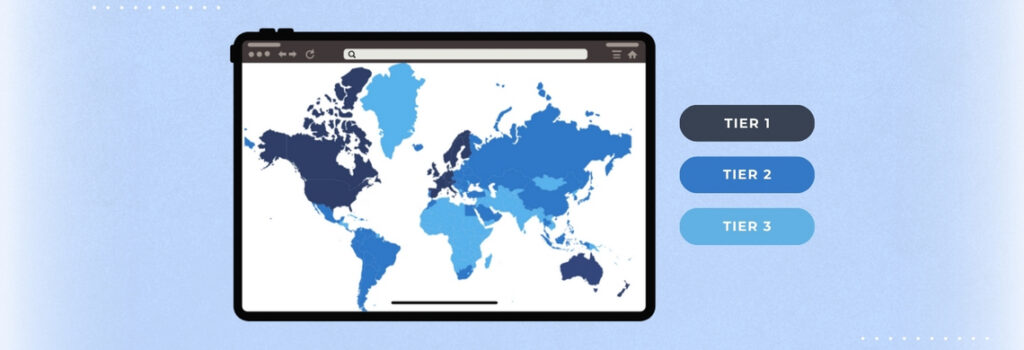
For example, here are some popunder CPM ranges based in recent Mondiad data*:
| Ad format | Tier | Example GEOs | CPM Range | Why |
|---|---|---|---|---|
| Popunder | Tier 1 | US, UK, Canada, Australia, Germany | $1-$2 | High purchasing power, high advertiser competition |
| Popunder | Tier 2 | Poland, Brazil, Mexico, UAE | $0.5 – $1.5 | Moderate purchasing power, growing advertiser demand |
| Popunder | Tier 3 | India, Philippines, Nigeria, Indonesia | $0.2 – $1 | High volume, lower average payout, strong for volume offers |
Keep in mind monetization is dynamic on many factors, including advertiser demand.*
This doesn’t mean Tier 3 traffic is low-value, it just monetizes differently. Volume-driven offers (sweepstakes, app installs, some dating funnels) are often priced on CPC or CPA and can perform very well on Tier 2/3 volume, even though per-impression CPM is lower.💡
How Does Ad Format Affect What Advertisers Pay?
Advertisers don’t just buy GEO, they buy the format that best fits their offer’s conversion path, and that shifts demand (and price) format to format:
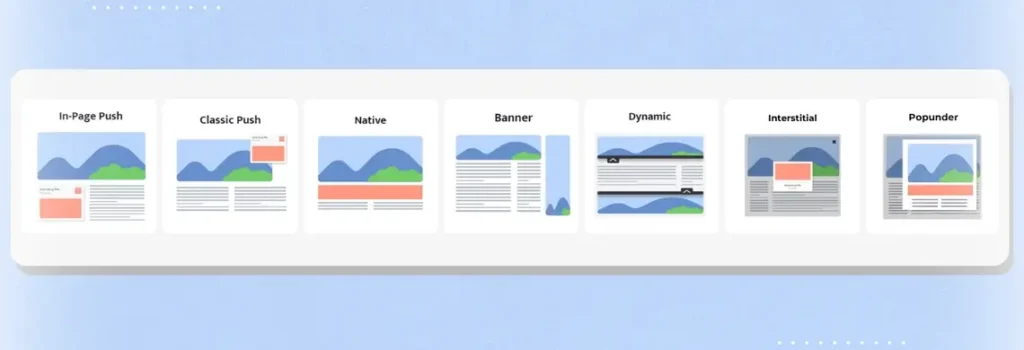
- Popunder traffic tends to command lower CPM per impression but very high volume, making it efficient for low-friction offers like dating and sweepstakes.
- In-page push and classic push often earn a premium on mobile, where advertisers see strong CTR for re-engagement and time-sensitive offers.
- Native placements typically earn more from advertisers running content-style or trust-dependent offers, since native converts better when the audience needs context before clicking.
- Banner placements are the most format-agnostic, working across nearly every vertical, and typically price closer to Tier 2/3 CPM ranges unless paired with premium placement (above-the-fold, high-viewability slots).
- Interstitial and dynamic formats sit between native and video in CPM, converting well for app-install and gaming offers where a full-screen moment fits the user flow naturally.
The takeaway: A publisher running several formats on the same audience typically earns more per session, because each format draws on its own pool of advertiser demand. Blended CPM may rise or fall depending on the mix.
How Does Traffic Intent and Vertical Fit Change Bids?
Not all traffic within the same GEO and format converts the same way, because intent varies by what a visitor was doing right before the ad appeared. A visitor on a finance comparison site and a visitor on a casual mobile game have very different purchase readiness, even if they’re the same age, GEO, and device.

This is why vertical fit matters as much as raw targeting. Advertisers running dating, iGaming, finance, or nutra offers bid more aggressively on publishers whose existing content or audience already overlaps with that vertical, since intent-matched traffic converts at a meaningfully higher rate than cold traffic of the same demographic profile.
Do Regulatory Restrictions Affect Traffic Value by GEO?
Yes, and this compounds directly with the GEO and vertical dynamics above, a Tier 1 label doesn’t guarantee Tier 1 demand once you factor in what advertisers are legally allowed to say to that audience.
– Gambling and sports betting advertising is heavily restricted in several major markets rather than simply banned outright, which is an important distinction for publishers estimating demand. In Germany, online casino and slot advertising is prohibited between 6am and 9pm daily, and betting ads cannot feature active athletes or sports officials.
In the Netherlands, sports sponsorships by gambling operators have already been phased out, and the Dutch regulator has continued tightening online betting-ad rules through 2026. Several US states license sports betting independently, so advertiser demand for casino/betting traffic can vary state by state rather than applying uniformly across “US” as a single GEO.
– Crypto and finance offers face their own restrictions. In the UK, the FCA’s financial promotion rules require crypto ads to be approved by an authorized firm, carry clear risk warnings, and, for first-time investors, include a 24-hour cooling-off period before they can invest. That changes both what creative is allowed and how aggressively advertisers can push urgency-based offers to UK traffic.
The practical takeaway: publishers running dating, iGaming, finance, or nutra content should check current ad policy for their top GEOs before assuming a Tier 1 label guarantees Tier 1 demand for that specific vertical. Restrictions shift the available advertiser pool for a vertical even when the underlying audience’s purchasing power hasn’t changed at all.
Why Does Traffic Quality and Fraud Filtering Matter So Much?
Fraud and bot traffic quietly cap CPM for otherwise legitimate publishers, because advertisers (and the networks pricing on their behalf) build fraud risk into every bid. A publisher whose traffic mix includes even a modest share of invalid clicks will see lower average CPMs across their entire inventory, not just on the flagged portion, since pricing algorithms adjust for the whole source.
This is one of the most overlooked levers publishers have. Working with a network that actively filters for bot activity, and keeping traffic sources clean on the publisher’s own end, directly protects the CPM ceiling advertisers are willing to pay, rather than just protecting against getting banned.
How Can Publishers Increase the Value of Their Traffic?
Publishers don’t need more traffic to earn more, in many cases they need better-matched traffic and format placement. A few concrete levers:
- Diversify ad formats on the same inventory. Each format is priced by its own demand, so a second or third format monetizes impressions a single format leaves unsold.
- Segment traffic by GEO where possible. Separate zones per GEO show what each market earns and let you set floors accordingly.
- Lean into vertical-relevant content. Content that naturally attracts intent-matched visitors (finance, dating, gaming-adjacent topics) earns a real premium over generic traffic at the same volume.
- Keep traffic sources clean. Avoid incentivized or low-quality traffic sources that introduce fraud risk into the mix, since it drags down CPM across the board.
- Test placements rather than assuming. The highest-CPM format or GEO segment isn’t always obvious upfront; publishers who split-test placements typically find meaningful upside within the first few weeks.
FAQ
Why does the same traffic pay differently on different days?
CPM is set by live advertiser demand, not a fixed rate, so pricing shifts with seasonality, advertiser budgets, and competition for that GEO/format combination at any given time.
Does more traffic always mean more revenue?
Not necessarily. A smaller, intent-matched, low-fraud audience can out-earn a much larger generic audience, since advertisers pay for conversion probability, not raw volume.
Is Tier 1 traffic always worth more than Tier 2 or Tier 3?
Usually on a per-impression CPM basis, yes, but Tier 2/3 traffic can be very profitable on CPC/CPA-priced volume offers, so “worth more” depends on how the campaign is priced.
Can publishers control how much advertisers pay for their traffic?
Not directly, but publishers can influence it significantly through format mix, content-vertical alignment, and traffic quality, all of which affect where their inventory lands in advertiser demand.
Ready to Monetize Your Traffic With Mondiad?
Mondiad matches publisher inventory to live advertiser demand across 8+ ad formats and worldwide GEO coverage, so your traffic is priced against the full range of demand it qualifies for, not locked into a single format or rate.
