



With the growth of internet accessibility and the shift from the offline to the online world, digital advertising has long overtaken traditional advertising. As a webmaster, much like the advertiser, in the dynamic online landscape, staying ahead in the game requires a strategic approach to maximizing ad revenue.
To capitalize on ad revenue with your website, the goal is to optimize it to gain more daily traffic and to make your space attractive to advertisers, ultimately increasing your ad revenue. At the same time, evolving consumer behaviors, technological advancements, and industry trends are constantly shaping the way ad publishers must approach ad revenue optimization.
So whether you’re an experienced publisher navigating the shifting tides or a newcomer seeking to get started, let’s explore 5 essential ad revenue optimization strategies for publishers in 2023.
TL;DR
- Optimize UX, page speed, mobile responsiveness, and navigation to keep visitors engaged.
- Create high-quality, audience-specific, SEO-friendly content to increase traffic and ad impressions.
- Test different ad formats and placements and measure performance using RPM.
- Improve ad viewability and adapt your strategy to your GEO, vertical, privacy requirements, and ad network opportunities.
How Ad Revenue Works for Publishers
Any webmaster with a website showing a decent amount of daily traffic can generate revenue by selling their ad space to advertisers. This ad inventory can be sold directly to advertisers but the most preferred method is selling via programmatic advertising which automatically facilitates this convention between advertisers and ad publishers. 😉💲

Ad revenue is generated when your website visitor is shown an ad(per impression) or clicks on one(per click/conversions). In fancy words, advertisers bid for ad space via CPM (cost per 1000 impressions) or via CPC(cost per click).
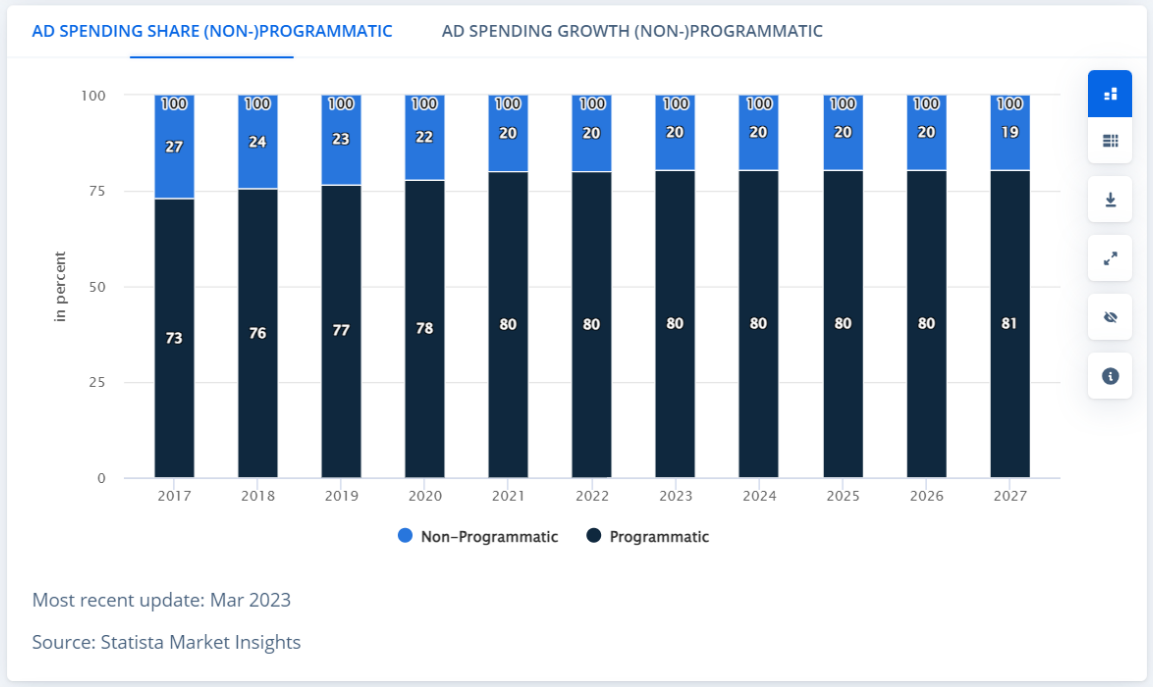
According to the Interactive Advertising Bureau (IAB), programmatic transactions now account for the large majority of digital display spend, and that share has continued to grow year over year.
Additionally, there are more ad revenue models but these two are the most common.
Enhance User Experience(UX) & Web Design
A smooth user experience translates to a growing, long-term ad revenue potential. 🎨⚡️
But a smooth user experience is also made of a plethora of things, not just one. The best trick to discover what’s missing is to put yourself in the shoes of your users. Is there something lacking or missing?
Page speed and responsiveness.
First of all, there’s the speed load and the overall website responsiveness. In this case, make sure your media is compressed and loads quickly, your template/layout fits and everything works in accordance with the screen size.
Mobile optimization.
Similarly, if your website is not optimized for mobile devices, what are you waiting for?! Today about half of website traffic worldwide comes from mobile. You are hurting your SEO and you are losing visitors!
Site structure and navigation.
And lastly, is your website easy to navigate? Is it logically structured and visually appealing? These things may sound irrelevant, but they can be game-changing elements.
Optimize Your Content for Engagement and SEO
Content and UX are the two levers that determine how long a visitor stays – and session length is the single biggest driver of ad impressions per user. Concretely, this means:
- Run a competitive content gap analysis. Identify the top 5-10 ranking pages for your target keywords, and list the subtopics, data points, or formats they cover that you don’t.
- Build audience-specific content, not generic coverage. The narrower and more specific your content is to a defined audience segment, the higher your engagement and ad relevance tend to be, which affects both organic traffic and the advertiser demand bidding on your inventory.
- Treat SEO as infrastructure, not an afterthought. Target keywords with clear commercial or informational intent, build internal links between related content clusters, and earn backlinks from relevant industry sites. More organic visibility means more traffic volume without a proportional increase in acquisition cost, which is the traffic a publisher actually wants to monetize.
Related reading: >> 5 Ad Monetization Myths You Should Stop Falling For
Related reading: >> AI Search Optimization for Traffic and Revenue
Related reading: >> Google Discover Traffic: A Publisher’s Guide to Getting Featured
Compare Ad Formats by Performance, Not Guesswork
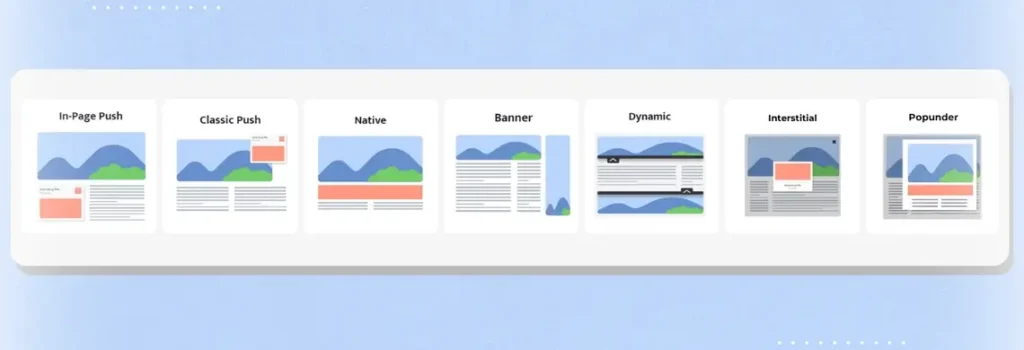
One of the easiest and most logical ways to increase your ad revenue is totest out different ad formats as well as ad displaying parameters. 🎨🆎
For example:
- Classic push notifications take no space on your website reaching users directly through mobile or desktop from everywhere.
- In-page push ads are embedded in your website, showing up like notifications and being compatible with all devices.
- Native ads are seamlessly integrated into the user experience, looking similar to related content on that page and generating more revenue than traditional ads.
- Banner ads are very versatile with placements, leading to higher attention-grabbing among website visitors, namely more conversions.
- Pop ads are best known for being the most non-intrusive ad types out there since they pop up or under the main window.
The beauty of advertising is that although there are a few guidelines to bring you closer to success, there is no secret recipe and no one-size-fits-all solution when choosing the right ad monetization plan. Format performance depends on vertical, GEO tier, and device mix. Test in controlled increments (one variable at a time) and measure against RPM, not just CTR.
Keep testing to determine what ad types work for your website and what impact each has on your ad revenue.
Optimize for Viewability
Viewability is a distinct metric from CTR, and advertisers increasingly weight it in their buying decisions, particularly those optimizing for brand awareness rather than clicks.
The industry standard, set by the Media Rating Council (MRC), defines a display ad as “viewable” when at least 50% of its pixels are on-screen for a minimum of one continuous second (two seconds for video). Publishers optimizing for viewability should prioritize:
- Above-the-fold (ATF) placement: the portion of the page visible before scrolling, still the highest-viewability real estate despite its print-era origin.
- Ad size and shape relative to typical viewport dimensions on your top traffic sources.
- Lazy-loading configuration: ads that load only as they approach the viewport reduce wasted impressions on ads a user never scrolls to.
Higher measured viewability directly increases the CPM advertisers are willing to bid, since it reduces their risk of paying for impressions that were never actually seen.
That being said, improving your ad space viewability will result in your website being more appealing to advertisers and thus generating more revenue.
Account for GEO Tier and Vertical
Ad revenue optimization tactics don’t perform uniformly across geographies or verticals, and treating them as if they do is one of the most common publisher mistakes.
GEO tier affects both CPM ceiling and format performance. Tier 1 GEOs (US, UK, Canada, Australia, Western Europe) typically command higher CPMs but also carry higher advertiser competition and stricter ad-blocker penetration. Tier 2–3 GEOs often see lower per-impression rates but higher fill rates and less format fatigue.
Vertical matters as much as geography. A finance-vertical publisher in a Tier 1 GEO and a sweepstakes publisher in a Tier 2 GEO will see meaningfully different optimal ad format mixes, payout structures, and seasonal volume patterns. Publishers should benchmark against their specific vertical + GEO combination, not category averages.
Related reading: >> Mistakes Sabotaging Your Ad Revenue as a Publisher
Privacy, Consent, and Cookie Deprecation
No modern ad-revenue strategy is complete without accounting for the ongoing shift away from third-party cookies. As browsers phase out third-party tracking (per initiatives like Google’s Privacy Sandbox), publishers relying on cookie-based targeting to justify premium CPMs should expect continued downward pressure on those rates unless they invest in:
- First-party data collection: newsletter sign-ups, logged-in experiences, and consented on-site behavioral data that publishers own directly.
- Consent management infrastructure: a compliant CMP (consent management platform) is now a baseline requirement in most Tier 1 GEOs, not an optional add-on.
- Contextual targeting readiness: as third-party identifiers degrade, ad networks increasingly lean on content-context signals, which rewards the content-quality work covered above.
Sell Your Ad Space Through an Ad Network
If you are not already part of it, welcome to the lucrative world of programmatic advertising! 💸
According to Statista, “In the Digital Advertising market, 81% of the Digital Advertising revenue will be generated through programmatic advertising in 2027.”
By making your ad space available to an ad network like Mondiad, you allow its thousands of advertisers to bid on your ad inventory, leading to higher CPM costs, thus increased ad revenue for you.
At Mondiad, setup follows four steps: submit your website, configure ad zones, implement the ad code, and let the auction run. Withdrawals start at $10 through multiple payment processors, including cryptocurrency, and can be scheduled as one-time or recurring.
FAQ
Is programmatic advertising better than direct ad sales for publishers?
Programmatic advertising typically increases competition for a publisher’s inventory by exposing it to a larger advertiser pool in real time, which tends to raise CPMs versus one-off direct deals. Direct sales can still outperform for publishers with strong, exclusive advertiser relationships in a specific niche.
How does viewability affect ad revenue?
Viewability measures whether an ad was actually seen, not just served. The MRC standard requires 50% of pixels visible for one continuous second. Advertisers increasingly bid higher for verified-viewable inventory, since it reduces wasted spend.
What traffic volume do I need to start monetizing with an ad network?
Requirements vary by network. At Mondiad, there is no published minimum traffic requirement. The main requirement is that your website/app passes our review and complies with our publisher policies.
What’s the difference between CPM and RPM?
CPM is what an advertiser pays per 1,000 impressions for a single ad slot. RPM (revenue per mille) is a publisher-side metric: total revenue across all ad units on a page, divided by total pageviews, per 1,000. RPM reflects real earnings; CPM reflects one bid.
