



An AI-powered GEO research workflow is a repeatable process that collects local market data through geo-accurate proxies. Then, AI shapes that data into sharper targeting, creatives and bids for every market you buy. Instead of guessing how an offer will perform abroad, you research each market from inside it and let AI turn the results into decisions.
For media buyers running offers across countries, the hard part is rarely launching a campaign. Instead, it is knowing what each market actually looks like before you spend. The sections below walk through the workflow end to end: choosing the right proxies, setting the exact geolocation, collecting local data at scale, structuring it with AI and mapping every finding to a real campaign setting.
TL;DR
Researching a market from your own location shows you the wrong market. Use geo-accurate residential or mobile proxies to see each GEO the way its local users do and set the same geolocation your campaign will target. Let AI structure the multi-language local data into ranked, comparable signals per market. Automate the cycle with an API and an agent so your view stays current, then map each finding to a concrete targeting, creative or bidding decision.
Why GEO Research Needs Geo-Accurate Proxies
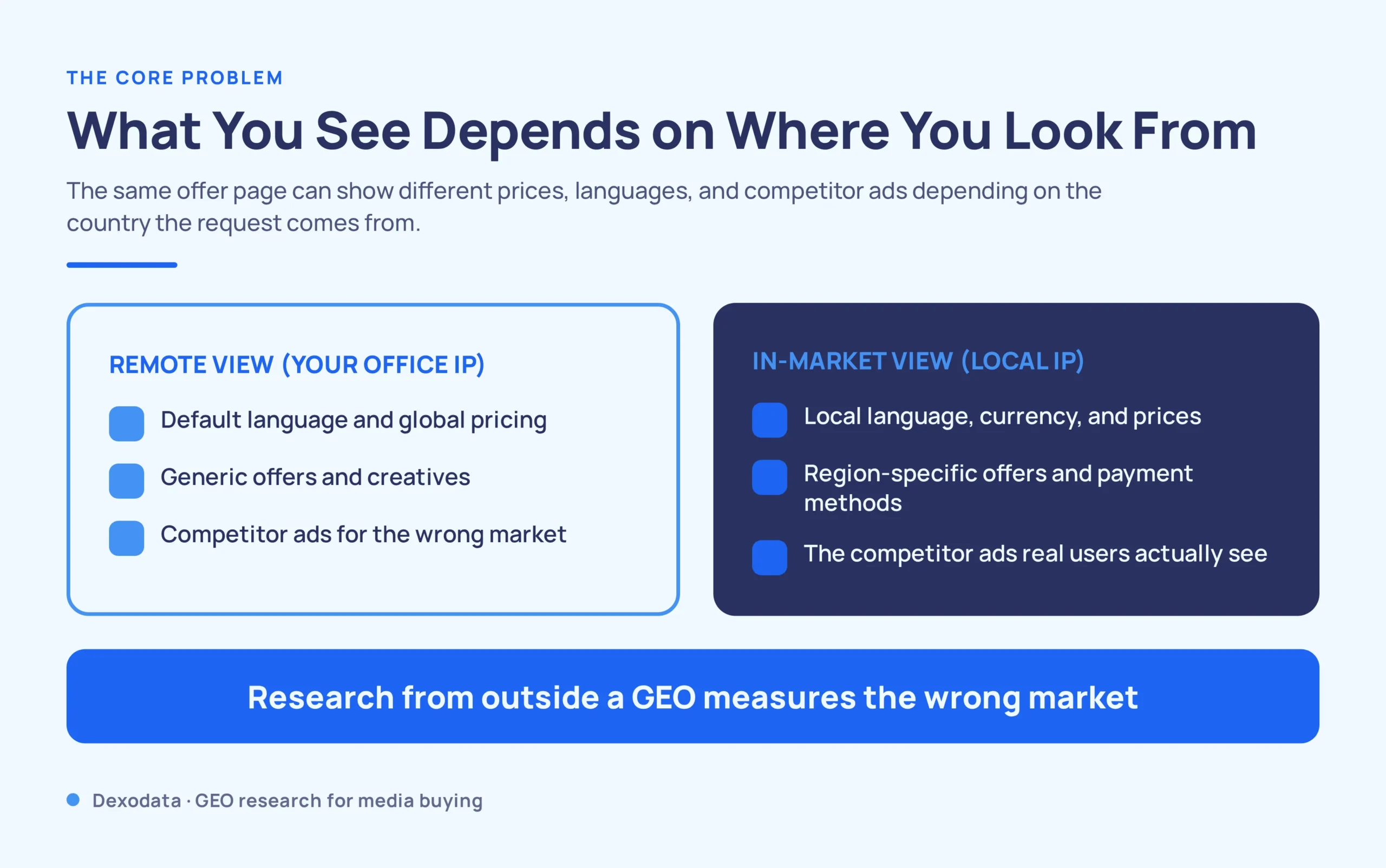
A search engine result, an offer page or a competitor’s ad changes based on the location of the request. From a single office IP, you see one version of a market: usually the default language, global pricing and ads aimed at your own country. That is the wrong reference point for a campaign that will run somewhere else. To research a market accurately, requests have to originate from inside it.
Geo-accurate proxies provide that local vantage point at scale, so you can view many markets the way their real users do rather than the way your own connection renders them. What matters most is control: a proxy network you can configure to each task, from how IP addresses behave to how requests are routed, so the workflow bends to your research instead of the other way around. This is what a network like Dexodata is built around, with advanced traffic control and flexible routing you set per task.
Residential, Mobile or Datacenter Proxies for GEO Research
The right pool depends on what you are researching.
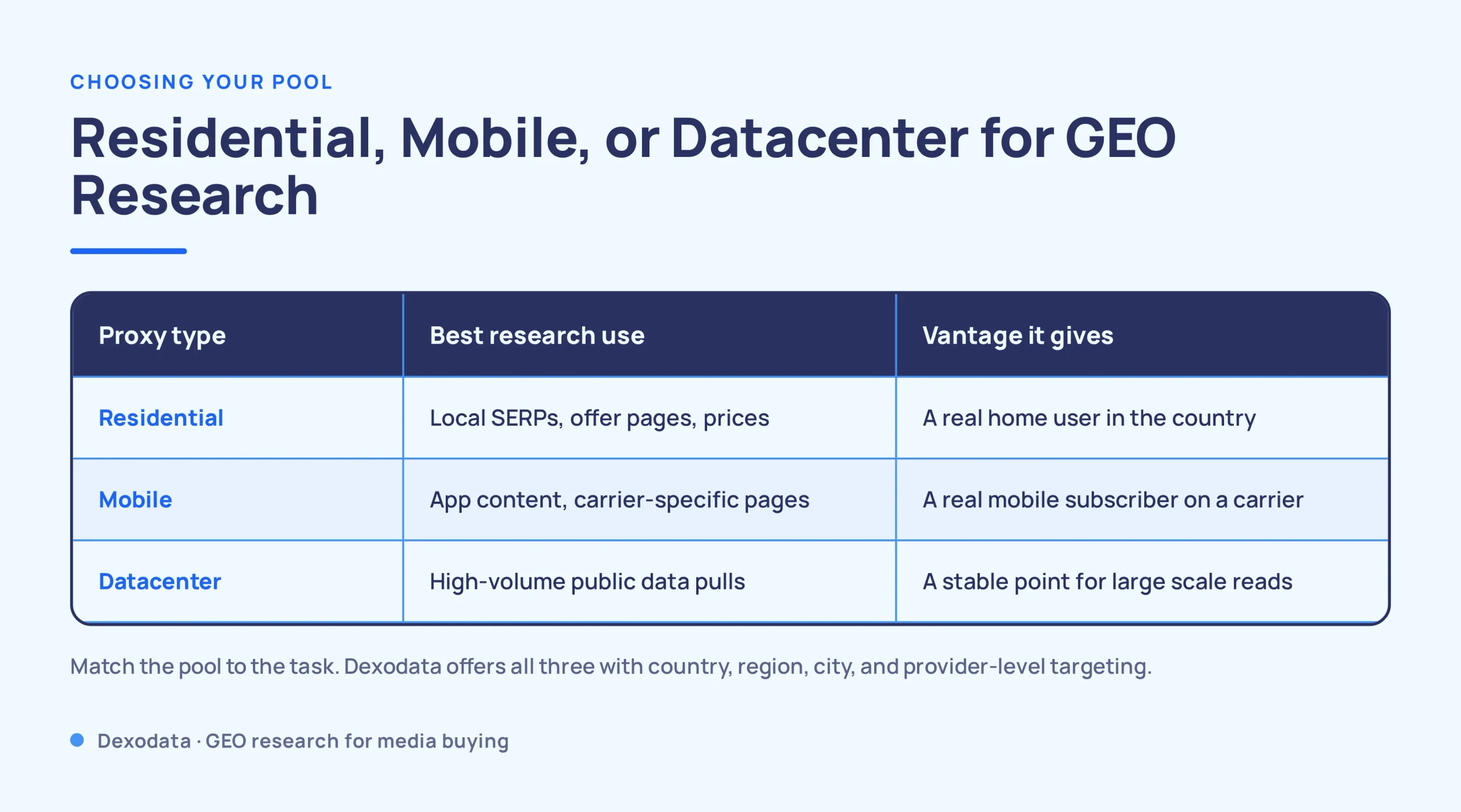
- Residential proxies route through real home connections and are the default for local search results, offer pages and pricing, because they show you the page the way local users see it.
- Mobile proxies route through real mobile subscribers on a specific carrier, which is what you need when content differs by carrier or targets mobile users, who make up a large share of push traffic.
- Datacenter proxies suit high-volume pulls of public data where a stable connection matters more than seeing the exact local view.
A fully configurable ecosystem such as Dexodata offers residential, mobile and datacenter proxies with country, region, city and provider-level targeting, flexible routing and a built-in firewall, so you can configure each pool to the research task instead of forcing one type to do everything.
| Proxy type | Best research use | Vantage it gives |
| Residential | Local search results, offer pages, prices | A real home user in the country |
| Mobile | App content and carrier-specific pages | A real mobile subscriber on a carrier |
| Datacenter | High-volume pulls of public data | A stable point for large-scale reads |
Setting the Right Geolocation for Each Market
Accurate research means matching the exact geography your campaign will target. Start at the country level for language and baseline pricing, then narrow to region and city where offers and competitors differ locally, and to provider level when the content depends on the carrier. Dexodata’s geo-targeting reaches country, region, city and provider level, so you can pin each session to the exact market a campaign will run in. The rule is simple: research from the same geolocation you will later target, so the data reflects the audience you will actually buy, and flexible IP rotation keeps each market’s sample fresh rather than resting on a single fixed connection.
Collecting Local Data Across Multiple IP Addresses
Once the location is set, collect a consistent set of data points for every market: local search results, offer pages and prices, competitor ads, landing pages, app store listings and the local content that shapes messaging. Rotating through several IP addresses per GEO keeps the sample representative instead of resting on one skewed session.
This is where automation earns its place. Dexodata’s API lets you pull the same data set across every target market on a schedule, and its pay-as-you-go, tokenized balance keeps the cost tied to how much you actually collect. Its built-in firewall, with configurable domain allowlists and blocklists, keeps collection scoped to the sources you intend to read.
How AI Turns Raw GEO Data Into Clear Signals
Raw local data is messy: several languages, different currencies, inconsistent formats. This is where AI does the heavy lifting. A language model reads the collected pages and extracts what matters, offers, angles, price points and calls to action, into one structured table you can compare. It translates local copy, clusters competitor angles, and flags the gaps where no one is addressing a clear need. The output is not a pile of screenshots but a ranked set of signals per market.
Comparing Markets Side by Side
The real value appears when markets sit side by side. The same offer can show strong local demand in one country and thin margins in another, or a high price index where competition is light. A comparison table of demand, pricing, dominant device and leading angle per GEO tells you where to lead, where to bid up and where to hold back. The values in such a comparison are illustrative, but the shape of the decision is what matters.
| GEO | Dominant device | Carrier mix | Top local angle | Price index |
| Brazil | Android | Tier-1 carriers | Instant discount | 82 |
| Indonesia | Android | Prepaid heavy | Free trial | 64 |
| Germany | iOS and Android | Postpaid heavy | Premium quality | 118 |
| Philippines | Android | Prepaid heavy | Bonus data | 70 |
Automating the Workflow With an API and an AI Agent
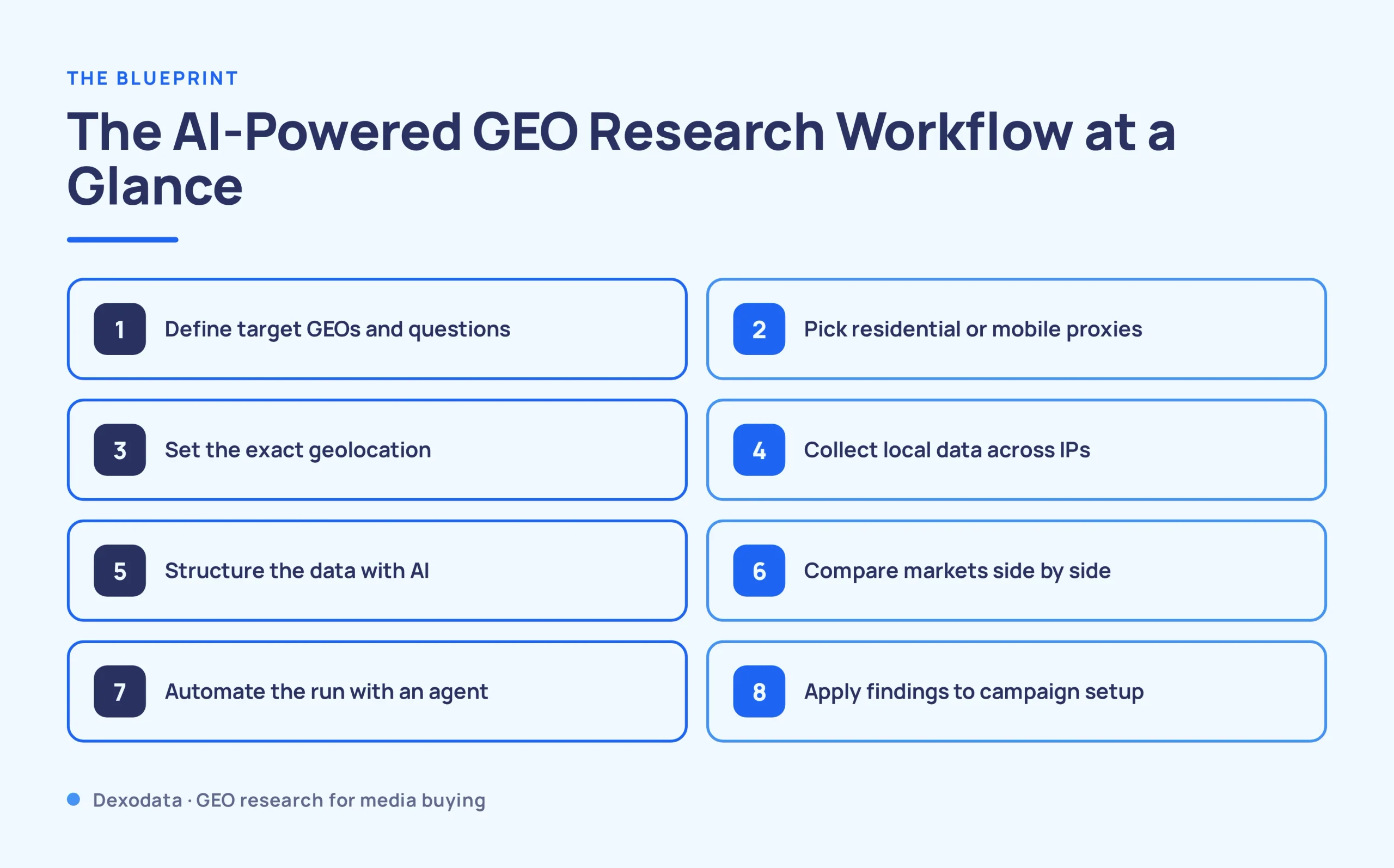
Manual research does not scale past a few markets. The workflow becomes an asset when an AI agent runs it end to end: the agent calls Dexodata’s API for each GEO, collects the standard data set, passes it to the model for structuring, and writes the comparison table, then repeats on a schedule so your view stays current as offers and competitors change. What took a full day of manual checking across eight markets can drop to under three hours per cycle after a one-time setup.
Applying GEO Research Findings to Your Media Buying
Research only pays off when it changes the campaign. Each finding maps to a real setting: the dominant device and OS from your local checks set device and OS targeting; the leading carrier guides carrier targeting; the winning angle and language shape localized creatives and copy; the local price band informs bids and budgets. On a network like Mondiad, that means your country, carrier, device, OS, language and creative choices are grounded in what the market actually shows, rather than in assumptions carried over from another GEO.
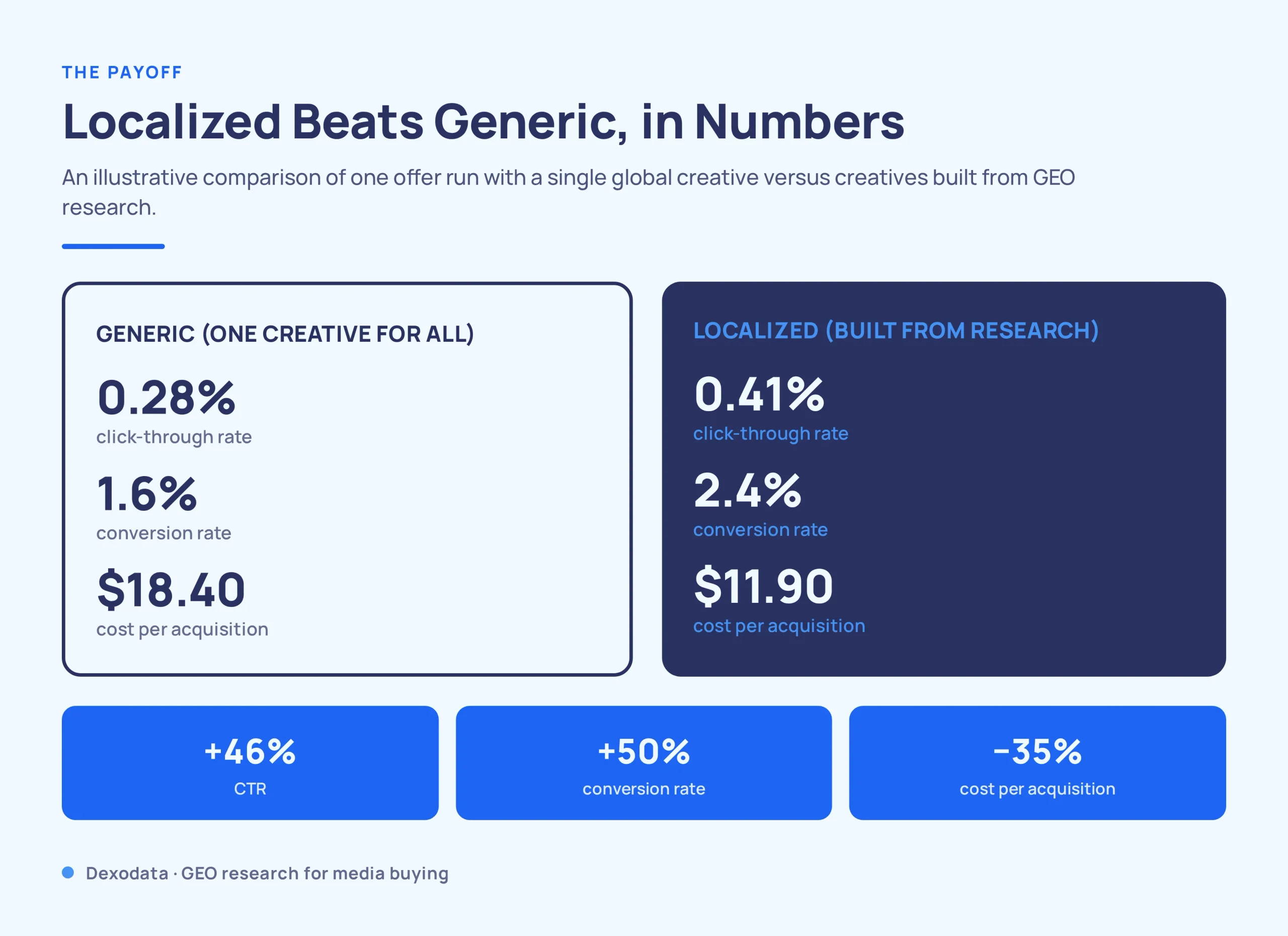
The payoff is measurable. As an illustration, a single global creative and landing page might run at a 0.28 percent click-through rate, a 1.6 percent conversion rate and an 18.40 cost per acquisition. Creatives and pages built from GEO research, matched to language, price and angle per market, might reach 0.41 percent, 2.4 percent and 11.90, a 46 percent lift in click-through, a 50 percent lift in conversion rate and a 35 percent lower cost per acquisition. The figures are illustrative, but the direction is consistent: campaigns built on local evidence convert better than campaigns built on assumptions.
Frequently Asked Questions
What is an AI-powered GEO research workflow?
It is a repeatable process that collects local market data through geo-accurate proxies and uses AI to turn it into targeting, creative and bidding decisions for media buying.
Do I need residential or mobile proxies for GEO research?
Use residential proxies for local search results, offer pages and pricing, and mobile proxies when content differs by carrier or is served mainly to mobile and app users. Many workflows use both.
How many GEOs can I research at once?
With an API and rotating IPs, a single automated run can cover ten or more markets, collecting the same data set for each so the results are directly comparable.
How does GEO research improve campaign performance?
It replaces assumptions with local evidence, so creatives, language, device targeting and bids match what the market actually shows, which typically lifts click-through and conversion rates.
Is proxy-based data collection compliant?
Collecting publicly available local data for market research is a standard practice. Keep your collection scoped to public pages and follow each site’s terms.
Put Your GEO Research to Work on Mondiad
Mondiad is a self-serve ad network built for advertisers who want direct control over where and how their budget runs. With 8+ ad formats and worldwide reach, it gives you the settings you need to turn every GEO research finding into a live campaign.
Here is how the research maps to the platform:
- Targeting: set country, carrier, operating system, device type, browser, browser language and traffic type, so each campaign matches the market profile you built.
- Ad formats: run classic push, in-page push, native, banners, popunders, Telegram Mini App ads and parked domains, then test which format fits each GEO’s dominant device and angle.
- Optimization: use optimization rules, blacklists and whitelists at zone and SubID level, plus bid estimation tools, to keep spend on the placements that perform.

Ready to launch campaigns built on local evidence? Create your Mondiad account and set up targeting for your priority GEOs today.
