



China has the largest online population in the world, with more than 1.12 billion internet users and penetration above 80%. On paper, that looks like the biggest opportunity on any GEO list.
In practice, it is the one market where the usual media buying playbook does not apply. Before you plan a China campaign, it helps to understand why, and what you can realistically do instead.
TL;DR
Localization decides results: traditional characters for Hong Kong and Taiwan, simplified for Singapore and Malaysia.
Mainland China is not a GEO you can simply target from a self-serve ad network the way you target India or Brazil.
Reaching mainland users properly requires a Chinese legal entity, an ICP filing and campaigns inside closed platforms like Baidu, WeChat and Douyin.
Gambling, crypto and circumvention tools are illegal there, so several standard affiliate verticals are off the table entirely.
For most media buyers, the realistic play is Chinese-speaking traffic in Hong Kong, Taiwan, Singapore and Malaysia.
Why Is China Different From Every Other GEO?
Three things separate China from markets like India, Indonesia or Brazil.
The traffic lives inside a closed ecosystem. Google, Meta and most Western ad tech do not operate in mainland China. Attention sits with Baidu, WeChat, Douyin, Xiaohongshu and Tencent properties, each with its own ad platform and its own rules. Global networks have very little mainland inventory, because the publishers that supply them mostly do not exist there.
You need a local entity to advertise properly. Foreign companies cannot apply for an ICP license directly and need a mainland-registered entity or a licensed local sponsor, plus hosting on an approved mainland provider. Running paid Baidu campaigns, integrating WeChat Pay or publishing a mini program all depend on that paperwork. Sites hosted offshore avoid the filing but load slowly and rank poorly.
The advertising rules are strict and specific. China’s Measures for the Administration of Internet Advertising, in force since May 2023, require pop-up ads to carry a clear close button that works with one click, and they ban timers, fake close signs and ads that reappear after closing. They also prohibit misleading clickbait such as fake system alerts or fake play buttons. In other words, a lot of standard aggressive affiliate creative is explicitly illegal.
Can You Buy China Traffic on a Self-Serve Network?
You will usually see a China option in targeting menus, and some volume does come through. It comes from users reaching sites outside the firewall, from overseas Chinese audiences and from business travelers, so it is a thin and unrepresentative slice rather than the mainland market.
Treat it as a small test, not a scaling plan. If a campaign shows real conversions there, keep it. Just do not build a forecast on it, and do not confuse it with actually reaching Chinese consumers at home.
Which Verticals Are Off the Table?
Several of the most common affiliate verticals have no legal route into mainland China. Here is a quick overview before the details.
| Vertical | Status in mainland China | Main risk |
|---|---|---|
| Gambling and betting | Illegal | Criminal liability, active enforcement against cross-border operators |
| Crypto and trading | Illegal | Ban extended to stablecoins and tokenization in 2026 |
| VPN and circumvention tools | Illegal without authorization | Legal exposure for advertiser, publisher and network |
| Health claims and nutra | High risk | Disguised medical and health food ads are specifically targeted |
Gambling and betting. All commercial gambling for profit is criminally illegal in mainland China, and enforcement against cross-border operators targeting Chinese players is a standing national priority. For markets where iGaming still works, see our iGaming ad networks comparison.
Crypto and trading. China reaffirmed its ban in February 2026, when regulators extended the crackdown to stablecoins and asset tokenization, including cross-border activity. Crypto offers have no legal route to Chinese users.
VPN and circumvention tools. Promoting unauthorized tools for getting around the firewall creates legal exposure for everyone involved.
Health claims and nutra. The internet advertising rules specifically target disguised advertising for medical treatments, medication, medical devices and health foods, so this vertical carries high risk even with a local entity.
Where Should You Reach Chinese-Speaking Audiences Instead?
This is the practical answer for most affiliates and media buyers. Chinese-speaking audiences outside the mainland are reachable through normal networks, and they convert on normal offers.
Hong Kong is a high-value market with strong purchasing power, good for finance, e-commerce and travel offers.
Taiwan offers solid volume and high mobile engagement, and performs well for e-commerce, apps, entertainment and dating.
Singapore is a small but premium audience, and it suits finance, travel and subscription offers.
Malaysia gives you a large Chinese-speaking segment alongside lower costs, which makes it a good testing ground before you move into pricier GEOs. Our guide to traffic tiers explains how those cost differences work.
Here is how the four markets compare side by side.
| GEO | Script | Main spoken language | Main messaging app | Popular local payments | Best-fit verticals |
|---|---|---|---|---|---|
| Hong Kong | Traditional | Cantonese, English | FPS, PayMe, AlipayHK, Octopus | Finance, e-commerce, travel | |
| Taiwan | Traditional | Mandarin | LINE | LINE Pay, JKO Pay, cards | E-commerce, apps, entertainment, dating |
| Singapore | Simplified | English, Mandarin | PayNow, GrabPay, cards | Finance, travel, subscriptions | |
| Malaysia | Simplified | Mandarin, Cantonese, Malay, English | Touch ‘n Go eWallet, DuitNow, GrabPay | Testing, e-commerce, apps |
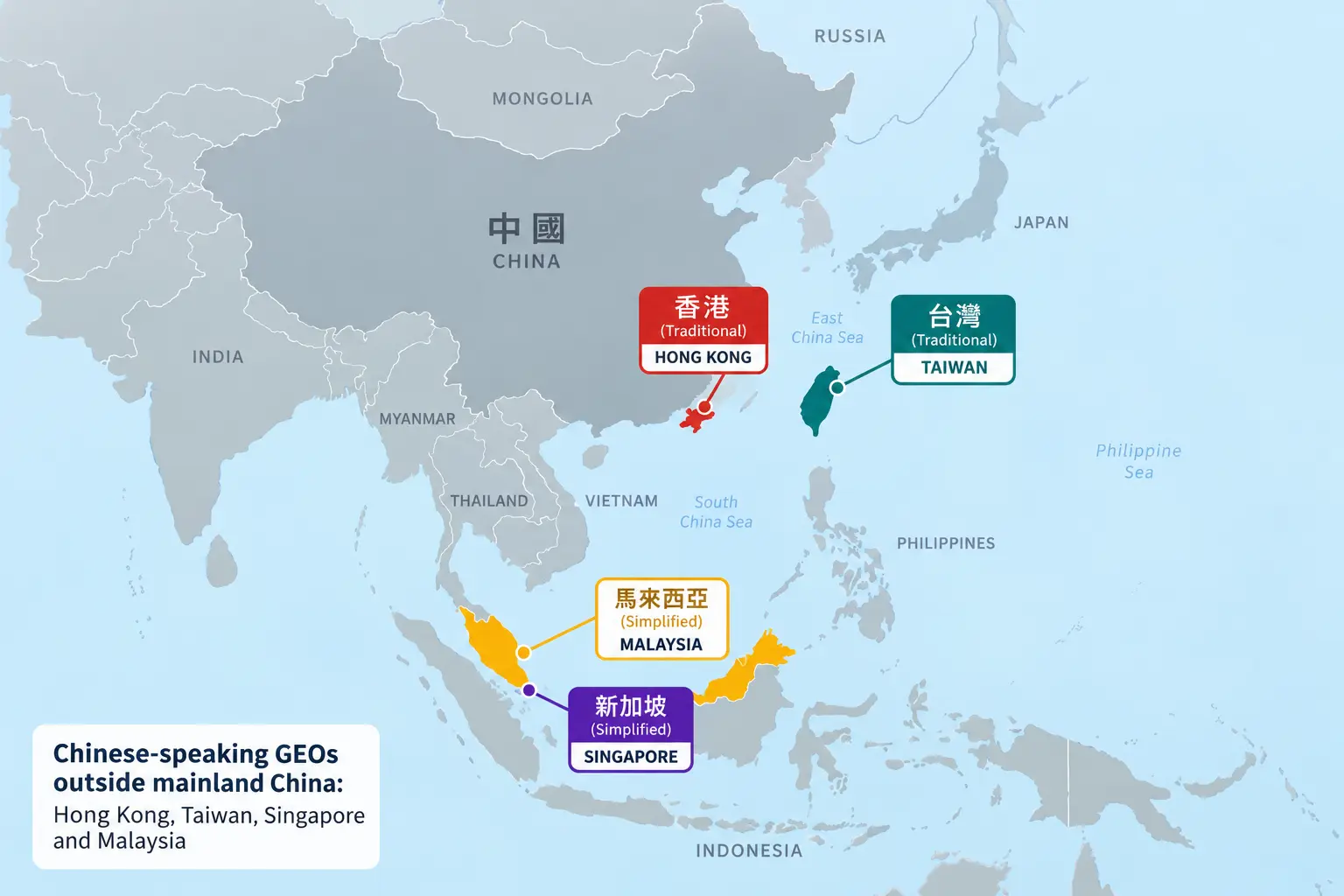
One detail matters more than people expect: Hong Kong and Taiwan use traditional Chinese characters, while Singapore and Malaysia mostly use simplified. Using the wrong script immediately signals that your ad was not made for that audience.
Which Ad Formats Work for These Markets?
All four markets are mobile-first, so the formats that perform best are the ones that reach users on their phones with little friction. Each format plays a different role in a Chinese-speaking campaign, from fast testing to warming up users before the click.
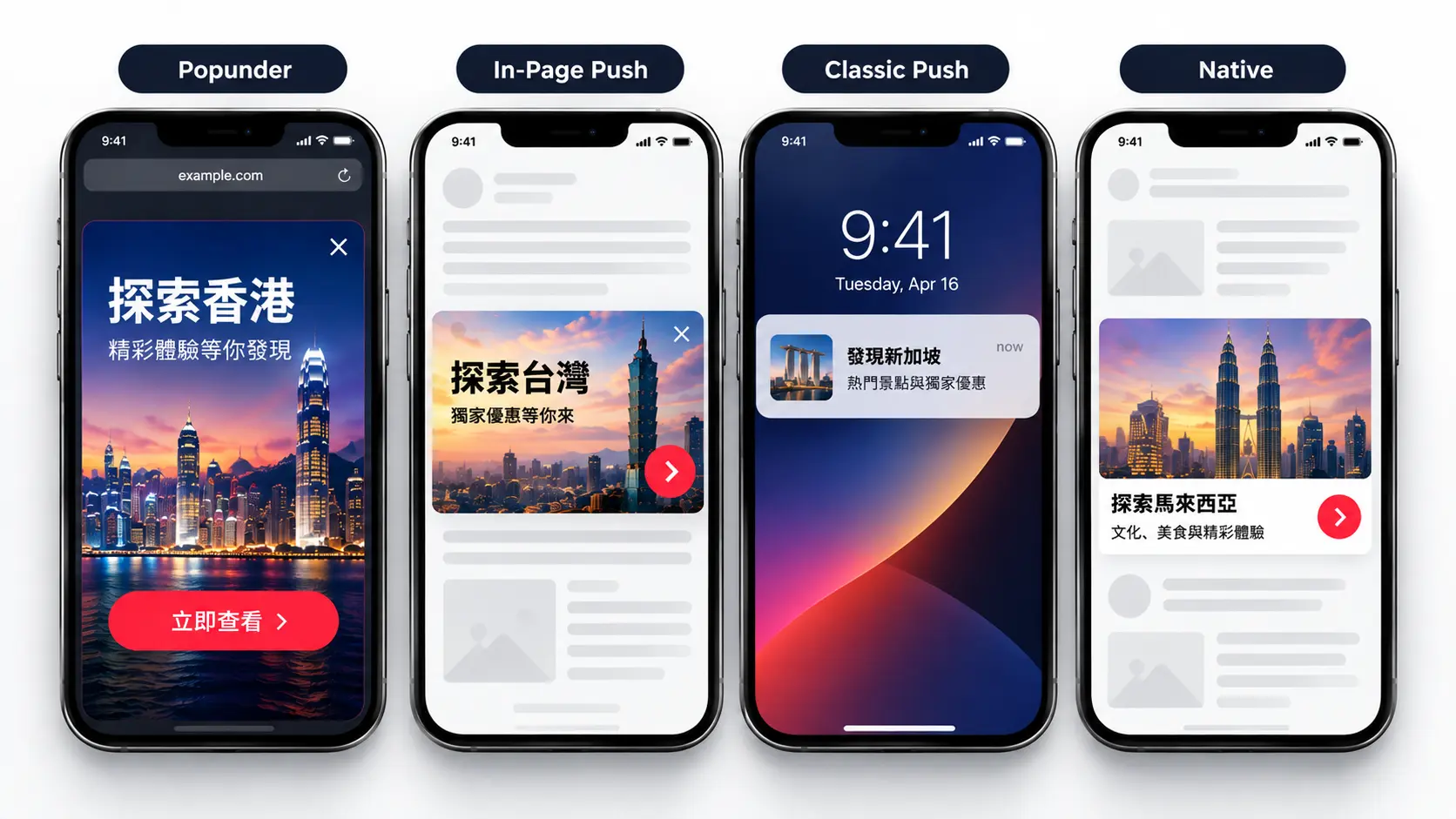
Popunders deliver volume at a low cost per visitor, which makes them the fastest way to test an offer across several Chinese-speaking GEOs at once. Our popunder advertising guide covers the setup.
In-page push reaches users without a subscription, including iOS users, so it works well in markets with high iPhone share such as Hong Kong and Taiwan.
Classic push suits urgency-driven angles and repeat exposure, especially for e-commerce and entertainment offers.
Native ads fit offers that need explanation before the click, such as finance or travel. If you are comparing formats, see our breakdown of push ads vs pop ads.
| Format | Main role | Best-fit GEOs | Offer examples |
|---|---|---|---|
| Popunder | Volume and fast testing | All four, especially Malaysia | E-commerce, apps, lead gen |
| In-page push | Reaching iOS users | Hong Kong, Taiwan | E-commerce, dating, entertainment |
| Classic push | Urgency and repeat exposure | Taiwan, Malaysia | Flash sales, entertainment, apps |
| Native | Pre-selling complex offers | Hong Kong, Singapore | Finance, travel, subscriptions |
How Do You Localize Creatives for Chinese-Speaking Audiences?
Translation alone rarely wins in these markets. The campaigns that scale are the ones that look like they were built locally, down to vocabulary, prices and timing.
- Match the script to the GEO. Traditional for Hong Kong and Taiwan, simplified for Singapore and Malaysia. Never run one creative across both groups.
- Localize vocabulary, not only characters. Converting simplified text to traditional automatically is not enough, because everyday words differ. “Video” is 视频 in mainland usage but 影片 in Taiwan. Hong Kong copy can also lean on Cantonese expressions that a Taiwanese reader would find odd.
- Show prices in local currency. Use HK$, NT$, S$ and RM, never USD or RMB, on both the ad and the landing page.
- Put familiar payment methods on the landing page. Showing FPS in Hong Kong, LINE Pay in Taiwan, PayNow in Singapore or Touch ‘n Go in Malaysia builds trust before checkout.
- Plan around the local calendar. Chinese New Year, the Mid-Autumn Festival and the 11.11 and 12.12 shopping days drive strong purchase intent across all four markets.
- Respect color and number symbolism. Red and gold read as festive and lucky, and 8 is a lucky number that works well in prices and promo codes. Avoid 4 in pricing and offers, since it sounds like the word for death.
- Test bilingual creatives in Singapore and Malaysia. Many Chinese-speaking users there are comfortable in English too, so an English headline with Chinese supporting copy is worth testing against a fully Chinese version.
What Targeting Pitfalls Should You Avoid?
Most failed campaigns in these markets come from setup mistakes rather than bad offers. These are the ones we see most often.
- Targeting by country only in Singapore and Malaysia. Chinese speakers are one segment of a multilingual population. Without browser language targeting, a Chinese creative is shown to many users who cannot read it.
- Relying only on language targeting in Singapore. The opposite mistake: many Chinese Singaporeans use English device settings, so a Chinese-only language filter misses part of the audience. Run a second campaign without the language filter and compare.
- Mixing traditional and simplified GEOs in one campaign. Split Hong Kong and Taiwan from Singapore and Malaysia so every creative matches its script and your data stays readable.
- Treating the China option as a scaling channel. Keep any mainland-tagged volume in a separate, small-budget campaign so it does not distort your results.
- Ignoring VPN traffic. Mainland users on VPNs can appear with Hong Kong, Taiwan or Singapore IPs. If a segment shows simplified Chinese browser language in Hong Kong or Taiwan alongside weak conversion rates, review those sources before scaling.
- Assuming nearby GEOs are compliance-free. Gambling, crypto and health offers face their own restrictions in all four markets.
- Scheduling in the wrong time zone. All four GEOs run on UTC+8. Check which time zone your reporting and dayparting use before you set schedules.
How Do Data Privacy and Tracking Work in These Markets?
Every market on this list has its own data protection law, and all of them apply to landing pages that collect personal data from local users. Here is what to keep in mind. This is general guidance, not legal advice.
| GEO | Main law | What it means for your landing pages |
|---|---|---|
| Mainland China | Personal Information Protection Law (PIPL) | Applies even to companies abroad when they offer products or services to people in China, with strict consent and cross-border transfer rules |
| Hong Kong | Personal Data (Privacy) Ordinance | Tell users why you collect data at or before collection, and get consent before using it for direct marketing |
| Taiwan | Personal Data Protection Act | Give notice at collection and use data only for the stated purpose |
| Singapore | Personal Data Protection Act | Get consent, and check the Do Not Call Registry before sending marketing messages to Singapore numbers |
| Malaysia | Personal Data Protection Act | Amended in 2024 with data breach notification and data protection officer requirements |
On the tracking side, high iPhone usage in Hong Kong and Taiwan means Safari limits third-party cookies for a large part of your audience. Use server-to-server postback tracking through your tracker instead of relying on pixels, pass click IDs cleanly and test the setup before launch. Host landing pages close to the audience or behind a CDN with Asian edge locations, since slow pages lose mobile users fast.
FAQ
Can I target mainland China from a self-serve ad network?
You can usually select China as a GEO, but the volume comes from users outside the firewall, overseas Chinese audiences and travelers. It is a small test segment, not access to the mainland market.
Do I need an ICP license to advertise in Hong Kong or Taiwan?
No. The ICP filing applies only to websites serving mainland China. Hong Kong, Taiwan, Singapore and Malaysia follow their own advertising and privacy rules.
Should I use traditional or simplified Chinese in my ads?
Use traditional characters for Hong Kong and Taiwan and simplified characters for Singapore and Malaysia. Localize vocabulary as well, not only the script.
Which Chinese-speaking GEO is best for testing a new offer?
Malaysia is usually the most cost-efficient starting point, thanks to a large Chinese-speaking segment and lower traffic costs. Once an offer proves itself there, move it to Hong Kong, Taiwan or Singapore.
Which ad format should I start with?
Popunders are the fastest way to test several GEOs at once. For Hong Kong and Taiwan, add in-page push early, since it reaches iOS users without a subscription.
Can I run gambling or crypto offers in Hong Kong or Singapore instead of mainland China?
Not freely. Gambling is tightly restricted in both markets and Singapore limits public marketing of crypto services, so check local rules before launching.
Why Run Chinese-Speaking Traffic With Mondiad?
Mondiad gives you classic push, in-page push, native, banners and popunders across worldwide traffic, so you can test Hong Kong, Taiwan, Singapore and Malaysia side by side from one dashboard. Targeting goes down to country, device, OS, browser, browser language and carrier, which makes it straightforward to separate Chinese-language audiences from the rest of a mixed market.

Ready to test Chinese-speaking GEOs?
