



Choosing the wrong ad network doesn’t just cost you money – it costs you time, data, and momentum. With so many platforms competing for your budget in 2026, the differences between them matter more than ever.
This roundup compares five of the best ad networks for affiliates right now: Mondiad, Adsterra, EvaDav, Zeropark, and RichAds. We break down what each one actually does well, where they fall short, and who they’re best suited for – so you can make a faster, smarter decision.
TL;DR
- Match the network to your traffic source and vertical first, brand recognition is a weak second-order signal.
- Compare tracking integration, payout models, minimum deposit, fraud protection, payment terms, and account manager responsiveness, not just headline traffic volume.
- No network wins on every axis. The comparison table and per-network notes below are built so you can weight the criteria that matter for your campaigns.
The Networks, One by One
1. Mondiad
- Tracking setup is clean: S2S postback, macros, Sub-IDs all work the way you’d expect them to;
- Targeting as well as reporting breaks down granularly, by GEO, device, source and creative, so optimizing isn’t guesswork;
- Flexible on payout models: CPM, CPC, TargetCPA, depending on what the offer calls for;
- Multiple campaign optimization tools including smart rules, custom bidding, event tracking, traffic audieces and more;
- Low deposit threshold, only $50, and 8+ ad formats across all verticals globally.
Keep in mind: as a newer entrant compared to ad networks with a decade-plus track record, Mondiad has a shorter public history for affiliates to vet against, it is worth confirming references or case studies for your specific vertical before scaling spend.
2. Adsterra
- Huge volume, 30B+ impressions across 248 GEOs, plenty of room to scale winning campaigns;
- Social Bar format tends to outperform regular banners, worth testing if you haven’t;
- Low barrier to entry, good for testing new offers without a big upfront commitment;
- Covers the verticals media buyers actually run: dating, VPN, sweepstakes, iGaming, utilities;
- Established player with a wide publisher network, giving fairly consistent inventory availability.
Keep in mind: volume at this scale means traffic quality varies more by placement. Expect to spend real time on source/zone-level whitelisting and blacklisting before campaigns stabilize.
3. EvaDav

- Push traffic is their strongest suit: above-average CTR and viewability on premium placements;
- Tier-2/3 GEOs are well covered, which is where a lot of profitable affiliate campaigns live right now;
- 3B+ daily impressions across 250+ GEOs;
- Native integrations with major affiliate trackers;
- Strong fit for affiliates specifically building push-first strategies rather than diversified formats.
Keep in mind: format range is narrower than some competitors. If your strategy depends on native, video, or banner inventory alongside push, you may need a second network to fill the gaps.
4. Zeropark
- Built by the Voluum team, so tracker integration is as smooth as it gets;
- Clean interface, targeting options are solid;
- Good match for affiliates running commerce media or keyword-targeted campaigns;
- 10+ years in the market with consistent reliability;
- Strong pop, domain redirect, and commerce media inventory.
Keep in mind: the $200 minimum deposit is the highest of the five compared here, which raises the bar for affiliates who want to test cheaply before committing budget.
5. RichAds
- Popular with media buyers running iGaming, nutra, dating, and VPN offers;
- 8 ad formats including emerging channels like Calendar Push and Telegram Mini App Ads;
- Strong for push volume in mid-tier and emerging market GEOs;
- Straightforward CPA/CPM/CPC bidding setup suited to performance-focused campaigns;
- Actively expanding into newer ad formats ahead of some competitors.
Keep in mind: GEO coverage (200+) is solid but narrower than the 248-250+ range some competitors report, worth checking if your target markets are covered before committing.
Mondiad vs Adsterra vs EvaDav vs Zeropark vs RichAds: Side-by-Side
| Feature | Mondiad | Adsterra | EvaDav | Zeropark | RichAds |
|---|---|---|---|---|---|
| Best for | Tech-forward affiliates, beginners, and restricted verticals | Beginners & broad verticals | Push & native traffic | Pop, domain redirect & commerce media | Push & pop at scale |
| Drawback | Shorter public track record than established competitors | Volume requires active zone/source whitelisting to stabilize | Narrower format range outside push | Highest minimum deposit of the five | GEO coverage narrower than top competitors |
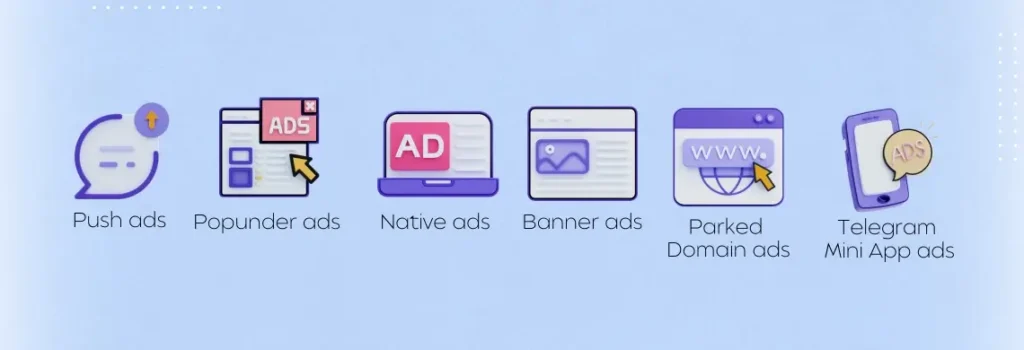
| Ad formats | Classic Push, In-Page Push, Popunder, Native, Banners, Parked Domain, Telegram Mini App, Pre-roll, and more | Popunder, Social Bar, In-Page Push, Native, Interstitial | Push, In-Page Push, Native, Popunder, Video | Pop, Domain Redirect, Push, In-Page Push, Commerce Media | Push, In-Page Push, Popunder, Native, Calendar Push |
| Bidding models | CPM, CPC, TargetCPA | CPA, CPM, CPC, CPL, CPI | CPM, CPC, RevShare, CPA | CPC, CPM, CPA | CPA, CPM, CPC |
| Minimum deposit | $50 | $100 | $100 | $200 | $100 |
| GEO coverage | Global, 250+ GEOs | 248 GEOs | 250+ GEOs | Global, Tier 1–3 | 200+ GEOs |
| Ad tracking | Postback, API, conversion goals, pixel tracking | Postback, pixel | Postback | Postback | Postback, API |
| Payment methods | PayPal, Payoneer, Paxum, crypto, and more | PayPal, Bitcoin, Paxum, WebMoney, Wire | PayPal, Payoneer, Paxum, WebMoney, Bitcoin, Wire | PayPal, Wire | PayPal, Payoneer, Paxum, Bitcoin, Wire, and more |
How To Choose Your Ad Network as an Affiliate
No network is the best for every affiliate. Here’s a simple framework:
- Start with your traffic source.
If you run push, find an ad network with strong push infrastructure. If you run native ads or paid social, you need networks whose offers convert on that traffic type. As an affiliate, mismatched traffic and offer types waste budget fast.
- Match your vertical to the network’s strength.
A network dominant in iGaming CPA offers is rarely the best place to run e-commerce offers. Specialists beat generalists in their lane.
- Understand the traffic inventory you will work with.
One of the first things to evaluate in an ad network as an affiliate is its traffic inventory: the volume, quality, and variety of traffic available for your campaigns. Even the best optimization tools won’t deliver results if the network can’t provide the right audience.
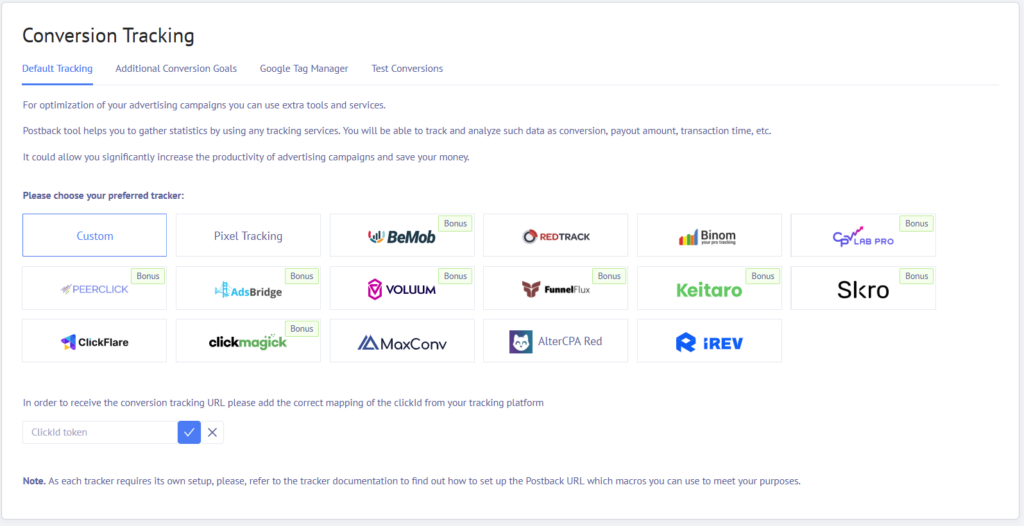
- Check conversion tracking compatibility before anything else.
You need real-time data, reliable postback integration, and granular reporting. Networks that keep you in the dark about campaign performance cost you money.
Confirm the network supports S2S postback and that their parameters integrate cleanly with your tracker (Voluum, Binom, RedTrack, Keitaro, etc). If their tracking is unreliable, everything downstream is unreliable.
- Weigh minimum deposit against your actual test budget.
Deposits in this category range from $50 to $200 across the networks compared here. Don’t commit more than you’re prepared to lose in a testing phase, regardless of how confident the sales conversation makes you feel.
- Understand payment terms before you scale.
Net-30 vs. weekly payouts is a cash-flow decision, not a minor detail. As an affiliate,you must confirm it from the start, since you’re relying on that revenue to fund the next ad campaign.
- Ask a pre-sales question and time the response.
How fast an account manager responds, how he help diagnose tracking issues, flag scaling opportunities, and interpret reporting data, it’s worth more than an extra dashboard widget. For newer affiliates, responsive onboarding can shorten the learning curve considerably.

- Confirm fraud protection specifics.
Ask each ad network directly what bot-filtering or invalid-traffic detection they run, and whether rejected traffic is disclosed in reporting.
The industry-standard framework here comes from the IAB Tech Lab and Media Rating Council, which classify invalid traffic into General Invalid Traffic (GIVT – known bots, data-center IPs, filtered through routine screening) and Sophisticated Invalid Traffic (SIVT – traffic engineered to mimic real user behavior, which requires active detection rather than static blocklists).
An ad network that can tell you which category its filtering addresses, and which it doesn’t, is giving you a real answer. A network that just says “we block fraud” is not.
Ad Network FAQs for Affiliates
What is the best ad network for affiliate marketing in 2026?
The best ad network for affiliates depends on the vertical, traffic source, and campaign goals. For affiliates who prioritize tracking, data control, and optimization tools, Mondiad stands out as a strong choice in 2026. For high-volume push traffic, iGaming, or mobile-first campaigns, specialized networks in those niches tend to outperform general platforms.
How do I know if an ad network is trustworthy?
Look for transparent reporting, reliable postback tracking, and a track record of on-time payments. Check community forums and reviews from other affiliates. Red flags include excessive scrubbing, vague reporting, or account managers who disappear when issues arise.
What payout model is best for affiliates?
It depends on your offer type and traffic quality. CPA is the safest starting point – you only earn when a real action happens. RevShare can be more lucrative long-term if you’re driving high-quality, retained users. Hybrid models (CPA + RevShare) are worth exploring once you have a proven traffic source.
Can I work with multiple ad networks at the same time?
Yes, and most experienced affiliates do. Running offers across multiple networks lets you A/B test payouts, access exclusive offers, and reduce dependency on a single platform. Use a tracker to manage everything centrally.
What tracking method should I use with ad networks?
Server-to-server (S2S) postback tracking is the gold standard. It doesn’t rely on cookies or browser behavior, making it more accurate and resistant to iOS privacy changes and ad blockers. Always confirm a network supports S2S before committing.
What GEOs are most profitable for affiliate marketing in 2026?
Tier 1 GEOs (US, UK, CA, AU) typically offer the highest payouts but also the most competition. Tier 2 and Tier 3 GEOs (Eastern Europe, Southeast Asia, Latin America) often deliver stronger ROI for affiliates who can optimize efficiently. The right GEO depends on your vertical and traffic source.
Key Takeaways for Affiliates Choosing an Ad Network
No single network on this list is the best for every affiliate: the right pick depends on your traffic source, vertical, and how much you’re ready to risk in a testing phase. With this in mind, a common rule is to start with a network whose minimum deposit fits your test budget, confirm tracking integrates cleanly before you scale, and weigh the account manager’s responsiveness as much as the feature list.

If you’re looking for a low-cost way to start testing – a $50 minimum deposit and broad format coverage – Mondiad is one option worth trying.
