



Picking the right ad format can seriously change how your campaign performs… but with so many options out there, it’s not always obvious what works best.
Whether you’re trying to boost clicks, improve conversions, or just get more out of your traffic, this Mondiad guide breaks down how each format actually performs in real campaign environments, so you can match format to funnel stage, GEO, and budget with precision.
TL;DR
- The ad format you use directly impacts visibility, engagement, traffic quality, and ultimately conversions.
- Each format behaves differently across user intent, GEO pricing tiers, device types, and funnel depth requirements.
- You don’t have to be limited to one ad format. Playtest different ad formats to identify what works for you.
What Are Ad Formats in Affiliate Marketing?
Ad formats define how users first interact with an offer before reaching a landing page.
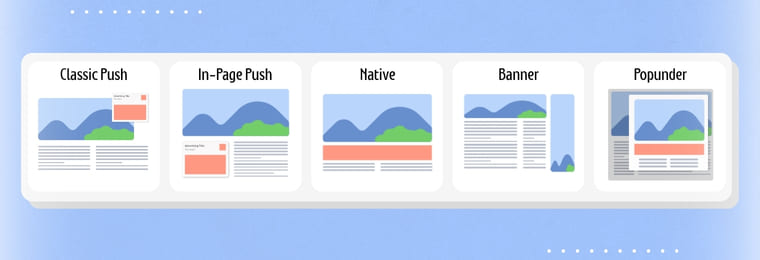
In performance marketing, 4 ad formats dominate global scale:
- Push Ads (classic + in-page notifications)
- Pop Ads (popunder / popup)
- Banner Ads (display placements)
- Native Ads (content-integrated ads)
Each format behaves differently across user intent, GEO pricing tiers, device types, and funnel depth requirements.
Push Ads
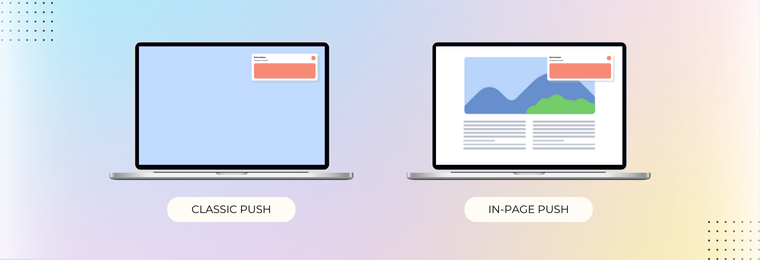
Classic push ads are a type of advertising that is delivered directly to a user’s device via their browser or OS notifications, but only after the user has given permission.
In-page push ads are a type of native advertising format that appears directly within a webpage, rather than being sent through the browser’s push notification system.
Push Ads Pros
- High click-through rates with strong creatives
- Low entry cost and quick setup
- Excellent for rapid testing and iteration
- Works well across both mobile and desktop
Best Use Cases
Push ads shine in direct-response campaigns where speed matters. They’re widely used for sweepstakes, utilities (VPN, antivirus), dating, igaming, and flash e-commerce offers. They’re also highly effective for retargeting, bringing users back with urgency-driven messaging.
Based on recent Mondiad campaign data, we recommend these combos:
- Gambling / Philippines / Classic push
- Sweepstakes / India / Classic Push
- Gambling / South Africa / Classic Push
- Dating / United States / In-page push
Difficulty Level: Easy → Medium
Push is beginner-friendly to launch, but sustaining performance requires frequent creative refreshes and optimization due to fatigue.
Classic & In-Page Push Ads
| Classic Push Ads | In-Page Push Ads |
|---|---|
| Require user opt-in (subscription) | No opt-in required |
| Delivered via browser/system notifications | Shown directly inside the webpage |
| Can reach users even when they’re not on a website | Only visible while the user is browsing |
| Limited on some devices (especially iOS) | Work on all devices and browsers |
| Typically higher intent audience (they chose to subscribe) | Larger reach, but colder audience |
Pop Ads
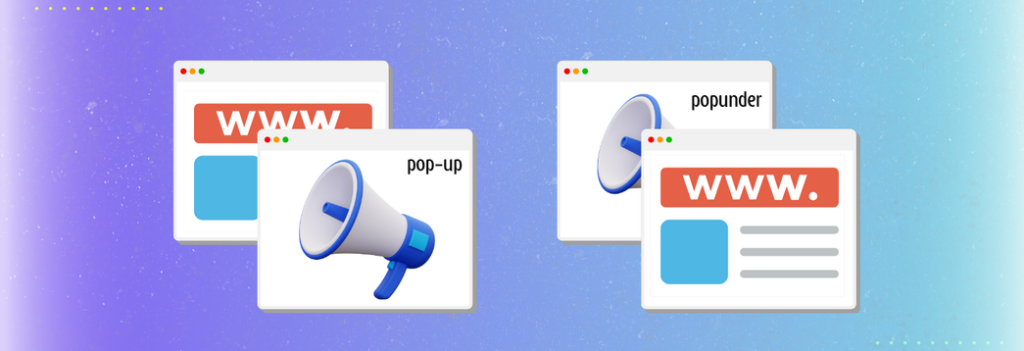
Pop ads open a full landing page in a new tab or window, usually behind the active browser (popunder). They redirect users instantly to an offer or a pre-lander.
Pop Advertising Perks
- Massive traffic volume and scalability
- Very low CPMs
- Compatible with a wide range of verticals
- Fast data collection for optimization
Best Use Cases
Pop traffic is ideal for high-volume affiliate campaigns, especially in sweepstakes, gambling, utilities, and subscription-based offers. It’s often used when the goal is to scale quickly and aggressively.
Difficulty Level: Medium → Hard
While easy to set up, pop advertising requires strong optimization skills, especially in landing pages, targeting, and frequency control, to achieve profitability.
Pop-up vs Popunder Ads
| Pop-up Ads | Popunder Ads |
|---|---|
| Open in a new window/tab above the current page | Open in a new window/tab behind the current page |
| Immediately visible and disruptive to user experience | Not immediately visible until the active window is closed/minimized |
| Higher chance of being blocked by ad blockers | Slightly better delivery rates vs pop-ups |
| Often perceived as intrusive by users | Less intrusive in the moment, but still noticeable later |
| Works on most devices but often restricted by browsers | More stable across desktop browsers, still limited on some mobile environments |
Banner Ads
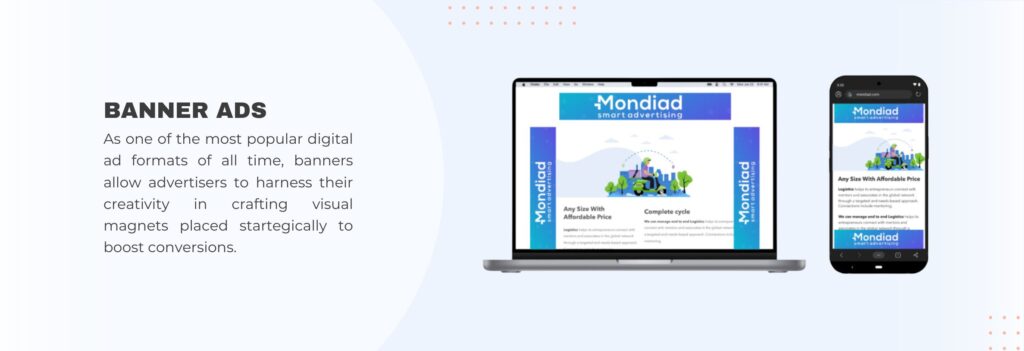
Banner ads are visual display ads (static or animated) placed within a website’s layout—commonly at the top, sides, or inside content.
Banner Ads Pros
- Easy to create and launch
- Scalable across many placements
- Great for brand visibility
- Effective for retargeting campaigns
Best Use Cases
Banner ads work best for brand awareness, remarketing, and supporting other formats in a funnel. They help reinforce messaging and keep your offer visible across multiple touchpoints.
Difficulty Level: Easy → Medium
Banners are simple to set up, but achieving strong performance can be challenging due to banner blindness. Success depends heavily on creative quality and placement optimization.
Native Ads
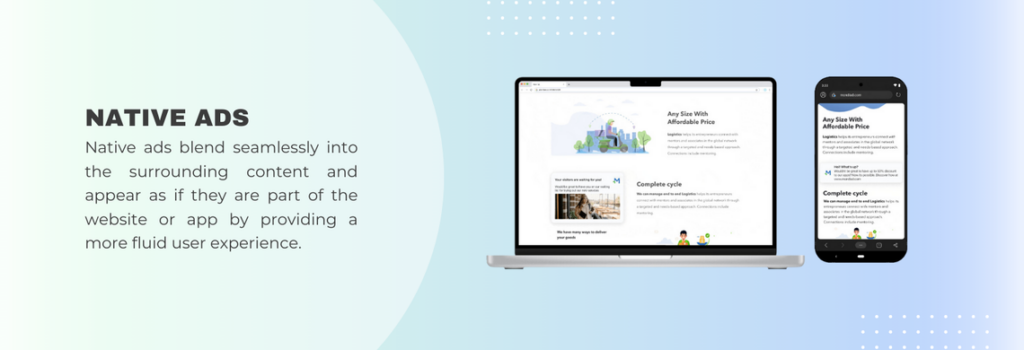
Native ads blend into the look and feel of the website they appear on, often mimicking editorial content like “recommended articles” or sponsored stories.
Native Ads Pros
- High user trust and engagement
- Less intrusive → better user experience
- Strong performance for long funnels
- High-quality, intent-driven traffic
Best Use Cases
Native is best for content-driven funnels that require storytelling and trust-building. It performs especially well in verticals like finance, health, insurance, and high-ticket e-commerce, where users need more information before converting.
Based on recent Mondiad campaign data, we recommend these combos:
Finance x US, UK, Canada, Germany, Spain, Singapore, Australia, Japan, South Korea.
Difficulty Level: Hard
Native advertising demands strong copywriting, well-designed pre-landers, and a solid funnel strategy. It’s slower to test but can deliver high ROI and long-term stability.
Ad Format Comparison – Quick Overview
Choosing the right ad format can make the difference between traffic that simply arrives and traffic that actually converts.
This comparison breaks down the most common ad formats, highlighting their strengths, ideal use cases, and performance considerations, so you can make more informed decisions when choosing.
| Format | Pros | Best Use Case | Difficulty |
|---|---|---|---|
| Push | Cheap, high CTR | Direct response, retargeting | ⭐⭐☆☆☆ |
| Pop | Huge scale, cheap traffic | Mass campaigns, sweepstakes | ⭐⭐⭐⭐☆ |
| Native | Trust, high engagement | Finance, health, lead gen | ⭐⭐⭐⭐⭐ |
| Banner | Simple, scalable | Branding, retargeting | ⭐⭐☆☆☆ |
Ultimately, the scope of comparing ad formats is to understand which ad types fit best for our needs.
Across Mondiad traffic, we consistently see that:
- Push ads can outperform banner traffic due to better visibility and urgency-friendly nature
- Native traffic typically delivers higher conversion intent but requires 2–3x longer funnels
- Pop traffic scales fastest but shows the highest variance in EPC depending on GEO
How to Select Ad Formats – A Checklist
Getting to the end of our reading, we’ll include this checklist designed to help you quickly evaluate the key factors that matter before launching or optimizing your Mondiad campaign.
Use it as a practical guide to match your offer with the most effective ad formats based on your goals, audience behavior, and traffic type.
1. Define Your Goal First
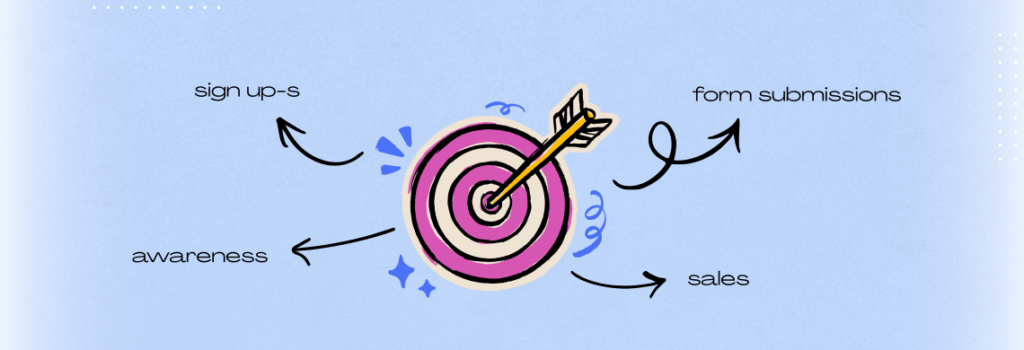
– Is your goal fast conversions or long-term ROI?
– Are you optimizing for CPA, ROAS, or volume?
– Do you need quick testing or a scalable funnel?
2. Identify Your Funnel Stage
– Cold traffic (no awareness) → Native, Banner
– Warm traffic (interested users) → Push, Native
– Hot traffic (ready to convert) → Pop, Push, Interstitial
3. Understand Your Audience’s Intent
– Low intent (casual browsing) → Pop, Push
– Medium intent (curious / comparing)
– High intent (ready to act) → Native
4. Analyze Your Offer Type
– Impulse-driven (e.g., sweepstakes, downloads) → Push, Pop
– Trust-based (e.g., finance, health, insurance) → Native
– Product-based (e-commerce) → Push + Native combo
5. Check GEO & Traffic Behavior
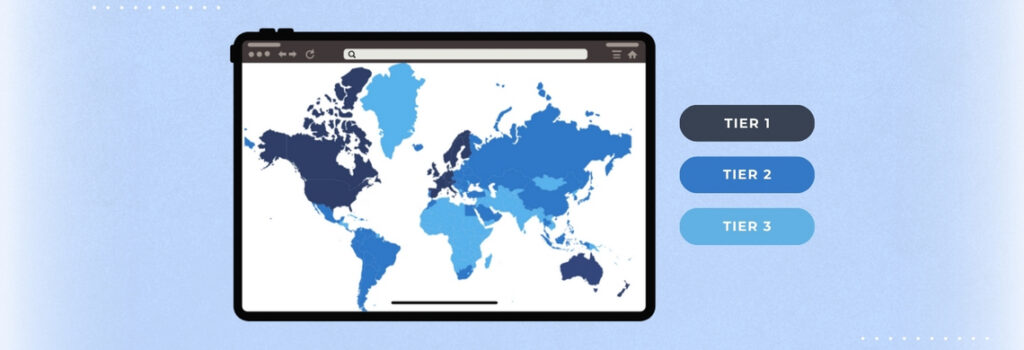
– Tier 1, Tier 2, or Tier 3 GEO?
– Is traffic expensive or cheap?
– Are users mobile-heavy?
General rule:
Tier 3 → Pop, Push (cheap + scale)
Tier 1 → Native, Push (quality + intent)
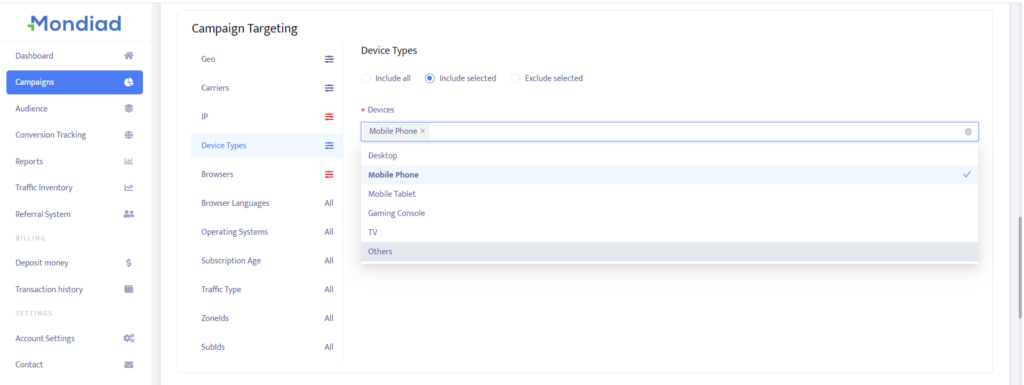
6. Choose by Device
– Mobile traffic? → Push, Interstitial, Native
– Desktop traffic? → Pop, Banner
7. Assess Your Creative Resources
– Do you have strong copywriting?
– Can you build pre-landers?
– Do you have multiple creatives ready?
If limited: Simple setup → Push, Banner
If advanced: Go for → Native, Pop (with funnels)
8. Consider Your Testing Budget
– Small budget (<$100–$300)? → Push
– Medium ($300–$1K)? → Push + Pop
– Large ($1K+)? → Native + full funnel
9. Plan for Optimization
– Can you test multiple creatives?
– Can you optimize zones/placements?
– Do you have a tracker?
Pop & Native require more optimization effort
Push is easier to iterate quickly
Ad Formats Comparison FAQ
What ad type is the easiest for beginners in affiliate marketing?
For most beginners, Push ads are the easiest ad format to start with. Push ads offer the best balance of simplicity, cost, and learning speed for beginners.
What ad format is most profitable?
There’s no single “most profitable” ad format; the answer depends on your offer, funnel, and optimization skills.
What ad format brings the fastest results?
If your goal is speed, the clear winner is: Push ads. If you want to validate an offer quickly or test a new GEO, start with Push ads.
Can multiple ad formats be used together effectively?
Yes, high-performing affiliates often combine formats: native for awareness, push for retargeting, and pop for scaling conversions. This creates layered funnel coverage across different intent levels.
The Takeaway
The format you use can directly impact visibility, engagement, traffic quality, and ultimately conversions. But truth be told, there is no secret recipe to success.
| Goal | Best Format |
|---|---|
| Cheapest traffic | Pop |
| Fastest testing | Push |
| Highest trust | Native |
| Largest scale | Pop |
| Best for beginners | Push |
| Best for long funnels | Native |
| Best for aggressive arbitrage | Pop |
| Best for premium offers | Native |

However, the advice presented in this article is failproof, being validated over time by many tests and from many industry pros, including our senior account Mondiad managers.
💡 Pro Tip: The best affiliates don’t choose one format; they build a mix.
Start Your Mondiad ADventure!
Get your Mondiad campaign up and running in less than 10 minutes. It’s that easy.
- Access global ad inventory;
- Access push, pop, native, banner traffic (and more).
