


Banner advertising is a form of display advertising that uses a rectangular graphic ad (placed in a website’s header, sidebar, or footer) to drive clicks, sign-ups, or sales. First launched in 1994, banner ads remain one of the most widely used and cost-effective digital ad formats, thanks to low production costs, fast testing cycles, and precise performance tracking via CTR, CPM, and CPC.
In this guide, you’ll learn how banner ads work, the standard sizes and placements (like the 300×250 Medium Rectangle and 728×90 Leaderboard), what they typically cost, and how to design a banner that actually converts, whether you’re running your first campaign or optimizing an existing one.
TL;DR
- Banner ads are graphic, clickable display ads placed in high-traffic spots on a webpage (top, bottom, or sidebar).
- They’ve existed since 1994 and remain one of the most cost-effective ways to drive traffic, retarget visitors, and build brand awareness.
- Advertisers typically pay via CPC (per click) or CPM (per 1,000 impressions), with standard sizes like the 300×250 Medium Rectangle and 728×90 Leaderboard performing best.
- Below: how they work, what they cost, and how to design one that converts.
What Is A Banner Ad?
A banner ad (also called a display ad) is a rectangular graphic advertisement placed in a high-visibility location on a website, typically the top, bottom, or side of a page. It links back to the advertiser’s landing page and is designed to drive clicks, sign-ups, or sales.
Banner ads are one of the oldest digital ad formats. The first one ran on October 27, 1994, when AT&T paid HotWired to run a banner directing users to its landing page for three months (per HubSpot’s history of digital advertising).
Despite decades of skepticism about “banner blindness,” the format remains a staple of programmatic advertising because it’s cheap to produce, easy to test, and measurable down to the click.
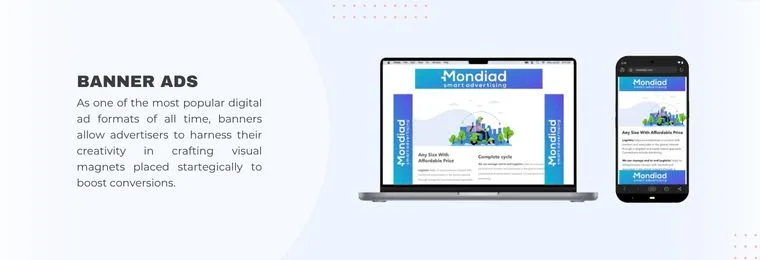
Banner ads come in two flavors:
- Static: the same creative shown to every viewer.
- Dynamic: creative that changes based on a viewer’s browsing history or behavior (retargeting).
How Do Banner Ads Work?
Banner ads work like most digital ads: they’re placed on a publisher’s site and link to an advertiser’s destination page when clicked.
If you’re an advertiser (you want to promote a business):
- Sign up with a traffic source or ad network
- Set your targeting, budget, and creative
- The network places your banners across its publisher inventory
- You track results and optimize
Why Use Banner Ads? (Key Benefits)
Banner ads remain a core part of most digital advertising strategies because they combine low cost, high visibility, and real-time measurability in a single format. Whether the goal is brand awareness, retargeting, or driving direct conversions, banner advertising delivers measurable results across nearly every stage of the funnel.
Here’s what makes them worth the investment:
- High visual impact: eye-catching and effective for driving brand awareness or sales.
- Easy for publishers to implement: a single script unlocks passive revenue.
- Versatile placement: top, bottom, or sidebar; works across nearly any site layout.
- Strong for retargeting: re-engage visitors who left without converting.
- Fully measurable: track performance via CTR, CPM, CPC, and conversion rate in real time.
Banner Ad Sizes and Placements: The Full Chart
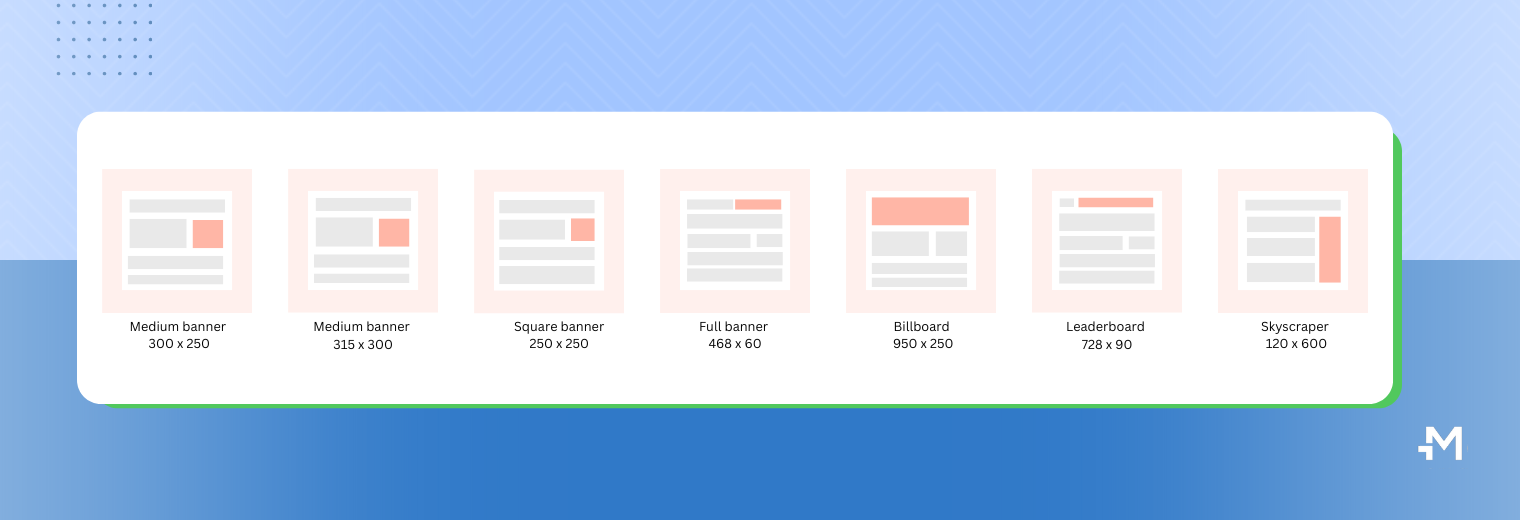
There are many types of banner ads out there, including page banners, leaderboards, skyscraper banners and many, many more. These types are mostly named after their pre-set sizes and the purpose of the ad campaign.
Another factor in choosing the right format for your ad campaign is whether you want to place your banners on mobile and desktop versions of a webpage.
Commonly called MPU or Med Rec, MREC, or Medium Rectangle, these ads are usually positioned above the fold on websites or to break up content. They perform very well and are also versatile, for looking good on both desktop and mobile devices.
A full banner is generally placed at the top of a page or occupies the space of a leaderboard. They are very common across the internet but due to their small area, they are ideal when wanting to promote with very simple messages.
Square banner ads have an aspect ratio of 1:1 and can be used on the sidebar of a webpage or the break-out content. Although they are relatively small and less appealing than most ads, they are ideal for small spaces.
Also known as Horizontal Banner, a Leaderboard banner is among the most used banner size for desktop websites. Leaderboard banners are mainly placed at the top of a homepage and are of great success since viewers don’t scroll all the way down to the page but sometimes it is also found at the bottom, or between articles.
A Skyscrapers banner is slimmer than the usual ad and it is placed vertically on the sidebar of a webpage, so viewers can experience it while scrolling down.
A Billboard banner can be adapted for various advertising goals. Its large size allows for eye-catching visuals and messages, making it suitable for building brand recognition.
Perfect for general display ads that can capture attention without overwhelming the viewer. Works well for a range of advertising goals, balancing visibility with user engagement.
Mondiad Banner Inventory, At a Glance
| Size (px) | Name | Best For |
|---|---|---|
| 300 × 250 | Medium Rectangle | Above the fold, breaking up content, strong on both desktop & mobile |
| 315 × 300 | Medium Banner | General display; balances visibility and user experience |
| 250 × 250 | Square Banner | Sidebars or small ad slots |
| 468 × 60 | Full Banner | Top-of-page placement, simple/short messaging |
| 950 × 250 | Billboard | Large-format brand awareness campaigns |
| 728 × 90 | Leaderboard | Top of homepage on desktop; one of the most-used sizes |
| 120 × 600 | Skyscraper | Vertical sidebar placement, scroll-friendly |
Related reading: >> Banner Ad Sizes & Dimensions: The Complete Reference Guide
How Much Do Banner Ads Cost?
Banner ad costs depend on your target site, audience, competition, and campaign goals — there’s no fixed price. Most advertisers choose between two pricing models:
- CPC (Cost Per Click): You pay a fixed amount each time someone clicks your ad. Best for campaigns focused on driving conversions.
- CPM (Cost Per Mille): You pay a fixed rate per 1,000 impressions. Best for brand awareness campaigns where reach matters more than clicks.
For performance-focused campaigns, smart/automated bidding (like TargetCPA) can optimize spend toward your target cost-per-acquisition automatically rather than requiring manual bid adjustments.
How to Design a High-Converting Banner Ad
A high-converting banner ad balances clear messaging, strong visuals, and a single, obvious call to action, all within a few square inches of space. Because viewers decide whether to engage in under a second, every design choice has to earn its place.

Follow these steps to design a banner that stands out and converts:
- Know your audience first. Research who you’re targeting before writing a single word of copy.
- Define your goal and USP. What should the viewer do, and why should they care?
- Set a budget and strategy before designing. This lets you measure effectiveness later.
- Lead with visuals. Use brand colors, high-quality imagery, and your logo for instant trust.
- Keep copy short and bold. One clear benefit, stated simply.
- Speak to a pain point. Promise a specific, believable result.
- Avoid “banner blindness.” Ads that look like a natural part of the page outperform ones that look like ads.
- Add urgency. Deadlines, “limited edition,” or FOMO language increase click-through.
- Write one clear CTA. Tell the viewer exactly what to do next: “Shop Now,” “Get Started,” “Subscribe.”
- A/B test everything. Run multiple creative variants to see what your specific audience responds to.
Related reading: >> Ad Creative Library: Your Success To Conversions
Which Industries Work Best With Banner Ads?
Banner ads can be used in a wide range of verticals but just to give you an idea, here are some popular niches:
- 🛒 E-commerce: visually driven, especially with urgency messaging like “limited promo.”
- 🍀 Casino / Sports Betting: strong around seasonal sporting events and promotions.
- 📲 Utilities, App Installs: antivirus, cleaners, ad blockers, and VPN offers all convert well since the buyer need is already established.
- 💌 Dating / Adult: global demand, high click-through rates, and strong conversion volume across both mainstream and adult offers.
Related reading: >> Mondiad Case Study [Banners x Adult]
Related reading: >> Shein Affiliate Program: A Guide to Banner Advertising for Affiliates!
Related reading: >> How to Drive Sales with Temu: Affiliate Advertising Guide
FAQ: Banner Advertising
What is the difference between a banner ad and a display ad?
They’re generally the same thing. “Banner ad” refers specifically to the rectangular graphic format, while “display ad” is the broader category that includes banners, video, and rich media.
What is the best banner ad size?
The 300×250 Medium Rectangle and the 728×90 Leaderboard are the most widely used and highest-performing standard sizes, since they work well across both desktop and mobile placements.
How much does a banner ad campaign cost?
There’s no fixed price, costs vary by site, audience, and competition. Advertisers typically pay via CPC (per click, often a few cents to a few dollars) or CPM (per 1,000 impressions), with exact rates set by auction/bidding.
Do banner ads still work today?
Yes. While click-through rates on banners are lower than on more novel formats, they remain effective for retargeting, brand awareness, and driving low-cost traffic at scale, especially when creative avoids “banner blindness” by blending naturally into the page.
What is banner blindness and how do I avoid it?
Banner blindness is when users unconsciously ignore anything that looks like an ad. Avoid it by designing banners that feel like a natural part of the page content rather than an obvious, generic ad unit.
Can I run banner ads on mobile devices?
Yes, banner ads can run on both desktop and mobile, but mobile placements should prioritize compact, responsive sizes like 300×250 rather than large desktop-oriented formats like the 728×90 Leaderboard.
Run Your First Banner Ad Campaign!
Banner ads are still one of the fastest, cheapest ways to test an offer, retarget lost visitors, and start driving measurable traffic, and with the right network, you can have a live campaign running in minutes, not days.
Set your targeting, upload your creative, and start tracking clicks, CPM, and conversions in real time: no long setup, no minimum learning curve.
