


Creative fatigue is what happens when your audience has seen the same push or native ad so many times that they stop responding, even though your targeting, bids, and offer haven’t changed. It’s one of the most common reasons a winning campaign slides into mediocrity. This guide shows how to recognize it, how to separate it from other problems, and when a refresh is actually worth the effort. Our central argument is simple: refresh on signals, not on a calendar.
TL;DR
- Creative fatigue is a decline in ad performance caused by repeated exposure to the same creative. CTR usually drops first.
- Refresh when a creative’s CTR stays well below its own early baseline for several days while traffic and targeting stay the same.
- Change one variable at a time, run the new creative next to the old one, and pause the old one instead of deleting it.
- Creative-level reporting is what makes this manageable, and Mondiad’s MCP can speed up the monitoring.
What Is Creative Fatigue In Push And Native Advertising?
Creative fatigue is the decline in an ad’s performance that happens when the same audience is shown the same creative too often. In push and native campaigns it typically shows up as falling click-through rate (CTR), followed by weaker delivery or higher costs to hold the same volume.
The key word is same. A creative doesn’t wear out because it’s old. It wears out because the people receiving it have already reacted to it, or decided to ignore it. That’s why two campaigns running identical creatives can fatigue at very different speeds: audience size, geo, and frequency decide the pace.
Most performance guides treat fatigue as a social media problem. It’s just as real in push notification ads, where a subscriber can see your message repeatedly on a device they check dozens of times a day.
Why Does Creative Fatigue Hit Push And Native Ads Differently?
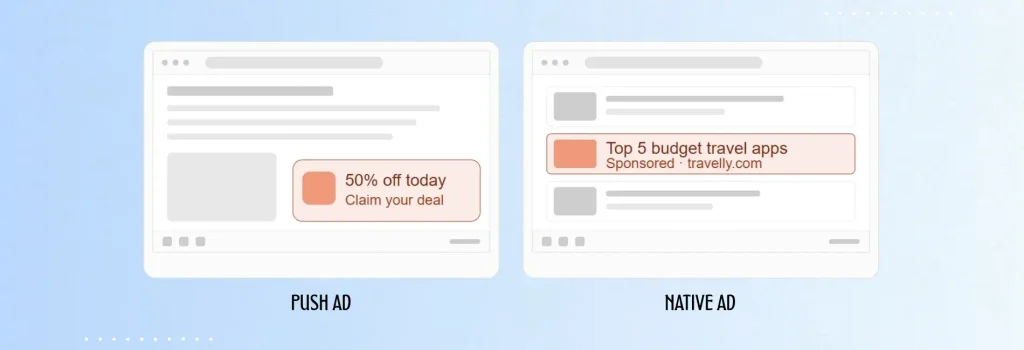
Push and native ads fatigue faster than many other formats because they have little creative surface to vary and they reach people in highly personal, repetitive spaces. A push ad is essentially an icon, a title, and a short description. A native ad is a headline and an image designed to look like the content around it. Neither gives you much room to hide a stale idea.
Push adds a second wrinkle: subscribers have a lifecycle. Someone who subscribed yesterday has a different relationship with your message than someone who has been receiving notifications for months. That’s why platforms that let you target by subscriber age, as Mondiad does with its fresh, new, medium, and old segments, give you a real lever against fatigue. You can match creative freshness to how long people have been in the pool.
Subscriber age in push advertising refers to the amount of time a user has been subscribed to a website, app, or push notification service.
It measures the period between the date a user subscribed to receive push notifications and the current date.
Example:
- Subscriber age: 1 day – The user subscribed yesterday.
- Subscriber age: 7 days – The user subscribed one week ago.
- Subscriber age: 30 days – The user subscribed one month ago.
- Subscriber age: 90+ days – The user has been subscribed for more than three months.
Why is it important in push ads?
Advertisers use subscriber age to:
- Segment audiences based on how recently they subscribed.
- Target new subscribers with welcome offers.
- Target older subscribers with special promotions.
- Analyze engagement and conversion rates over time.
- Optimize advertising campaigns.
Here’s how the two formats compare:
| Format | What Wears Out First | Where Fatigue Shows Up | Fastest Levers |
|---|---|---|---|
| Push Ads | Title angle and icon | CTR slide on repeat subscribers | New title angle, new icon, frequency cap, subscriber age segments |
| Native Ads | Main image | Thumbnails get scrolled past | New image concept, headline rewrite, zone-level split |
The native row reflects a tendency, not a law. In practice the image is the first thing people stop noticing, but your own data should have the final say.
What Are The Warning Signs Of Creative Fatigue?
The clearest warning sign is a steady CTR decline on a single creative while impressions, targeting, and bids stay flat. One bad day means nothing. A slope that continues for several days is the pattern worth acting on.
Watch for these together, because any one alone can mislead:
- CTR drifting down on a creative that used to perform, measured against its own first week rather than against other campaigns.
- Rising eCPM or average CPC, or delivery that softens unless you raise bids to hold volume.
- Stable conversion rate with fewer clicks. The people who click still convert; fewer of them are clicking.
- A fresh creative beating the old one in the same zones, countries, and time window.
That last one is the closest thing to proof. If a new variant outperforms the control on identical traffic, the audience is telling you something.
How Do You Tell Creative Fatigue From Other Problems?
You tell creative fatigue apart from other problems by checking whether the decline is isolated to one creative or spread across everything. Fatigue is local to the creative. Traffic quality, offer, and landing page problems tend to hit the whole campaign.
| Symptom | Points To Creative Fatigue If… | Points To Something Else If… |
|---|---|---|
| CTR Drops | Only the oldest creative is sliding and newer ones hold | Every creative drops at once, which suggests a traffic or zone change |
| Conversion Rate Drops | It doesn’t. Clicks fall but conversion holds | It falls with CTR, which suggests a landing page or offer issue |
| Costs Rise | The rise tracks the CTR decline on one creative | Costs jump suddenly, which suggests competition or seasonality |
| One Zone Vs All Zones | The decline appears first in your highest-frequency zones | One zone collapses alone, which suggests a source-quality issue |
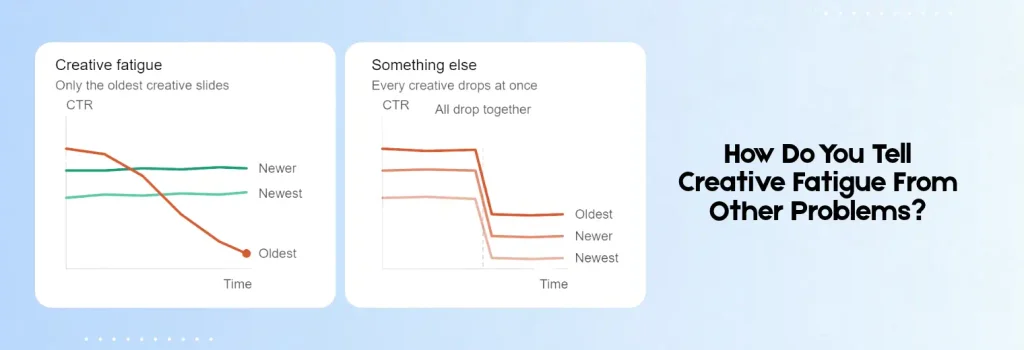
This is where creative-level breakdowns earn their keep. If you can only see campaign-level totals, fatigue hides inside the average. A healthy new creative can mask a dying old one for weeks.
When Should You Refresh Your Push And Native Ads?
Refresh when a creative’s CTR sits meaningfully below its own early baseline for several consecutive days and you’ve ruled out traffic and landing page causes. There is no universal number of days, and anyone who gives you one is guessing.
Here’s what we’d weigh in practice:
- Audience size. Narrow geos and small subscriber pools get saturated quickly. Broad, high-volume traffic gives a creative more room.
- Spend level. The more you spend against one audience, the sooner it tires. Scaling a winner is exactly what accelerates its decline.
- Pipeline readiness. The best time to build the next creative is while the current one still works. Waiting for a visible drop means you’re always a week behind.
It also depends on budget. Small campaigns may run out of money before any creative fatigues, and a refresh there is wasted effort.
How Do You Refresh Creatives Without Losing What Works?
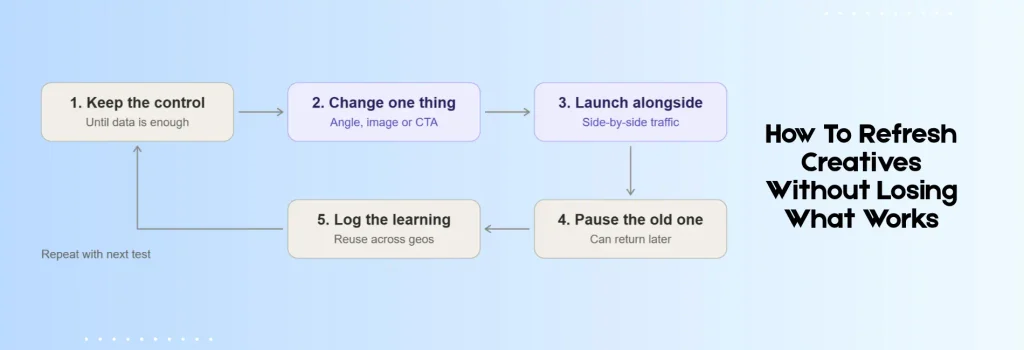
Refresh by changing one variable at a time and running the new creative alongside the old one, not instead of it. A full rewrite makes it impossible to know what helped.
- Keep the control running until the challenger has enough data to judge fairly.
- Change one thing. Test a new angle, a new image, a rewritten headline, or a different call to action. Not all four.
- Launch alongside, not in place of. Side-by-side traffic is the only fair comparison.
- Pause, don’t delete. Retired creatives can come back after a rest, and their history is useful.
- Log what you learned. A winning angle in one geo often travels to the next.
You can also stretch a creative’s life before it needs replacing. A frequency cap limits how often one user sees the ad (on Mondiad it can be applied per campaign or per creative), and subscriber age targeting keeps your oldest message away from your most saturated segments.
How Can Mondiad’s MCP Help You Catch Creative Fatigue Faster?
Mondiad’s MCP connects a compatible AI assistant to your Mondiad account so you can query performance and manage creatives in plain language.
The manual version of fatigue monitoring means exporting reports, sorting by creative, and eyeballing trends. It’s tedious enough that most people skip it until the damage is done.
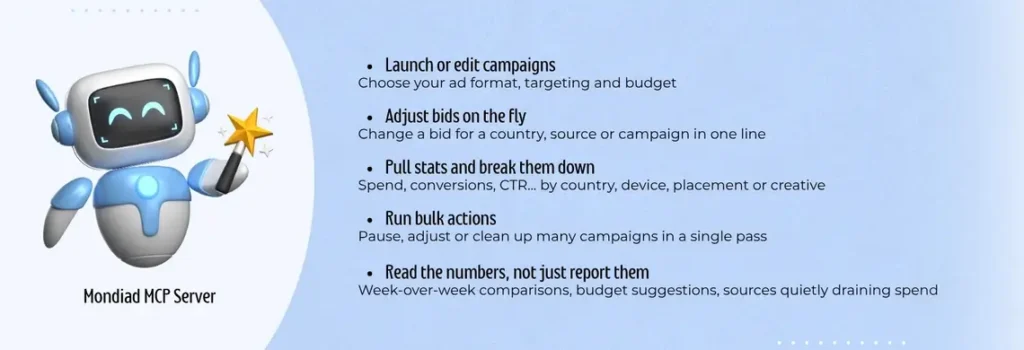
With the MCP connected, the assistant can pull campaign reports broken down by creative, date, zone, or country, including impressions, clicks, CTR, eCPM, average CPC, spend, and conversions. It can also list the creatives inside a campaign, create new ones, upload image assets from a public URL, and update existing creatives.
A few prompts we’d start with:
Pull creative-level results for campaign [ID] over the last 14 days by date, and flag any creative whose CTR has fallen several days in a row.
List the creatives in this campaign and show which has the lowest CTR this week compared with its first week.
Draft three new title variants for the weakest creative, keeping the same offer.
The assistant works from your real account data, and you stay in control of what gets launched, paused, or changed. Think of it as a faster way to run the monitoring loop above, not a replacement for your judgment about what makes a good creative.
So, What Should You Do About Creative Fatigue Today?
Treat creative fatigue as a routine part of running push and native campaigns, not a surprise. Check creative-level CTR against each creative’s own baseline, confirm the problem is local before you blame the creative, and keep the next variant ready before the current one slips. Refreshing on signals rather than a calendar saves you from both premature changes and slow decline.
FAQ
What Is Creative Fatigue In Advertising?
Creative fatigue is the drop in an ad’s performance that happens when the same audience sees the same creative too often. Click-through rate usually falls first, followed by rising costs or weaker delivery. It affects push, native, and display ads, and it’s fixed by rotating in fresh creatives.
How Often Should You Change Push Notification Ads?
There is no fixed schedule. Refresh when click-through rate stays well below its own early baseline for several days while impressions hold steady. Narrow geos and small subscriber pools tire faster than broad traffic, so watch each campaign’s trend rather than following a calendar.
How Do You Know If An Ad Creative Is Fatigued?
Look for a sustained decline in CTR on a creative whose targeting, bids, and landing page haven’t changed. If conversion rate holds but clicks fall, fatigue is the likely cause. A fresh creative beating the old one on the same traffic is strong confirmation.
Do Native Ads Suffer From Creative Fatigue Too?
Yes. Native ads blend into content, but audiences still learn to scroll past familiar images and headlines. The main image tends to wear out first, so testing new visual concepts is often the fastest fix. Rotating headlines helps, but a new image changes how the unit looks at a glance.
Can You Prevent Creative Fatigue Instead Of Reacting To It?
You can slow it, not stop it. Set frequency caps, segment by subscriber age where your platform allows it, and keep a pipeline of tested variants ready before performance slips. Every creative eventually wears out, so the goal is to refresh on your timeline, not the audience’s.
How Does Mondiad’s MCP Help With Creative Fatigue?
Mondiad’s MCP lets a compatible AI assistant work with your Mondiad account. It can pull creative-level reports, compare performance over time, list a campaign’s creatives, and help create new variants. You still review and approve changes, but spotting declining creatives takes far less manual work.
Tired Of Watching Good Campaigns Fade?
If you’re a media buyer or affiliate running push and native traffic, you already know the pattern: a creative works, you scale it, and the CTR starts to slip.
Mondiad gives you creative-level reporting, CPC and CPM bidding across push and native formats, and an MCP that lets you check for fatigue and ship fresh variants without the spreadsheet grind. Spend less time diagnosing and more time testing what’s next.
