Advertising in Indonesia is a major opportunity for businesses looking to reach one of Southeast Asia’s largest and fastest-growing digital audiences. With millions of consumers using search engines, social media, e-commerce platforms, video services, and mobile apps every day, Indonesia offers multiple channels for generating targeted traffic, leads, and sales.
But what is the best way to advertise in Indonesia? The answer depends on your target audience, business model, budget, and campaign goals. Google Ads and search advertising can capture users with high purchase intent, while platforms such as social media, video advertising, influencer marketing, and e-commerce advertising can help businesses build awareness and reach new audiences.
Understanding the Indonesian digital advertising market is therefore essential before investing in paid traffic. Advertisers need to know which platforms Indonesians use most, which audience segments to target, how consumer behavior differs across regions and age groups, and how to adapt messaging to local preferences.
In this complete guide to advertising in Indonesia, we’ll cover the most effective advertising channels, audience targeting strategies, traffic-generation tactics, advertising costs, campaign optimization techniques, and key considerations for reaching Indonesian consumers.
Whether you’re a local business, international brand, affiliate marketer, SaaS company, e-commerce business, or agency, this Indonesia advertising playbook will help you choose the right channels, reach the right audience, and turn paid traffic into measurable business growth.
TL;DR
- Indonesia is a mobile-first, price-sensitive GEO where scale beats desktop-grade spending power.
- Push and in-page push win on format because they need no heavy landing page or fast connection; native and video work better for higher-consideration verticals like e-commerce and fintech.
- Best-converting verticals: e-commerce, OJK-licensed fintech, dating, utilities, sweepstakes, and app installs.
- On cost, don’t chase the cheapest CPC: track the full funnel (CPM → CTR → CPC → CVR → CPA → ROAS) since a pricier click with a higher conversion rate often wins.
- Cultural fit matters as much as price; creative should lean into family/collectivism, respect Ramadan/Eid sensitively, and use hand-localized Bahasa Indonesia rather than machine translation.
- Payment flows need to default to e-wallets (GoPay, OVO, DANA, ShopeePay), not cards.
- Launch playbook: test 2-3 formats small, segment by city tier before going national, set frequency caps to counter multi-SIM distortion, and clear compliance before scaling.
Indonesia Market Snapshot: Digital Reach
Indonesia’s advertising opportunity comes from scale and mobile dependence, not from a wealthy, desktop-heavy audience. The numbers explain why format choice matters more here than in a typical Tier-1 GEO.
Indonesia’s expanding internet access has transformed daily activities, boosting connectivity, and economic growth. As demand for digital services rises, Indonesia’s digital landscape is poised for further expansion and innovation.
Source: Statista
Indonesian Audience Snapshot
- Young adults, especially Gen Z and Millennials: internet penetration is particularly high among these groups (around 89–90% in 2026).
- Urban and digitally active consumers: roughly 60% of Indonesians live in urban areas, and internet penetration is higher in urban areas than rural areas. That split matters for targeting: device quality, connection speed, and payment method availability all vary sharply between Jakarta-tier cities and secondary/rural regions.
- Middle and aspiring-middle-class consumers: together they represent a very large share of the population and account for the majority of household spending.
- Mobile-first, social-media and e-commerce users: Indonesia had over 230 million internet users in 2026, with digital communication, entertainment, information, and e-commerce among major online activities.
Cultural Sensitivity in Indonesian Advertising
Indonesia is a large and culturally diverse advertising market, making localization an essential part of campaign strategy. Advertisers should avoid treating Indonesia as a single, uniform audience: consumer preferences can vary across regions, ethnic communities, languages, and religious backgrounds.
Religion is an especially important consideration. As a Muslim-majority market, Indonesia offers significant opportunities around Ramadan and Eid, but campaigns should engage with these occasions respectfully rather than simply treating them as promotional moments. Religious symbols, imagery, and messaging should be used with care and genuine cultural understanding.
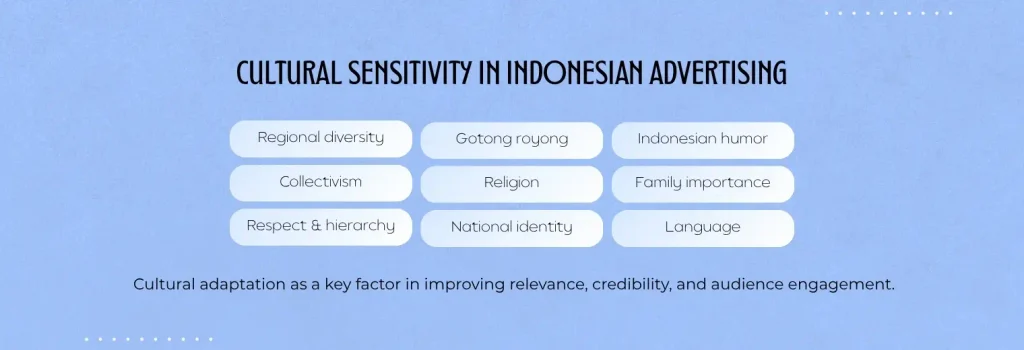
Language and creative execution also matter. Bahasa Indonesia provides a common national language, but effective advertising often requires more than direct translation. Copy, visuals, humor, family dynamics, and cultural references should feel natural to local audiences. Research on Indonesian advertising consistently highlights cultural adaptation as a key factor in improving relevance, credibility, and audience engagement.
A Western-style ad creative might communicate:
“This product makes you better.”
An Indonesian ad creative may more naturally communicate:
“This product makes life better for you and the people around you.”
That’s not an absolute rule, but relationships and social context tend to be particularly useful creative territory.
For advertisers and media buyers, the key takeaway is simple: successful campaigns in Indonesia combine scale with local relevance. Adapting creative to cultural context, and considering the values of different audience segments can help brands build trust while improving campaign performance.
Key ways Indonesian culture shapes ad creatives
| Cultural factor | Effect on ad creative | Example |
|---|---|---|
| Collectivism | Ads often emphasize family, friends, communities, and togetherness | A food delivery ad shows the whole family eating together rather than one individual |
| Family importance | Family relationships are powerful emotional storytelling devices | “Make your parents proud” or celebrating a family moment |
| Gotong royong | Cooperation and mutual support can be used as a brand message | Neighbors helping each other, community initiatives |
| Religious values | Creatives may adapt to Islamic practices and other religious traditions | Ramadan campaigns, halal positioning, Eid/Lebaran storytelling |
| Respect & hierarchy | Tone can be more respectful toward parents, elders, teachers, and authority figures | Younger characters showing respect to older family members |
| Indonesian humor | Local slang, wordplay, relatable situations and playful humor can outperform generic humor | Everyday “awkward” family or social situations |
| Regional diversity | Indonesia isn’t culturally homogeneous | A Jakarta-focused ad can feel very different from one targeting Java, Bali, Sumatra, or Eastern Indonesia |
| Language | Bahasa Indonesia is dominant, but local expressions and slang add authenticity | Using casual “gue/lo” in some urban youth campaigns versus more neutral Bahasa |
| Community/social proof | People often respond strongly to recommendations and participation from others | Creatives showing friends, creators, communities, or large groups using a product |
| National identity | Indonesian symbols, food, landscapes, traditions, and local pride can create emotional resonance | Independence Day campaigns using red-and-white imagery |
Key takeaway
Avoid treating “Indonesia” as one culture. Jakarta Gen Z, Javanese families, Balinese consumers, Muslim audiences during Ramadan, and consumers in other regions can have substantially different cultural contexts. Audience segmentation matters.
Which Ad Formats Perform Best in Indonesia?
Push notifications and in-page push convert best in Indonesia because the market is mobile-first and price-sensitive, and both formats work without needing a heavy landing page or desktop-grade connection.
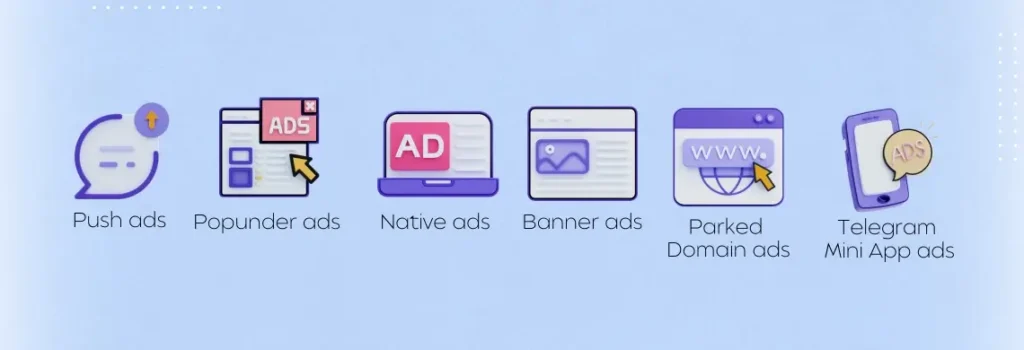
Here’s how the main formats stack up.
| Format | Why it works in Indonesia | Best used for |
|---|---|---|
| Push notifications | Reaches users directly on-device; doesn’t compete for screen space with content; strong CTR (reported 0.5–3% vs ~0.05% for standard display) | Sweepstakes, app installs, utilities, finance |
| In-page push | No opt-in required, works across iOS and Android, blends naturally into mobile pages | Broad-funnel offers, e-commerce, dating |
| Native ads | Matches the look of Indonesian news and content sites, which dominate mobile browsing time | E-commerce, fashion/beauty, health |
| Popunder | Cheap, high-volume, works well on lower-end devices and slower connections common outside major cities | Utilities, app installs, sweepstakes |
| Banner | Familiar format, easy to localize into Bahasa Indonesia creative, works alongside other formats in a stack | Brand awareness, e-commerce retargeting |
| Video / pre-roll | Fastest-growing format, benefiting from OTT and social video consumption; Indonesia is a top GEO for video test campaigns | Fintech, e-commerce, finance, app installs |
| Telegram Mini App ads | Telegram has strong daily usage in Indonesia, and Mini Apps let ads sit inside an in-chat experience users already trust, without sending them to an external landing page | Sweepstakes, fintech, app installs |
In-page push is a native-style ad unit that displays within a webpage, resembling a push notification visually, without requiring the user’s prior subscription, which is why it performs well in markets like Indonesia where opt-in push adoption is lower than in Tier-1 GEOs
For a deeper breakdown of how push and in-page push formats behave across different verticals, see Mondiad’s push notification advertising guide.
Which Verticals Convert Best in Indonesia?
E-commerce, licensed fintech, dating, utilities, sweepstakes, and mobile app installs are the strongest-converting legal verticals in Indonesia, each for a different reason tied to local behavior and regulation.
| Vertical | Why it works | Recommended formats |
|---|---|---|
| E-commerce | Indonesia drives roughly 44% of Southeast Asia’s total e-commerce GMV; mobile shopping via Shopee, Tokopedia, and TikTok Shop is deeply embedded in daily behavior | Native, in-page push, video |
| Gambling & Betting | Despite strict regulations, online gambling and sports betting remain active underground markets, creating a complex but potentially significant vertical for affiliate advertisers. | Popunder, push, video |
| Fintech & Crypto | Rapid e-wallet and digital banking adoption (GoPay, OVO, DANA, ShopeePay); demand for loans and investment apps is high, but only OJK-registered lenders are legal to promote | Push, native, video |
| Dating | High mobile and social app usage supports dating-app funnels, though creative should stay conservative for a majority-Muslim, socially conservative audience | In-page push, native |
| Utilities (VPN, cleaners, antivirus) | Consistent demand tied to device performance and data-privacy concerns in a mobile-first, often lower-spec device market | Push, popunder |
| Sweepstakes / lead generation | Simple mechanics travel well across Indonesia’s broad, price-sensitive audience; commonly used to test new creative before scaling into other verticals | Push, in-page push, popunder |
| App installs / mobile subscription | High mobile-only internet usage drives strong app-install economics, especially for utility and productivity apps | Push, popunder, video |
| Fashion, beauty & modest/halal niches | Muslim modest fashion, Korean beauty, and halal product niches are uniquely strong and underserved by generic global creative | Native, banner |
Key Takeaway
Indonesia’s diverse digital economy provides multiple vertical opportunities, but successful campaigns require an understanding of local audiences, market trends, and regulatory considerations.
For a broader look at which verticals scale across multiple GEOs and formats, not just Indonesia, see Mondiad’s best affiliate marketing verticals guide.
Which Format Fits Which Vertical?
Push and in-page push formats support the widest range of verticals in Indonesia, while native and video suit higher-consideration purchases like e-commerce and fintech. Use this matrix as a starting point before testing your own traffic.
| Push | In-page push | Native | Popunder | Video | |
|---|---|---|---|---|---|
| E-commerce | ✓ | ✓ | ✓✓ | ✓✓ | |
| Fintech (licensed) | ✓✓ | ✓ | ✓ | ✓✓ | |
| Dating | ✓ | ✓✓ | ✓ | ||
| Utilities | ✓✓ | ✓ | ✓✓ | ||
| Sweepstakes | ✓✓ | ✓✓ | ✓✓ | ||
| App installs | ✓✓ | ✓ | ✓✓ | ✓ | |
| Beauty | ✓ | ✓✓ |
✓✓ = strongest fit · ✓ = solid secondary option
Advertising Costs: Buying Traffic in Indonesia
The cost of buying traffic in Indonesia can be relatively low compared with many Western markets, but low-cost clicks do not automatically mean profitable advertising. The right way to evaluate traffic is to look at the relationship between CPM, CPC, conversion rate, and CPA rather than focusing on a single metric.
CPM vs. CPC: What Are You Actually Paying For?
Two of the most important pricing metrics are CPM (cost per mille) and CPC (cost per click).
- CPM is the amount you pay for 1,000 ad impressions. For example, a $1.40 CPM means that displaying your ad 1,000 times costs approximately $1.40.
- CPC is the amount you pay for each click. At a $0.06 CPC, a $56 advertising budget would generate approximately 1,000 clicks, assuming the CPC remains constant.
These metrics are connected through your click-through rate (CTR): CPC ≈ CPM ÷ (1,000 × CTR)
For example, with a $1.12 CPM:
- 1% CTR → approximately $0.11 CPC
- 2% CTR → approximately $0.06 CPC
- 3% CTR → approximately $0.04 CPC
This is why improving your creative can be just as important as finding a cheaper audience. A stronger ad that generates more clicks from the same number of impressions can substantially reduce your effective CPC.
What Does Indonesian Traffic Cost?
Rather than relying on broad platform benchmarks, here’s what Indonesian traffic actually costs across Mondiad’s inventory right now:
| Format | Avg. CPM | Avg. CPC |
|---|---|---|
| Classic push | $0.23 | $0.072 |
| In-page push | $0.19 | $0.013 |
| Popunder | $0.40 | (CPM only) |
| Banner | $0.014 | $0.002 |
| Native | $0.011 | $0.001 |
| Video | $0.059 | $0.021 |
Don’t Optimize for the Cheapest Click
The cheapest traffic is rarely the objective. What matters is the cost of acquiring a useful action: a lead, registration, purchase, or other conversion.For this reason, advertisers should generally monitor the full funnel: CPM → CTR → CPC → conversion rate → CPA → revenue → ROAS
CPC is a useful diagnostic metric, but CPA and revenue are usually much closer to the actual business outcome.
Don’t Overlook Smart bidding: Target CPA
For conversion-focused campaigns, smart bidding can shift the focus away from manually trying to find the cheapest CPC. Instead, Mondiad’s automated bidding systems, TargetCPA, can adjust bids in real time based on the likelihood that an individual auction will produce a conversion.
You specify the average amount you are willing to pay for a conversion (for example, $2.80 per lead) and the bidding system attempts to generate conversions around that target. This changes the way you should evaluate traffic.
You might see one campaign paying $0.06 per click and another paying $0.17 per click. If the first produces conversions at $4.47 CPA while the second produces them at $2.51 CPA, the more expensive clicks are actually the better buy.
Geographic Differences Matter
Indonesia should not be treated as a single homogeneous advertising market. Audience costs and purchasing behavior can vary between Jakarta, other major cities, and smaller or more regional markets.
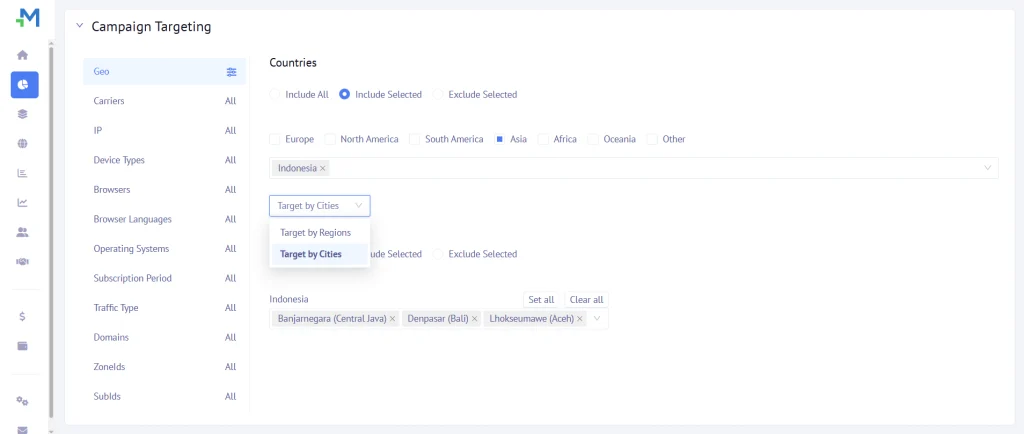
If your product can be sold nationwide, test different geographic segments rather than assuming that the cheapest impressions will automatically produce the best customers. Major urban audiences may cost more but can also have higher purchasing power or conversion rates.
A useful approach is to test:
- Major cities
- Secondary cities
- Broader nationwide targeting
Then compare not only CPM and CPC, but also conversion rate and CPA.
How to Buy Indonesian Traffic Efficiently
- Start with enough budget to generate meaningful data, then test systematically rather than changing everything at once.
- Test several creative concepts before aggressively narrowing your audience. A compelling local-language ad can improve CTR enough to offset a more expensive audience.
- For display and social traffic, evaluate the quality of visitors after the click. Extremely cheap traffic can sometimes produce low engagement, poor conversion rates, or little revenue.
- Finally, compare traffic sources on a common business metric. If one source produces $0.06 clicks and another produces $0.14 clicks, that does not tell you which one is better. The source producing the lower cost per profitable customer is the one worth scaling.
Key Takeaway:
The goal is not to buy the cheapest Indonesian traffic. The goal is to find the combination of audience + creative + platform + landing page that produces profitable conversions at scale.
Payment and Localization Considerations
Creative and funnels built for Indonesia need to reflect local payment habits and language, not a generic Southeast Asia template. A few specifics worth building into your campaign from the start:
- E-wallets dominate, not cards. GoPay, OVO, DANA, and ShopeePay are the primary payment rails for both consumers and affiliate payouts, a checkout or offer flow that only supports card payments will underperform.
- Bahasa Indonesia localization matters. Machine-translated creative is easy to spot and tends to underperform hand-localized copy, especially for trust-sensitive verticals like fintech.
- Seasonality around Ramadan and Lebaran drives major spikes in e-commerce and fintech activity, plan creative refreshes and budget increases around this period rather than treating it as a normal month.
- Urban/rural device gaps matter for creative weight. Lighter-weight creative and formats (push, popunder) travel better outside Jakarta-tier cities where connection speeds and device specs are lower.
Indonesian Regulatory Ad Environment
Buying traffic in Indonesia is not simply a matter of choosing a platform and setting a budget. Advertisers also need to comply with Indonesia’s rules on electronic commerce, advertising, consumer protection, personal data, and sector-specific products.
For advertisers buying traffic in Indonesia, the most important point is that platform approval does not necessarily mean legal compliance. An ad can pass a traffic source’s review and still create regulatory issues under Indonesian law.
For performance marketers, Indonesia requires a compliance-first approach. Campaigns should be transparent, culturally appropriate, respectful of consumer rights, and carefully reviewed for restricted content. This is especially important for finance, alcohol, tobacco, and other regulated verticals.
There are effectively three layers of compliance to consider:
- Indonesian law
The campaign must comply with applicable Indonesian regulations. - Platform policy
Advertising platforms have their own prohibited-content, targeting, landing-page, and industry policies. - Industry requirements
Regulated categories such as medicines, tobacco, financial products, food, cosmetics, and other products can have additional requirements.
Advertisers should satisfy all three layers rather than assuming that approval by an advertising platform is sufficient.
Tips on Campaign Launch for Indonesia
A successful Indonesia launch starts small, tests across formats, and clears compliance before scaling, not after. Use this checklist before committing meaningful budget.
- Test small, across 2–3 formats first. Split an initial test budget across push, in-page push, and native rather than committing to one format up front. A small multi-format test tells you where to concentrate spend before scaling.
- Localize creative natively, not via machine translation. Hand-localized Bahasa Indonesia copy consistently outperforms auto-translated creative, especially for trust-sensitive verticals like fintech and lending.
- Build lightweight, fast-loading landing pages. Roughly 45-50% of Indonesia’s smartphones are entry-level or budget devices, and secondary-city connections are slower than Jakarta-tier speeds. Strip landing pages down to essentials so they load fast on the lower-spec Android hardware most traffic arrives on.
- Default checkout and payout flows to local e-wallets. GoPay, OVO, DANA, and ShopeePay are the primary payment rails for Indonesian consumers – a card-only funnel will leak conversions.
- Segment targeting by city tier before going national. Jakarta, Surabaya, Bandung, and Medan have higher-spec devices and faster connections than secondary and rural regions. Establish a performance baseline in tier-1 cities before expanding outward.
- Watch for multi-SIM distortion in early data. Indonesia has 331 million mobile connections against 230 million internet users, many people run multiple SIMs. Set frequency caps early and judge performance on conversion rate and EPC rather than raw click volume.
- Plan budget spikes around Ramadan and Lebaran. E-commerce and fintech activity surge around this period each year – refresh creative and increase budget ahead of it rather than mid-campaign.
FAQ
What is the best ad format for Indonesia?
Push notifications and in-page push perform best overall in Indonesia because the market is mobile-first, 86% smartphone penetration, and both formats work without requiring a heavy landing page or a fast connection. Native ads and video are strong for higher-consideration verticals like e-commerce and fintech.
What are the best converting verticals in Indonesia?
E-commerce, dating, utilities (VPN, cleaners, antivirus), sweepstakes/lead generation, and modest fashion/beauty niches are the strongest legal, converting verticals in Indonesia as of 2026.
Is Indonesia a mobile-first or desktop market for advertising?
Mobile-first. Indonesia has 331 million mobile connections against 230 million internet users, with 90% smartphone penetration, so campaigns should be built and tested primarily for mobile devices and formats.
Do I need to localize creative for Indonesia?
Yes. Hand-localized Bahasa Indonesia creative consistently outperforms machine-translated copy, and payment flows should default to local e-wallets (GoPay, OVO, DANA, ShopeePay) rather than card-only checkouts.
Advertise with Mondiad
Ready to test these formats and verticals with real traffic? Mondiad covers push, in-page push, native, banner, popunder, and interstitial formats across Indonesian traffic on CPM and CPC models, with self-serve campaign setup and real-time reporting.