



Paying only when someone clicks sounds like the safest way to buy traffic. It often is, but CPC ad networks differ a lot in formats, minimum deposits, traffic quality and how well they fit your geo.
This guide compares eight options for 2026: Mondiad, RichAds, PropellerAds, Adsterra, Clickadu, HilltopAds, Zeropark and Google Ads. You’ll see what CPC really costs, how it stacks up against CPM and CPA, and how to avoid paying for clicks that never convert.
Whether you’re buying traffic or monetizing it, you’ll leave knowing which network to test first and how much budget to put behind it.
TL;DR
- CPC ad networks charge you only when someone clicks your ad. That makes them the safest starting point for most advertisers testing a new offer, and a steady earner for publishers with consistent traffic.
- In 2026, the strongest options for push and native traffic include Mondiad, RichAds, PropellerAds, Adsterra, Clickadu and HilltopAds. Zeropark suits pop and domain traffic, and Google Ads covers search intent.
- Most networks ask for a $100 to $250 minimum deposit, so budget for a proper test, not a single click.
What are CPC ad networks and how do they work?
A CPC (cost-per-click) ad network is a platform that sells ad inventory on a pay-per-click basis. Advertisers bid an amount for each click, publishers supply the traffic, and the network sits in the middle matching the two.
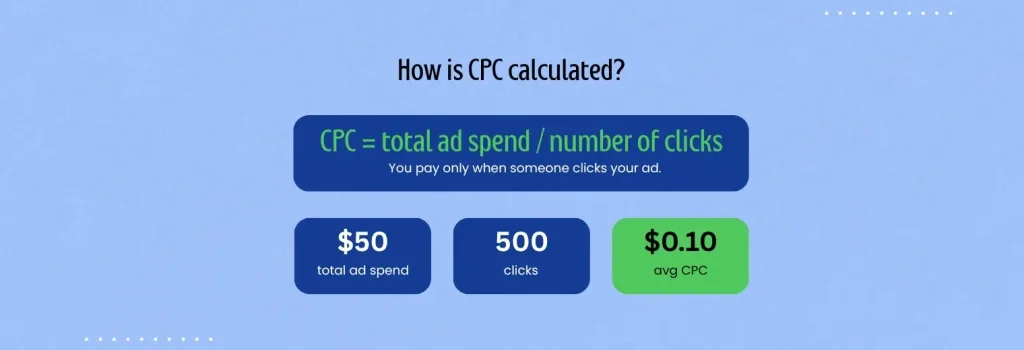
The math is simple: CPC = total ad spend ÷ number of clicks. If you spend $50 and get 500 clicks, your average CPC is $0.10.
The model covers push notifications, in-page push, native ads, popunders, banners and even Telegram placements. Most platforms also run an auction, so the final price you pay depends on your bid, your geo, and how many other advertisers want the same audience.
One honest note: we run an ad network ourselves, so we’re biased. We’ve tried to keep this comparison useful anyway, because you’ll test two or three platforms regardless of what we say.
How much do CPC ad networks cost in 2026?
Most CPC ad networks let you start with a deposit of roughly $100 to $250, and minimum bids can be as low as $0.0001 to $0.005 per click. Those minimum bids are floors, not what you’ll actually pay.
Real prices vary widely. A click from a Tier 3 geo on push can cost a fraction of a cent. The same click in the US, UK or Germany costs far more. Format matters too: a popunder click and a native click are not the same thing, even when they sit at similar bids.
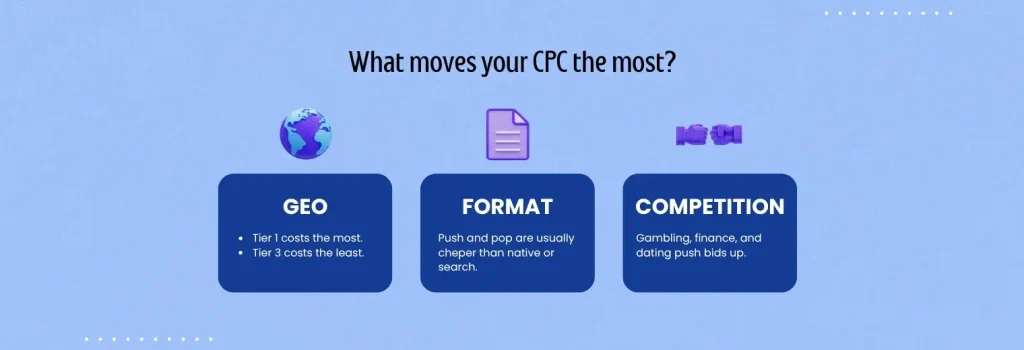
Three things move your price more than anything else:
- Geo: Tier 1 countries cost the most, Tier 3 the least.
- Format: push and pop are usually cheaper than native or search.
- Competition: popular verticals like gambling, finance and dating push bids up.
If you’re comparing pricing on push specifically, our push notification pricing guide goes deeper on CPC vs CPM for that format.
Which are the best CPC ad networks in 2026?
The best CPC ad networks in 2026 are the ones that match your format, budget and geo, and there’s no single winner. Here’s a side-by-side view. Minimum deposits come from public third-party roundups and network pages, so confirm them on each platform before you fund an account.
| Network | Best for | Main formats | Pricing models | Min. deposit |
|---|---|---|---|---|
| Mondiad | Push and native advertisers, publishers wanting fast payouts | Push, native, banner, popunder | CPC, CPM, TargetCPA | $50 |
| RichAds | Push campaigns with automation tools | Push, in-page push, pop | CPC, CPM | ~$150 |
| PropellerAds | Mixed-format testing | Push, in-page push, interstitial, popunder | CPC, CPM, CPA | ~$100 |
| Adsterra | Both advertisers and publishers | Push, in-page, popunder, display, native | CPC, CPM, CPA | ~$100 |
| Clickadu | Quality push traffic | Push, pop, in-page | CPC, CPM | ~$100 |
| HilltopAds | Very low minimum bids | Push, pop, in-page | CPC, CPM | ~$100 |
| Zeropark | Pop and domain traffic with bid control | Pop, domain, push | CPC, CPV | ~$200 |
| Google Ads | Search intent and brand reach | Search, display, video | CPC, CPM, CPA | No fixed minimum |
Mondiad
Mondiad is a performance focused ad network serving over 8 ad formats, to all verticals, worldwide. Performance optimization tools include custom bidding, automated rules, TargetCPA, conversion goals and more. Mondiad data can also be managed in the usual AI assisted chat, via the Mondiad MCP.
For publishers, the pitch is simple: payouts go out through options like PayPal, Paxum, Payoneer, Capitalist, crypto and wire, with a $10 minimum withdrawal, daily and an average of 24 to 48 hours to receive funds.
RichAds
RichAds is a push-focused network known for automation and optimization tools. It’s a solid pick if you run a lot of affiliate campaigns and want rules and auto-bidding to do part of the work. The deposit is a bit higher than average, so it’s less friendly to tiny tests.
PropellerAds
PropellerAds is one of the longest-running networks and covers the widest mix of formats. That’s useful when you don’t yet know which format converts. The flip side is quality: with that much volume, you’ll want blacklists and tight tracking from day one.
Adsterra
Adsterra works on both sides of the market, serving advertisers and publishers across push, in-page, popunder, display and native. It’s a reasonable all-rounder, though like any big network, results depend heavily on the geo and offer.
Clickadu and HilltopAds
Clickadu leans on push quality, while HilltopAds stands out for extremely low minimum bids. If your goal is cheap volume to find a winning angle quickly, HilltopAds is worth a test. If you’d rather pay a bit more for cleaner traffic, try Clickadu first.
Zeropark and Google Ads
Zeropark gives granular bid control on pop and domain traffic, and Google Ads captures people who are already searching. They solve different problems. Zeropark is for performance buyers who like tinkering with bids. Google Ads is for intent, and it usually costs more per click.
CPC vs CPM vs CPA: which pricing model should you pick?
Pick CPC when you want traffic and control, CPM when you want reach, and CPA when you want to pay only for results. None is better in every case. The right one depends on how much you trust your landing page and tracking.
| Model | You pay for | Best when | Main risk |
|---|---|---|---|
| CPC | Each click | Testing offers, driving traffic, tight budgets | Clicks that never convert |
| CPM | 1,000 impressions | Awareness, big reach, cheap push at scale | Paying for views nobody acts on |
| CPA | Each conversion | Proven offers with solid tracking | Fewer networks offer it, and bids run higher |
Here’s how we’d think about it. If you have a new offer and no data, start with CPC. You’ll learn what people actually click on before committing to anything bigger. Once you’ve got a profitable campaign, try CPM on the same placements and compare the cost per conversion, not just the cost per click.
How do you choose a CPC ad network?
Choose a CPC ad network by checking five things: format fit, minimum deposit, traffic quality, targeting depth and support. Skip any one of those and you’ll probably regret it by week two.
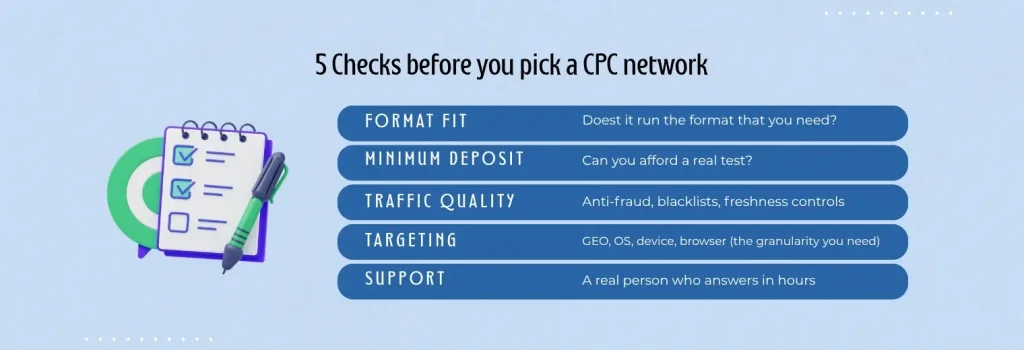
- Format fit. Make sure the network actually does the format you want. Some smaller ones are push-only.
- Minimum deposit and minimum bid. A $250 deposit is a lot if you’re just validating an idea.
- Traffic quality. Look for anti-fraud filters, source blacklists and subscriber freshness controls on push.
- Targeting. At minimum you want geo, OS, device and browser. Carrier, ISP and connection type are a bonus.
- Support and tracker integrations. A real person who answers in hours, not days, is worth more than a 5% bonus on your deposit.
A practical tip: don’t judge a network on $20 of spend. Plan for enough budget to reach a few hundred clicks per test, otherwise you’re reading noise.
What should publishers look for in a CPC ad network?
Publishers should look for a network with consistent advertiser demand, a low payout threshold and fast, flexible payments. High CPC rates mean little if the network can’t fill your inventory.
Check these before you integrate:
- Fill rate and demand consistency across your top geos.
- Minimum payout and payment speed. A $10 threshold with 24 to 48 hour payouts beats a $100 threshold with net-30 terms.
- Payment methods you can actually use where you live.
- Format fit for your site or app, so ads don’t wreck the experience.
For more ideas, see our post on 5 essential ad revenue optimization strategies for publishers.
How do you avoid wasting budget on bad clicks?
Avoid wasted spend by tracking every campaign, blacklisting weak sources early, and starting with small daily caps. CPC protects you from paying for impressions, but it doesn’t protect you from low-intent clicks.
- Use a tracker such as ClickFlare, ClickMagick or Skro so you see which sources convert.
- Cut underperforming placements fast. Waiting “just one more day” is how budgets disappear.
- Split-test creatives and landing pages separately, not together.
- Follow industry guidance on invalid traffic. The IAB publishes standards worth knowing, and Google Ads Help explains how click quality and invalid clicks are handled on the search side.
Seasonal timing matters as well.
FAQ
What is the best CPC ad network in 2026?
There isn’t one best network, because it depends on your format and budget. For push and native, Mondiad, RichAds, PropellerAds and Adsterra are common starting points. For search intent, Google Ads is the standard.
How much money do I need to start with a CPC ad network?
Most CPC ad networks require a minimum deposit between about $100 and $250. Some platforms go lower, and a few ask for more. Budget enough for several hundred clicks per test.
Is CPC better than CPM?
CPC is better for driving traffic and testing offers, while CPM is better for reach. Many advertisers start on CPC, then test CPM once a campaign is profitable.
What are the best CPC ad networks for push notifications?
Mondiad, RichAds, PropellerAds, Adsterra and Clickadu are widely used for push. Compare minimum bids, subscriber freshness controls and geo coverage before picking one.
Ready to run CPC campaigns that actually pay off?
Whether you’re buying traffic or monetizing it, Mondiad gives you CPC and CPM pricing on push, in-page push, native, banner, popunder, and many more formats. Advertisers get tracker integrations and flexible targeting. Publishers get low-threshold payouts through the methods they already use.
