


Are the terms CPM, CPA, CPI, CPL and the like giving you a hard time? We hope this article will clear the path for you and help you drive success with your ad campaigns!

To start with, programmatic advertising is an automated method of buying digital ad space, which relies heavily on real-time bidding (RTB) to ensure the most efficient ad placements.
In the context of affiliate offers, programmatic advertising leverages sophisticated algorithms and data to target potential customers and optimize ad spend.
New to the space? Start with our beginner’s guide to affiliate marketing programmatic campaigns, then come back here for the bidding details.
But when it comes to buying traffic, it can be done in many different ways, thus understanding bidding models and conversion flows in is crucial for any campaign effectiveness, regardless of its end goal. Let’s get into it!
TL;DR
- Bidding models = how you pay for traffic: CPM (per 1k impressions), CPC (per click), CPA (per action), CPL (per lead), CPI (per install), CPS (per sale), RevShare (% of revenue over time)
- No “best” model – pick based on your goal, budget, and offer type
- Conversion flows: SOI (email only) → DOI (email + confirm) → PIN Submit → CC Submit. Easier = more volume, harder = higher payout
- Ad sequence: creative → pre-lander (warms user up) → landing page
- Key KPIs to track: Impressions, Clicks, CTR, CR, ROI
- Manual vs auto bidding: SmartCPC/TargetCPA let algorithms optimize bids in real time based on conversion likelihood
Understanding Programmatic Advertising Bidding Models
To put it simply, a bidding model measures the cost an advertiser pays for ad placements and each model is tied to specific performance indicators, such as clicks, sales, number of impressions, and so on.
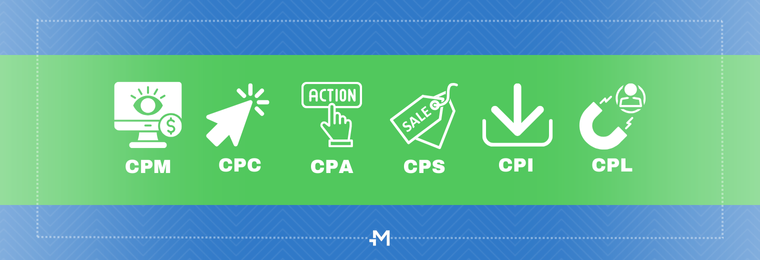
In time, bidding models have been marked by significant changes driven by technology advancements, data availability, and shifting advertiser objectives.
What started with the classic models of CPM and CPC, in recent years we’ve seen a notable interest in performance-based models like CPS, CPI, CPL and the like. Today, there are many variations of pricing models, however, the most common remain CPM, CPC, and CPA.
Here are the key bidding models you should be familiar with:
| Bidding model | Definition | Best for | Considerations |
|---|---|---|---|
| CPM (Cost Per Mille) | Advertisers pay for every 1,000 impressions of their ad. | Commonly used for brand awareness campaigns where the goal is to reach as many people as possible. | Effective for large-scale reach but doesn’t guarantee engagement or conversions. |
| CPC (Cost Per Click) | Advertisers pay each time their ad is clicked. | Ideal for campaigns focused on driving traffic to a website or landing page. | Ensures engagement but clicks might not always lead to conversions. |
| CPA (Cost Per Acquisition) | Advertisers pay only when a specific action is completed, such as a sale, sign-up, or form submission. | Conversion-focused campaigns, specific actions like purchases or sign-ups. | Higher cost per action but aligns payment with actual campaign goals. |
| CPL (Cost Per Lead) | Advertisers pay for each lead generated, such as a contact form submission. | Used in lead generation campaigns where the goal is to collect user information for future follow-up. | Valuable for collecting leads, but quality and conversion of leads may vary. |
| CPI (Cost Per Install) | Advertisers pay for each app installation resulting from their ad. | Typically used in mobile app marketing campaigns to drive app installations. | Specific to app promotions, ensures users install the app but doesn’t guarantee active usage. |
| CPS (Cost Per Sale) | Advertisers pay for each sale generated from their ad. | Common in e-commerce campaigns focused on driving purchases. | Directly tied to revenue but may have higher costs per sale. |
| CPV (Cost Per View) | Advertisers pay each time a video ad is viewed. | Common in video advertising campaigns, particularly on platforms like YouTube. | Focused on video content, but views don’t necessarily equate to engagement or conversion. |
| RevShare (Revenue Share) | Advertisers or offer owners share a percentage of the revenue generated by referred users over time. | Best for long-term partnerships, recurring-revenue offers, and verticals where lifetime value matters. | Returns can compound over time, but results are less predictable in the early stage than fixed payouts. |
These bidding models allow advertisers to tailor their programmatic ad campaigns to meet specific goals, whether it’s increasing brand awareness, driving website traffic, generating leads, or ensuring high user engagement.
Affiliates typically choose offers based on their audience’s interests and behavior to maximize their earnings. The effectiveness of each type can vary depending on the industry, target audience, and specific goals of the advertiser.
CPA: Why It Deserves a Closer Look
CPA remains one of the most attractive models for advertisers who care more about outcomes than visibility alone. Instead of paying for impressions or clicks first and hoping the funnel will do the rest, the advertiser pays only when a predefined action actually happens, such as a sign-up, lead, or sale.
That makes CPA particularly useful when campaign efficiency needs to be measured against a clear business result.
At the same time, CPA is not a shortcut around strategy. To make it work consistently, you still need accurate tracking, realistic payouts, a solid post-click funnel, and enough conversion data to understand where performance is coming from. In practice, the strongest CPA campaigns are usually the ones where targeting, offer fit, and conversion flow are already aligned before scaling starts.
If you want to go deeper into the model, see our dedicated CPA guide here.
RevShare: The Long-Game Model
RevShare belongs in the same conversation because it represents a different way of evaluating campaign value. Instead of rewarding a one-time action, RevShare is tied to the revenue generated by the referred user over time.
This makes it especially relevant in niches where customer lifetime value matters, such as subscriptions, gaming, finance, SaaS, and other recurring-revenue environments.
The advantage of RevShare is its upside: a user acquired today can continue generating value long after the initial conversion.
The trade-off is predictability. Unlike CPA, where the value of the action is usually known in advance, RevShare can take longer to evaluate and may fluctuate depending on retention, monetiZation depth, and overall user quality.
For many teams, CPA is the validation model, while RevShare becomes more attractive once the traffic quality is proven.
RevShare: The Long-Game Model” block. The article already has a dead line there: “For a deeper breakdown, see the dedicated RevShare article here.” The word “here” isn’t linked. Replace that sentence with: “For a deeper breakdown, see our revenue share explained guide.
Manual Bidding vs Automatic Bidding
Did you ever come across SmartCPC or TargetCPA?

Compared to manual biddings, automated bidding strategies like the ones above aim to optimize ad spend and achieve specific performance goals with the help of smart algorithms and and historical performance data.
Using automated bidding, the system is doing the work for you.
Bids are adjusted in real time for each auction based on the likelihood of conversion. For a step-by-step look at winning more auctions without overpaying, see how to increase your win rate.
The Million-dollar Question: Which Bidding Model is Best?
This question cannot be answered, at least not in this form, because it is incomplete. There is no right or wrong answer because they all serve a purpose. The right question can be, “which model is best for my ad campaign?”
Choosing the best bidding model depends on your campaign goals, budget, and the specific actions you want your audience to take. By understanding the strengths and use cases of each model, you can effectively allocate your advertising budget to achieve the desired outcomes.
- Identify your conversion funnel:
It’s vital you clearly define your campaign objectives and your conversion funnel, especially when dealing with affiliate offers. By systematically guiding potential customers through the conversion funnel, you will maximize your chances of converting leads into loyal customers or driving growth and profitability.
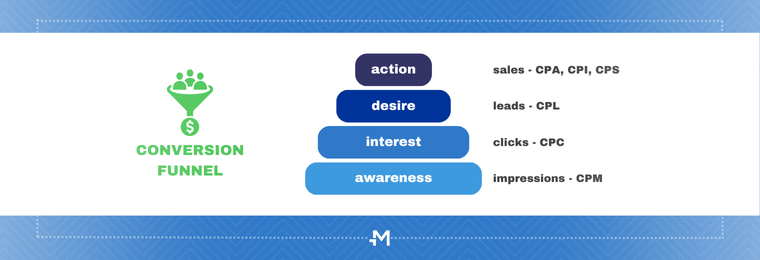
These are the goals commonly targeted in digital marketing and advertising campaigns:
| Conversion Goal | Description |
|---|---|
| Brand Awareness: | Building brand awareness is crucial for establishing a presence in the market, creating a brand identity, and differentiating from competitors. |
| Website Traffic | High website traffic can indicate strong brand interest and provides opportunities for conversions. |
| Engagement/Clicks | High engagement indicates that the content resonates with the audience and can lead to increased brand loyalty and conversions. |
| Conversions/Sales | Conversions are critical as they directly impact revenue and indicate the effectiveness of marketing strategies. |
| App Installations | Essential for businesses offering apps, as a higher number of installations can lead to increased user engagement and revenue. |
| Sign-ups | Sign-ups are a sign of user interest and provide opportunities for further engagement and conversion. |
| Lead Generation | Generating leads is crucial for building a pipeline of potential customers to nurture and convert into sales. |
- Prepare a clear budget:
It is vital to have an idea of your available budget and divide it accordingly.
- Is your budget fixed or limited?
- Are you planning on setting daily spend limits?
- What is your targeting?
- What ad formats are you choosing?
- What is your test budget?
- What is your affiliate offer payout?
Answering all these questions will help you figure out a strategy for spending your budget wisely.
Understanding Ad Conversion Flows
The conversion flow in advertising or affiliate marketing is a comprehensive process designed to guide users from initial exposure to a final conversion, with each step meticulously tracked and analyzed to optimize performance and maximize ROI.
| Conversion Type | Description | Example |
|---|---|---|
| SOI | Users provide their email or basic info once to subscribe or sign up. | A user enters their email to subscribe to a newsletter and immediately starts receiving emails. |
| DOI | Users confirm their subscription by clicking a link in a confirmation email. | A user signs up for a newsletter, receives a confirmation email, and clicks the link to complete the subscription. |
| CC Submit | Users enter their credit card information for a trial, purchase, or subscription. | A user signs up for a software trial and must enter credit card details, which will be charged after the trial. |
| PIN Submit | Users enter a PIN received via SMS to confirm their action. | A user subscribes to a service by entering their mobile number and confirming with a PIN received via SMS. |
These types of submissions help advertisers and marketers ensure they are engaging with users who are genuinely interested and committed to their offers.
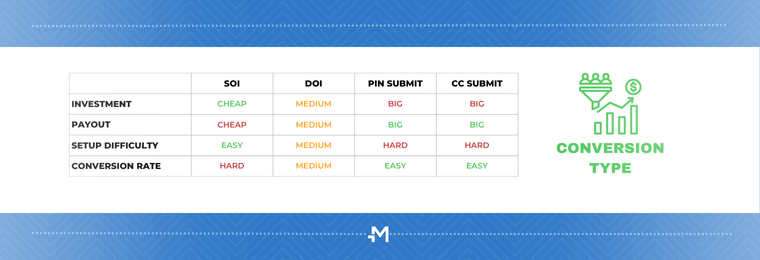
For example, while SOI and DOI offers provide quicker data engagement CC Submits and PIN Submits offers offer higher payouts due to building a better credibility among its users. Naturally, the shorter the form is, the easier it is to get a conversion but is this all that it matters?
Ad Display Sequences
In advertising, users have another way of getting to conversions via different elements within an advertising campaign, each serving a unique purpose in the user journey.
Ad creative
- The ad creative is the actual advertisement content that is displayed to potential customers.
- This includes text, images, videos, or interactive media designed to attract and engage the audience.
Pre-lander
- A pre-lander is an intermediary webpage that a user is taken to after clicking on an ad but before reaching the main landing page.
- It serves as a buffer between the ad and the final destination.
It’s mainly used to warm up the user and provide additional context, information, or persuasion to increase the likelihood of conversion when they reach the landing page.
Landing Page
- The landing page is the final webpage that users are directed to after clicking on the ad or passing through a pre-lander.
- It is specifically designed to convert visitors into leads or customers via specific actions such as filling out a form, making a purchase, signing up for a newsletter, or downloading a resource.
- Each component plays a crucial role in guiding the user through the conversion funnel, maximizing the effectiveness of the advertising campaign.
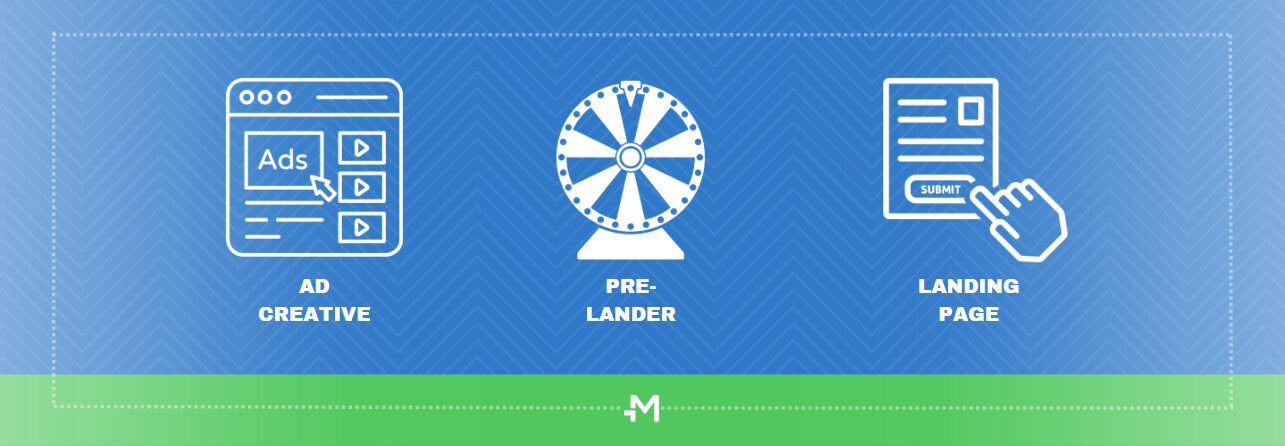
Flow example:
Ad creative -> pre-lander -> landing page
| Ad Creative | Pre-lander | Landing Page |
|---|---|---|
| A user sees an engaging push ad for a new fitness app. | Upon clicking the ad, the user is taken to a short quiz about their fitness goals. | After completing the quiz, the user is directed to a landing page with personalized fitness plans and a sign-up form for the app. |
Measuring Advertising Campaign Results
Choosing the right metrics depends on campaign objectives, type of offer, and the stage of the advertising funnel being targeted (e.g., awareness, consideration, conversion). Here are the most common KPIs that can tell you relevant information about the performance of your ad campaign.
🔹 Impressions
Impressions represent the number of times an ad is displayed or viewed and indicates the reach and visibility of the ad.
🔹 Clicks
Clicks refer to the number of times users click on an ad, measuring user engagement and interest in the ad content.
🔹 CTR – Click-Through Rate
CTR stands for click through rate, namely the amount of times users are clicking on your ads. A high CTR indicates that a higher percentage of users who view the advertisement or link are clicking on it, which is generally considered favorable in advertising as it signifies that the ad is relevant or compelling to the audience.
| Formula: CTR = Clicks / Impressions * 100 |
🔹 CR – Conversion Rate
This metric measures the percentage of users who take a desired action on a website(making a purchase, signing up for a newsletter, filling out a form, or completing some other predefined goal), out of the total number of visitors or users who interacted with the website or advertisement.
Naturally, a higher Conversion Rate indicates that a larger percentage of visitors are completing the desired action, which can lead to increased revenue and success in achieving business goals.
| Formula: CR = Conversions / clicks * 100. |
🔹 ROI – Return On Investment
When your buying traffic, especially when doing affiliate marketing, it’s important to keep track of your investments, and even more so, to measure your campaign efficiency. Did you make a profit, did u breakeven or did you lost money?
| Formula: ROI = Net Profit / Cost * 100. |
Advertisers should continuously monitor these metrics, analyze trends, and adjust strategies to optimize performance and achieve their advertising goals effectively.
FAQ
Which bidding model is best for a new campaign?
CPM or CPC is usually better for new campaigns because CPA models need enough historical conversion data to price accurately. Starting on CPM/CPC lets you gather data on CTR and conversion rate by GEO and creative before shifting to CPA-style optimization.
How do I know when to switch bidding models mid-campaign?
Switch once you have statistically significant data, typically after a campaign has generated enough clicks or conversions per GEO/placement to trust the numbers, not just a handful of results. If CPC spend is consistently converting at a predictable rate, moving toward CPA (or a target ROAS bid) can improve efficiency.
What is a conversion flow, and why does it matter for bidding?
A conversion flow is the full path a user takes from ad click to landing page to the desired action (signup, purchase, deposit, etc.). Bidding models only perform well when the conversion flow is short, fast-loading, and matched to the traffic source, a mismatched flow will waste spend no matter how well the bid is optimized.
How often should I adjust my bids?
Check performance daily during the first week of a campaign to catch obvious issues, then move to a 2-3x/week cadence once results stabilize. Over-adjusting bids too frequently (multiple times a day) can prevent the algorithm or your own testing from reaching statistical significance.
What’s the biggest mistake advertisers make with conversion flows?
Adding unnecessary steps between the ad click and the conversion action – extra forms, slow-loading pages, or unclear CTAs – which inflates cost-per-conversion regardless of the bidding model chosen. Simplifying the flow usually improves results faster than adjusting bids.
Run Programmatic Ads with Mondiad
Choosing a bidding strategy is a game-changing element in your ad campaigns however it’s important to note that there is no one right strategy for everyone.
In this decision you should take into considerantions many other elements, including your end goals, your budget, your niche, your desired targeting, offer payout, conversion flow, and all other factors that you find relevant for your campaign.
Whether you are just starting out or you are already experienced, we are here to bring you closer to success. We serve traffic for all countries and verticals via a multitude of ad formats and we’ve got you covered whether you prefer the stability of CPM (Cost Per Mille), the performance-driven approach of CPC (Cost Per Click), or the cutting-edge efficiency of Smart Bidding algorithms.
