



Affiliate marketing in 2026 is more competitive, data‑driven, and opportunity‑rich than ever. Rising ad costs, stricter platform rules, and smarter users mean one thing: choosing the right vertical is no longer optional; it’s critical.

For affiliate marketers and media buyers monetizing traffic through ads, the right vertical can be the difference between scaling profitably and burning budget. Choosing a vertical is only half the decision.
In this guide, we’ll break down the top advertising verticals to target in 2026, explain why they perform, and show how running campaigns through a performance‑focused ad network can help you unlock their full potential.
TL;DR
- AI & SaaS, Finance & FinTech, iGaming, Utilities, and Health/Nutra remain important affiliate verticals to evaluate in 2026, but performance varies substantially by GEO, traffic source, offer and funnel.
- Payout alone is not a profitability metric. Compare acquisition cost, conversion rate, payout, LTV and the actual conversion event before scaling.
- Traffic format matters. Push, popunder, native and banner traffic can behave differently within the same vertical and GEO.
- The best vertical is the one that fits your traffic and economics. Use controlled tests, granular tracking and performance data rather than copying a generic vertical list.
How to Choose an Affiliate Marketing Vertical in 2026
Choosing a niche isn’t about picking what sounds trendy; it’s about aligning demand, traffic, and monetization. In 2026, the most successful affiliate marketers follow a structured approach instead of guessing.
A useful vertical-selection framework considers these variables:
- Demand: Is there persistent or growing user demand?
- Monetization: What conversion events and payout models are available?
- Traffic fit: Which formats, devices and GEOs suit the offer?
- Economics: Can the expected revenue justify traffic acquisition costs?
- Compliance: Can the offer and advertising strategy operate legally and within the relevant platform and market rules?
1. Demand is necessary, but not sufficient.
A profitable niche always solves a real problem or desire.
- Strong signals of demand include:
- High advertiser competition
- Evergreen needs (money, health, security, convenience)
- Repeat or long‑term user value
Verticals like finance, health, and utilities continue to perform because demand doesn’t disappear when trends change.
2. Monetization Potential.
Not all niches pay equally. Before committing, evaluate:
- Average pay ratesand payout models (CPA, RevShare, subscription)
- Conversion flow complexity
- User lifetime value
High‑value niches like SaaS, finance, and iGaming may require more testing but offer significantly better long‑term ROI.
Consider two hypothetical campaigns:
| Metric | Campaign A | Campaign B |
|---|---|---|
| Traffic cost | $100 | $100 |
| Conversions | 5 | 20 |
| Payout | $30 | $10 |
| Revenue | $150 | $200 |
| Gross revenue minus traffic cost | $50 | $100 |
Campaign A has the higher payout, but Campaign B produces the better result in this simplified example.
For real campaign decisions, compare the complete economics:
- Revenue = conversions × payout
- ROI = (revenue − traffic cost) ÷ traffic cost
For RevShare offers, subscription products and multi-step funnels, also account for downstream value and the actual event that defines success.
For more on acquisition economics, see Mondiad’s guide to user acquisition costs in advertising.
Payout is not the same as profitability.
3. Scalability Across Traffic Types and GEOs.
In 2026, verticals must scale beyond a single format or region. Top-performing verticals:
- Convert well across multiple ad formats (push, popunder, native, banners)
- Perform in both Tier-1 and emerging GEOs
- Allow creative testing and audience segmentation
This flexibility lets affiliates and advertisers move budgets quickly and maintain performance even as markets change.
Types of Affiliate Marketing Niches
Understanding the main types of affiliate marketing niches helps advertisers and affiliates choose verticals that align with their traffic, ad formats, and monetization goals.
The table below breaks down the most common niche types and how they perform.
| Niche Type | Description | Common Verticals | Why It Works |
| Evergreen Niches | Always-in-demand niches that solve ongoing needs | Finance, Health & Wellness, Utilities, Dating | Stable year-round demand, predictable performance, long-term scalability |
| Trend-Driven Niches | Niches fueled by new technologies or market shifts | AI & SaaS tools, new apps, emerging tech | High engagement, early-mover advantage, strong curiosity factor |
| High-Payout Niches | Niches with high CPA or RevShare models | iGaming, Betting, Loans, Insurance, Crypto | High advertiser budgets, strong ROI per user |
| Impulse-Driven Niches | Niches that rely on fast, emotional decisions | Sweepstakes, Mobile apps, Utilities, Gadgets | Fast conversions, simple funnels, scalable testing |
| Content-Driven Niches | Niches that require education and trust | SaaS platforms, Finance tools, Health & Beauty | Higher-quality users, better long-term value |
| Seasonal Niches | Niches that peak during specific times of the year | Travel, Holidays, Events, Sales campaigns | High-intent traffic during peak seasons |
Best Affiliate Marketing Verticals In 2026
Affiliate marketing never sits still, and 2026 is proving that louder than ever. New technologies, shifting user behavior, and tighter competition are reshaping which verticals actually convert and which ones quietly drain budgets.
Luckily, we’ve been around and in the know to help you navigate making money via ads. Consider this your compass for navigating success in today’s affiliate landscape.
1. AI & SaaS Tools
AI is no longer a buzzword; it’s infrastructure. From content creation and video editing to analytics, CRM, and automation, businesses and creators actively seek tools that save time and increase productivity. This makes AI and SaaS one of the most attractive affiliate verticals in 2026.
Why it works:
- Subscription‑based products = recurring revenue
- High LTV users
- Global demand across industries
Before buying traffic, check:
- Is the conversion a signup, trial, paid subscription or qualified lead?
- Is there recurring commission or only an initial CPA?
- How long is the attribution window?
- Does the product have a localized landing page?
- Does the offer convert on mobile?
- How much education does the user need before converting?
4. Utilities: VPNs, Security & Mobile Apps
Utilities include VPNs, security products, device-management tools, productivity apps and other software designed to solve a specific user problem.

VPN usage is growing worldwide as users look for more privacy and ways to access restricted content.
The global VPN market value in 2026 is estimated at $59-63 billion, with ~19% year-on-year growth.
The attraction is relatively straightforward: the value proposition can often be communicated quickly.
Mobile traffic deserves segmentation.
Do not treat “mobile” as one audience. We recommend breaking campaigns into micro-segments rather than treating a GEO or device category as uniform.
At minimum, consider:
- operating system;
- device;
- connection type;
- GEO;
- browser;
- time of day;
- and placement/source.
2. Finance & FinTech

With no surprise, finance remains one of the highest‑paying verticals in affiliate marketing.
This includes:
- Trading and investing platforms
- Banking and payment apps
- insurance and loan products
Compliance matters: Financial advertising requirements vary by jurisdiction and product. Claims should be reviewed against the applicable rules and the advertiser’s approval requirements before traffic is scaled.
Trading platforms, banking products, payment apps, insurance, loans and other financial products can have very different:
- conversion events;
- approval processes;
- compliance requirements;
- customer values;
- GEO availability;
- and acquisition costs.
For this reason, working with an ad network that understands these requirements is key to profitable scale.
Build the campaign around the real conversion event: A finance campaign should not automatically optimize toward the cheapest lead. If you ultimately value funded accounts or qualified customers, optimizing only for registrations can produce misleading performance. Instead, define the conversion goal before launch, then connect it to tracking and reporting.
See Mondiad’s conversion-goal guide and Mondiad’s conversion-tracking guide for practical implementation guidance.
3. Betting & Casino
Betting continues to dominate performance marketing thanks to:
- Strong user engagement
- Fast conversions
- Scalable globally with GEO‑specific targeting
iGaming can produce strong performance when the offer, GEO, traffic source and conversion event are aligned. But it is also one of the clearest examples of why “high payout” is not enough.
For casino campaigns, the meaningful KPI may be a first-time deposit (FTD) rather than an install or registration.
Think in terms of the complete funnel.
Ad impression → click → landing page → registration → deposit → FTD
The optimization target should match the advertiser’s commercial objective. For more campaign-optimization context, see our guide to smart traffic distribution.
A recent Mondiad case study illustrates this operationally: a Brazil push campaign reduced FTD cost from $48.86 to $11.11 after custom bidding and subscriber-age segmentation, while FTD conversion rate increased from 0.30% to 0.79%. The case used advertiser-provided postbacks for install, registration and deposit events.
Regulatory requirements are part of the campaign.
Gambling advertising is jurisdiction-specific. In Great Britain, for example, gambling operators must comply with applicable advertising codes, and the UK Gambling Commission states that operators remain responsible for relevant third-party activity.
Affiliates should therefore confirm:
- permitted GEOs;
- licensing requirements;
- age-targeting requirements;
- promotional terms;
- responsible-gambling requirements;
- approved creative language;
- and placement restrictions.
5. Health, Nutra & Wellness
Health and wellness is a stable, evergreen vertical that continues to evolve. Popular sub‑verticals include supplements and nutraceuticals, weight management, beauty, wellness, and fitness products.
Why it works:
- Emotional buying decisions
- Repeat purchase potential
Educational creatives and high‑quality traffic are essential here: users need trust before converting.
Treat claims as a performance variable.
A creative that generates a high CTR but makes an unsupported health claim is not a sustainable campaign asset.
As an example, for US-facing health products, the FTC states that advertising claims must have appropriate substantiation and that health-related claims generally require competent and reliable scientific evidence.
That means affiliates and advertisers should review:
- express claims;
- implied claims;
- before/after imagery;
- testimonials;
- scientific references;
- landing-page claims;
- disclaimers;
- and the consistency between ad copy and landing-page content.
Affiliate Vertical Comparison for 2026
| Vertical | Typical monetization | Traffic overview | GEO overview | Main challenge | Best suited to |
|---|---|---|---|---|---|
| AI & SaaS | CPA, subscription, RevShare | Native, display, push, and content-led funnels can be tested | Global potential; localization and product availability matter | Competition and increasingly crowded offers | Affiliates comfortable with longer consideration cycles |
| Finance & FinTech | CPA, CPL, RevShare | Native, display, and other compliant direct-response formats | Strongly GEO- and product-dependent | Regulation, approval, and claim restrictions | Experienced media buyers |
| Betting & Casino | CPA, RevShare, hybrid | Push, native, display, and other permitted formats | Highly market-specific | Licensing, responsible marketing, and offer restrictions | Experienced affiliates in regulated markets |
| Utilities | CPA, CPI, subscription | Push, popunder, native, and display can be tested | Mobile behavior and local product availability matter | User intent and creative fatigue | Mobile-focused media buyers |
| Health, Nutra & Wellness | CPA, RevShare, subscription | Content-led and direct-response funnels require careful claims management | Compliance and localization vary by market | Claim substantiation and consumer trust | Experienced affiliates with compliant funnels |
Affiliate Marketing Vertical Performance Depends on GEO
GEO is not a footnote to vertical selection. The same offer can perform differently across countries because of differences in:
- consumer intent;
- purchasing power;
- advertiser competition;
- regulatory environment;
- language;
- device mix;
- payment methods;
- traffic availability;
- and conversion behavior.
Instead of asking: “What is the best vertical?”
ask: “What vertical + GEO + format + offer combination has a viable unit-economics profile?”
Use micro-segmentation before scaling.
Start broad enough to collect signal, then break performance down by: GEO; device; OS; browser; placement; source/zone; subscriber age where applicable; hour/day; creative; and funnel stage.
At Mondiad, we recommend starting broad, then narrowing toward segments that demonstrate better performance.
Traffic Quality Makes the Difference
Even the best vertical won’t perform without the right traffic.
You can have the perfect offer, creatives, and funnel, but if the traffic isn’t relevant or engaged, the numbers just won’t add up. High-quality traffic means better CTRs, higher conversion rates, cleaner data for optimization, and way less budget burned on users who were never going to convert anyway.
Get the latest deals from our partners via the Mondiad marketplace.
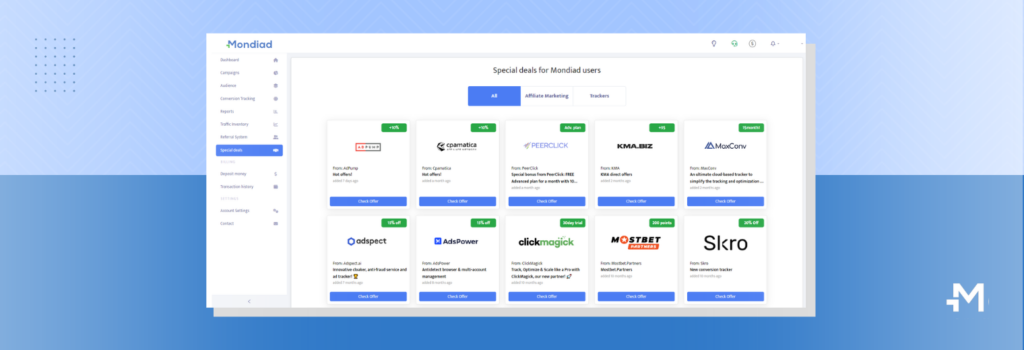
Mondiad advertisers get access to exclusive deals on top-converting offers from top affiliate programs and affiliate networks in the industry.
A good ad network like Mondiad helps by pre-filtering traffic, offering precise targeting, optimizing placements, and cutting out low-quality sources before they drain your budget.
Affiliates get flexibility with multiple ad formats and support from a team that understands affiliate goals, so you’re not just buying traffic, you’re getting guidance that helps you grow faster and smarter.
When advertisers and affiliates work with quality traffic, testing becomes scaling, not guessing.
Take Everything With a Grain of Salt
A high-paying vertical won’t perform if it doesn’t align with your traffic type, user intent, or ad format. The same vertical can be highly profitable for one affiliate and unscalable for another. Long-term success comes from alignment, not imitation. Market saturation is a real deal.
Ultimately, there’s no single “best” vertical, only the one that best matches your traffic and strategy.

In 2026, the most successful affiliates don’t blindly follow trends. Instead, they:
- Analyze how their traffic behaves
- Test verticals that naturally fit their working formats and GEOs
- Scale decisions based on performance data, not assumptions
When traffic, vertical, and strategy work together, optimization becomes predictable, and scaling becomes sustainable.
Final Takeaway: Choose the Combination, Not the Category
The most useful conclusion for 2026 is not that one vertical has replaced another. It is that vertical selection has become a matching problem.
The right combination is: Vertical + GEO + traffic format + offer + funnel + conversion event + economics
AI & SaaS may suit one media buyer while finance works better for another. A push campaign can outperform native for one iGaming funnel and fail for another. A high-payout offer can lose money when acquisition costs are too high.
The way to find the answer is to test the combination, track the actual conversion event, segment the traffic and scale the parts of the campaign that prove their economics.
Affiliate Vertical Selection: The Practical Decision Framework
Before launching a new vertical, score the opportunity across these seven questions:
| Question | What to verify |
|---|---|
| Is there demand? | Search demand, advertiser activity, offer availability |
| Does the offer pay? | CPA, CPL, CPI, RevShare, or subscription economics |
| Does the traffic fit? | Format, device, audience, and funnel |
| Does the GEO fit? | Volume, competition, conversion behavior, and regulation |
| Can it be tracked? | Click IDs, postbacks, and conversion events |
| Can it scale? | Available traffic, budget capacity, and repeatable performance |
| Can it run compliantly? | Offer, creative, landing page, and targeting requirements |
What Advertisers Should Look for in an Affiliate Traffic Partner
Advertisers should evaluate the other side of the marketplace. The key questions are:
- Can the network deliver the required GEO?
- Can it optimize toward the advertiser’s actual conversion event?
- Can it pass and receive tracking parameters correctly?
- Can traffic be segmented by source and device?
- Can low-quality sources be identified quickly?
- Can the network support compliance requirements for restricted verticals?
- Is there enough reporting to distinguish volume from qualified conversions?
For advertisers, the goal is not simply more traffic. It is more qualified traffic at an acquisition cost that works with the offer’s economics.
If you already know your vertical and offer, the next step is to define the GEO, traffic format and conversion goal, then build a controlled test.
2026 is about smarter affiliate marketing. If you’re ready to test, optimize, and scale campaigns in the top‑performing verticals of 2026, joining a traffic‑focused ad network is the logical next step. Run Mondiad traffic if you’re ready for measurable results.
FAQ: Affiliate Marketing Verticals in 2026
What are the best affiliate marketing verticals in 2026?
There is no universal best vertical. AI and SaaS, finance, iGaming, utilities, and health remain important categories to test, but profitability depends on the offer, GEO, traffic format, conversion event, acquisition cost, compliance requirements, and downstream customer value.
Which affiliate verticals have the highest payouts?
High payouts can appear in finance, iGaming, insurance, loans and other categories, but payout size alone does not determine profitability. Affiliates should compare payout with conversion rate, traffic cost, approval requirements, funnel length, customer value and the specific conversion event being optimized.
What is the best traffic format for affiliate marketing?
There is no format that consistently wins across every vertical. Push, popunder, native and banner traffic can perform differently depending on GEO, device, offer, funnel and user intent. Test formats against the same commercial KPI rather than optimizing for CTR alone.
How do GEOs affect affiliate campaign performance?
GEO affects traffic cost, volume, conversion behavior, advertiser competition, purchasing power, language, payment methods and regulatory requirements. A campaign that performs well in one country may not translate directly to another. Segment GEOs separately and compare performance using the same conversion and profitability metrics.
Should affiliates choose high-payout offers?
Not automatically. A high payout can be attractive, but the offer may also have a low conversion rate, expensive traffic, strict compliance requirements or a long conversion funnel. The better approach is to estimate expected revenue per unit of traffic and compare it with acquisition cost.
How do I choose an affiliate vertical to test first?
Start with the combination of vertical, GEO, format and offer that matches your existing traffic and operational capabilities. Define the conversion event, confirm compliance, set up tracking, run a controlled test, then scale only after the data shows acceptable acquisition economics.
