


Mobile app ad networks are platforms that connect app publishers with advertisers and pay you for the ads shown inside your app. Choosing between them comes down to how each one performs on your traffic, not how polished its homepage looks.
That’s the part most comparison pages skip. They rank networks by headline eCPM, which says very little about your app, your countries, or your users. In our experience, fill rate, SDK weight, payout terms, and the effect on retention usually decide the winner.
This guide shows how publishers compare mobile app ad networks in practice. You’ll get the main network types, five criteria worth scoring, the formats that tend to earn most, and a safe way to test a new network before you commit. If you’d rather start with a lightweight option, the Mondiad SDK for Apps is built for exactly that.
TL;DR
- The best mobile app ad network is the one that earns you the highest revenue per user without hurting retention. That depends on your geography, app category, and formats, not on a “top 10” list.
- Screen networks on five criteria: demand quality, formats, SDK weight, payout terms, and reporting transparency. Then decide with a test that measures revenue per daily active user, fill rate, eCPM, and day-7 retention.
- Run two or three networks against identical placements for at least two weeks before you commit.
- If you want a lightweight SDK and a fast path to monetization, start with the Mondiad SDK for Apps.
What Are Mobile App Ad Networks?
A mobile app ad network is a platform that connects app publishers who have ad space with advertisers who want to reach app users. It collects demand from many advertisers, delivers ads into your app through an SDK or API, and pays you for impressions, clicks, or installs.
The value is simple. Without a network, you would have to sell inventory to every advertiser yourself. With one, you plug in a single integration and get access to demand you could never negotiate for individually.
If you’re comparing mobile app ad networks right now, you’ve probably noticed that every vendor claims high fill rates and top eCPMs. Those claims are hard to verify from a landing page. That’s why this guide focuses on how to test and compare, not on who shouts loudest.
How Do Mobile App Ad Networks Make You Money?
Mobile app ad networks pay publishers based on a pricing model, most commonly CPM, CPC, or CPI. Which model dominates your revenue depends on the advertisers buying your inventory.
- CPM (cost per mille): the advertiser pays per 1,000 impressions. Your effective rate is reported as eCPM.
- CPC (cost per click): payment happens only when a user taps the ad.
- CPI (cost per install): payment happens when a click results in an app install, which is typical for app-install campaigns.
In practice, you rarely see these in isolation. A network blends them, and what lands in your dashboard is a single eCPM figure. Two metrics matter more than any headline rate: fill rate (the share of ad requests that return an ad) and revenue per daily active user. A network with a great eCPM and a weak fill rate can still lose to a slightly cheaper one that fills nearly every request.
6 Best Mobile App Ad Networks To Test Out
Mondiad
Mondiad is an ad network built for publishers who want straightforward monetization without heavy integration work. For app publishers, that means the Mondiad SDK for Apps, which plugs Mondiad demand directly into your app.
Here’s how we’d position it honestly. Mondiad is a strong candidate when you want to add a performance-focused monetization source, you care about keeping your SDK footprint under control, and you’d like clear reporting on what each placement earns. It’s designed to sit alongside your existing setup, not replace everything you’ve built.
Mondiad SDK help you monetize any type of Android app with push and banner ads, worldwide. More improvements are coming up in the near future, so better ask the support team for the latest inventory details.
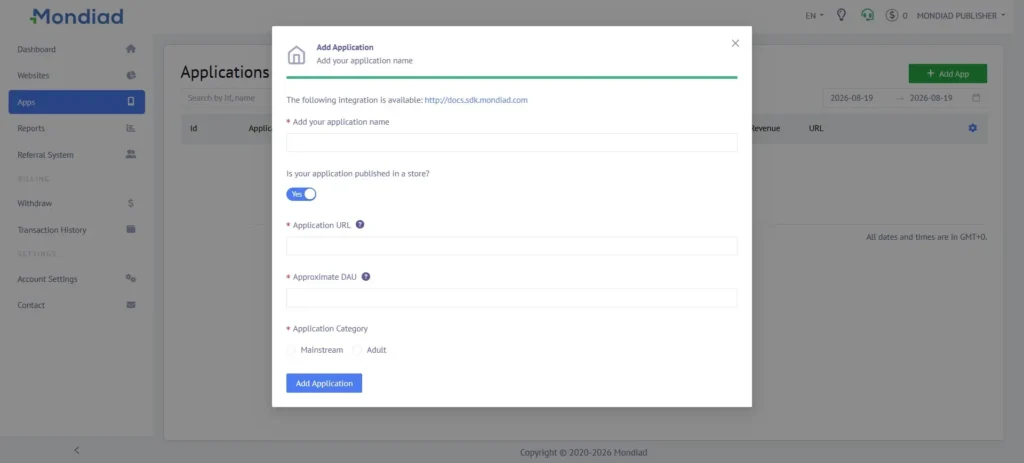
If you want to see how it performs on your traffic, the cleanest way is the method above: integrate it, run it against your current setup on identical placements, and let the numbers decide.
Google AdMob
AdMob is Google’s mobile ad network, and for many apps it’s the default first integration. It supports banner, interstitial, rewarded, rewarded interstitial, native advanced, and app open formats. That covers nearly every standard in-app placement from a single SDK.
The trade-off is that AdMob is a generalist. You get reliable coverage and familiar tooling, but you won’t find push-style or other high-impact formats there. Most publishers start with it and then add specialists around it.
AppLovin (MAX)
AppLovin is best understood as an ecosystem. MAX is its mediation platform, and AppLovin also runs its own network and exchange. The company describes MAX as offering 25+ SDK networks and 20+ in-app bidders, which is a lot of competition for each impression.
That depth is the draw for games and larger apps. The cost is complexity: more adapters to integrate, update, and monitor. For a small app with modest traffic, that overhead can outweigh the gain.
Unity Ads and LevelPlay
Unity’s offering also has two parts. Unity Ads is the network, and LevelPlay is the mediation platform that manages Unity Ads, ironSource Ads, and other networks. It’s the natural choice for games built in Unity.
One current detail matters if you’re integrating now. Unity’s documentation says apps using direct integration may see reduced ad performance, and it recommends integrating Unity Ads as a bidder through LevelPlay. In practice, that means planning for mediation from day one rather than treating Unity Ads as a standalone network.
Start.io
Start.io is a mobile supply-side platform and network with a self-service SDK. It supports video, interstitial, rewarded video, native, rich media, and banner formats, including MREC, and offers in-app bidding.
It’s a solid option for Android and iOS publishers who want a broad format range without a mediation-heavy setup. As with any network, results vary by geography and app category, so test it on your own traffic.
AdMaven
AdMaven is the closest comparison to Mondiad in style. For apps, it offers full-screen ads and push notifications, and it’s best known for high-impact web formats like pop-unders.
The same strength is its main risk. Third-party reviews note that pop-under and push formats can feel intrusive and may affect retention. That applies to any push-style network, Mondiad included, so watch day-7 retention and not just eCPM.
Side-by-side comparison
Compare mobile app ad networks on five criteria: demand quality, ad formats, SDK weight, payout terms, and reporting transparency. Skip any of these and you’ll discover the gap after you’ve shipped.
| Network | What it is | Formats for apps | Best for | Minimum payout | Payment frequency | Main watch-out |
|---|---|---|---|---|---|---|
| Mondiad | Push and banners app monetization via SDK | Push and banner ads | Adding a performance demand source to an existing stack | $10 (PayPal, Paxum, WebMoney, Capitalist); $50 (Payoneer, USDT, USDC); $150 (BTC, ETH, BCH) | Weekly or monthly automatic payouts, or manual withdrawal on request | Only Android apps supported (currently) |
| Google AdMob | Google’s app ad network and mediation layer | Banner, interstitial, rewarded, rewarded interstitial, native, app open | A default starting point for most apps | $100 (USD; varies by currency) | Monthly, paid around the 21st | Generalist; no push-style formats |
| AppLovin (MAX) | Mediation platform plus its own network and exchange | Rewarded video, interstitial, banner, native | Games and larger apps seeking bidding competition | $100 | Monthly, NET 15 | More adapters and setup to maintain |
| Unity Ads / LevelPlay | Unity’s network plus its mediation platform | Interstitial, rewarded video, banner | Games built in Unity | Set in your payout profile ($100 in Unity’s support example) | Monthly, net 60 | Direct integration is discouraged; plan for LevelPlay |
| Start.io | Mobile SSP and network with in-app bidding | Video, interstitial, rewarded, native, rich media, banner | Android and iOS apps wanting a self-service SDK | $50 for the first payment | Net 45 | Revenue share; results vary by vertical |
| AdMaven | Performance network for web and apps | Full-screen ads, push notifications | Publishers with high-volume or network traffic | None for PayPal, Payoneer, Paxum, Capitalist or USDT; $1 for Bitcoin; $1,000 for wire | Net +30 | Intrusive formats can hurt retention |
1. Demand quality and geo coverage. Ask where the network’s advertisers actually spend. A network with strong Tier 1 demand may fill poorly in Southeast Asia or Eastern Europe, and vice versa. Your own country mix decides what “good demand” means.
>> Here’s why some publisher traffic is worth more than others.
2. Ad formats. Confirm that the formats you plan to use (banner, interstitial, rewarded, native) are supported on both Android and iOS where relevant. If your monetization strategy leans on one format, make sure it’s a first-class citizen, not an afterthought.
3. SDK weight and stability. Every SDK adds size, initialization time, and crash risk. Ask for the SDK’s size footprint and check its changelog. A network that ships frequent, documented updates is usually one that’s maintained seriously.
4. Payout terms. Look at minimum payout thresholds, payment frequency, and supported payment methods. Terms that look minor on paper become a real cash-flow issue for small publishers.
Mondiad pays it’s publishers daily, starting with just $10 via multiple payment options, including cryptocurrencies. Automatic payouts may also be set on a weekly or monthly schedule.
5. Reporting and control. You need to see eCPM, fill rate, and impressions by placement, country, and format. You also want controls to block categories or advertisers that don’t suit your audience. If a network can’t show you clean numbers, you can’t optimize.
One more point, and it’s where many publishers stumble: privacy and policy compliance. Your networks have to work within platform rules like Apple’s App Tracking Transparency and Google Play policies, and with consent frameworks in your key markets. A network that treats this casually can put your app listing at risk.
Which Ad Formats Earn the Most in Apps?
Rewarded video and interstitials usually earn more per impression than banners, but the best format is the one your users tolerate. Revenue means nothing if retention collapses. See how monetization options break down by category to match formats to your app type.
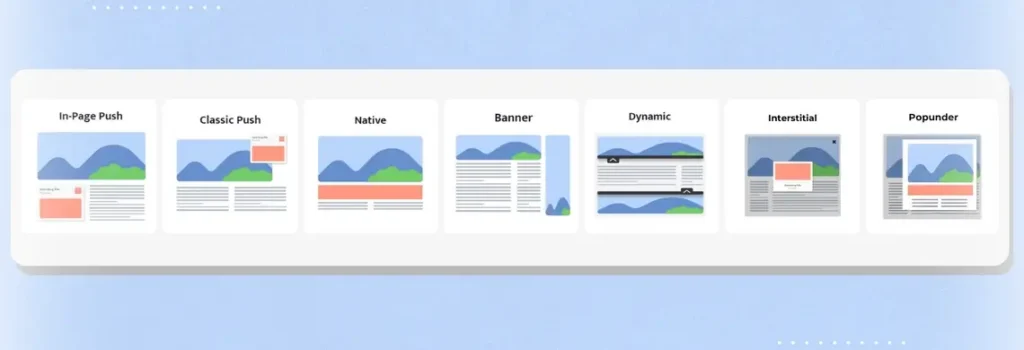
- Classic Push notifications reach users even when your app is closed, so they re-engage people without taking up any screen space. They work best when you keep the frequency in check, because too many will get notifications switched off.
- In-Page Push looks like a notification but appears inside the app or page itself, so it doesn’t depend on notification permissions. It’s a good fit when you want push-style visibility without asking users to opt in.
- Native ads blend into your UI. They take more design effort but can protect the user experience in feed-based apps.
- Banners are steady and unobtrusive, but they typically pay the least per impression. They work well in utility apps with long sessions.
- Dynamic ads adapt to the available space and stay in view as the user moves through the screen. They get strong visibility, but test the placement so they don’t crowd your content.
- Interstitials are full-screen ads shown at natural breaks. They pay better, but placement matters. Interrupt a user mid-task and you’ll see it in your uninstall rate.
- Popunder ads open behind the current screen and wait until the user is done. They avoid interrupting the task at hand and often pay well, but they suit apps with high traffic volume more than apps that prioritize a minimal experience.
- Rewarded video gives users something in return for watching, such as extra lives or premium access. It tends to earn well and get good user acceptance, because the user opts in.
Mondiad recommendation: start with the format that fits your app’s natural rhythm, not the one with the highest advertised rate. A banner suits a utility app with long sessions, while push suits an app users return to regularly. The Mondiad SDK covers both, so you can test them side by side before adding other networks for formats like rewarded video.
How Do You Integrate and Test a New Ad Network Safely?
Integrate a new ad network in a staging build first, run a controlled A/B test on identical placements, and review results after at least two weeks. Shorter tests get distorted by day-of-week and campaign-budget swings.
Here’s the process we recommend:
- Check the documentation. Clear docs and sample code are a good sign. Confusing docs usually mean a confusing integration.
- Integrate in a test build. Measure SDK size, initialization time, and any change in crash or ANR rates before touching production.
- Use test ads, then limited live traffic. Roll out to a small percentage of users first.
- Keep placements identical. Same screens, same formats, same frequency caps. Otherwise you’re comparing placements, not networks.
- Compare the right metrics. Look at eCPM, fill rate, revenue per DAU, and retention side by side.
Don’t skip the retention check. A network that raises revenue by 10% but lowers day-7 retention may be costing you more than it earns. For platform-specific setup details, refer to the official documentation of your ad network.
FAQ
What is a mobile app ad network?
A mobile app ad network is a platform that connects app publishers with advertisers. It aggregates ad demand, serves ads inside apps through an SDK or API, and pays publishers for impressions, clicks, or installs. Publishers get monetization without selling ad space directly to each advertiser.
Which ad network is best for app monetization?
There is no single best network. The right choice depends on your traffic geography, app category, and ad formats. Most publishers test two or three networks, compare eCPM and fill rate on identical placements for at least two weeks, and keep the ones that deliver the best revenue without hurting retention.
How much do mobile app ad networks pay?
Payouts vary widely by country, platform, format, and audience quality. Rewarded video and interstitials generally pay more per impression than banners, and Tier 1 traffic pays more than Tier 3. Check each network’s reporting for real eCPM on your own traffic rather than relying on advertised averages.
What is the difference between an ad network and a mediation platform?
An ad network supplies advertiser demand directly. A mediation platform sits on top of several networks and routes each impression to the highest bidder or best-performing source. Many publishers use both: a mediation layer for competition, and multiple ad networks feeding it.
Do ad SDKs slow down apps?
They can. Each SDK adds size, network calls, and potential startup overhead. Poorly built SDKs can hurt load times and crash rates. Before committing, test SDK size, initialization time, and crash impact in a staging build, and avoid stacking more networks than your traffic actually needs.
Ready to Monetize Your App Without the Guesswork?
You’ve built an app people use. Now you need ad revenue that grows with your audience, not an SDK that slows it down.
Mondiad gives app publishers a lightweight way to add performance-driven demand, clear placement-level reporting, and a setup you can test against your current stack before you commit. Pick your formats, drop in the Mondiad SDK for Apps, and let your own numbers tell you whether it earns its place.
