Push notification ads have evolved from a simple re-engagement tool into one of the most powerful traffic sources in digital advertising and affiliate marketing. In 2026, they’re no longer just about sending alerts but about delivering timely, personalised messages that reach users directly on their devices, even when they’re not actively browsing.
Keep on reading as we’ll break down push notification advertising, especially why they remain a top-performing format for performance marketers looking to scale in 2026.
When Did Push Notifications Appear?
The rise of push notifications is closely tied to advancements in browser technology and the growing demand for more direct, user-centric communication channels.
- It all started around 2015, when major web browsers such as Google Chrome and Mozilla Firefox introduced support for web push notifications. Initially, this feature was designed to help websites re-engage users by sending timely updates, alerts, or content reminders(even when users were no longer actively browsing the site).
- By 2016-2017, marketers recognised their potential, and thus push notifications began to be used as an advertising format, allowing brands to deliver promotional messages directly to users who had opted in.
- From 2018 onward, push ads experienced rapid adoption across the digital marketing ecosystem, particularly within affiliate marketing and performance-driven campaigns. Their effectiveness, combined with ease of use, made them a preferred format for both advertisers and publishers.
[Statista] The web push advertising market is steadily growing globally, driven by:
– Increased mobile usage
– Demand for real-time communication
– Shift toward personalised advertising
What Are Push Notifications & How Do They Work?
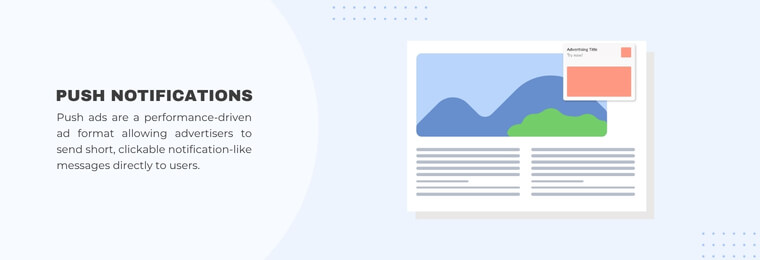
Push ads are a performance-driven ad format allowing advertisers to send short, clickable notification-like messages directly to users.
Unlike traditional ads that rely on placements within webpages or apps, push ads are delivered outside the browser environment, appearing on a user’s device even when they are not actively browsing.
For ad networks, push notifications act as a bridge between publishers and advertisers:
- Publishers collect user subscriptions (traffic source)
- Advertisers send campaigns to those subscribed users (traffic demand)
The Anatomy of a Push Ad
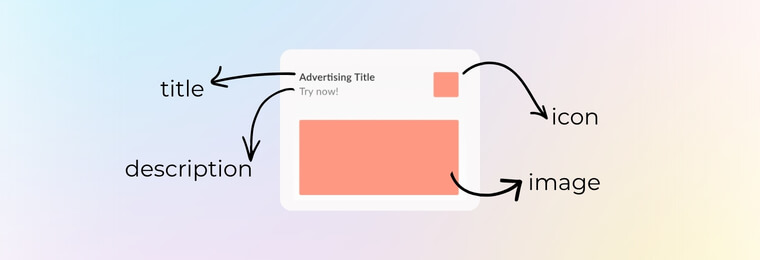
A high-performing push ad is built from a few small but powerful elements, each playing a specific role in grabbing attention and driving clicks.
- At the top is the icon, which acts as a visual hook. It should be clear, relevant, and eye-catching to stop users from scrolling.
- Next comes the headline, the most important part; it needs to spark curiosity or urgency in just a few words.
- Right below it, the description supports the headline by adding context, reinforcing the value, or teasing the outcome.
- The image (large creative), when available, boosts engagement by making the ad more dynamic and visually appealing.
- Then comes the CTA (call-to-action), which guides the user on what to do next. Strong CTAs like “Try Now,” “Get Offer,” or “Claim Prize” tend to perform best.
- Finally, the landing page is where conversion happens. Even the best push ad won’t perform if the page doesn’t match the message or loads slowly.
In 2026, success comes from aligning all these elements(visuals, copy, and user intent) into one seamless experience that encourages fast action.
Classic Push vs In-Page Push Ads: What’s the Difference?
To put it simply, classic push ads relies on opt-in audiences and higher intent, while in-page push offers broader reach and easier scalability. We can say this split exists based on how users are reached and what technology allows.
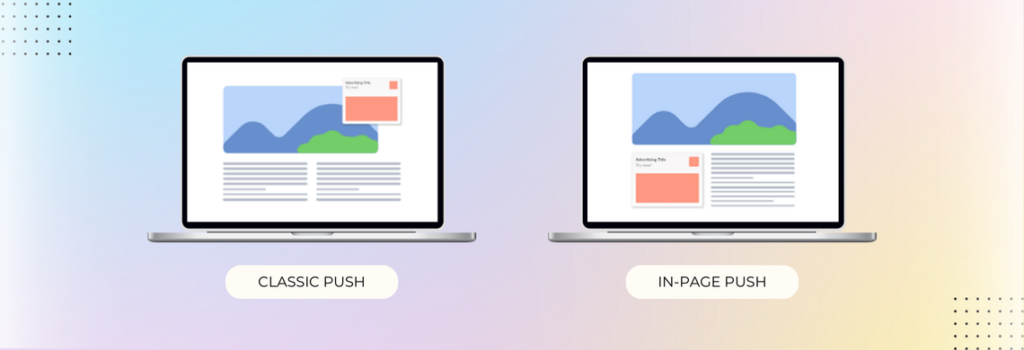
What Are Classic Push Ads?
Classic push ads are the OG format. They are sent directly to users who have opted in to receive notifications through their browser. Once subscribed, users receive ads as system-level notifications via browsers, even when they are not actively browsing the website.
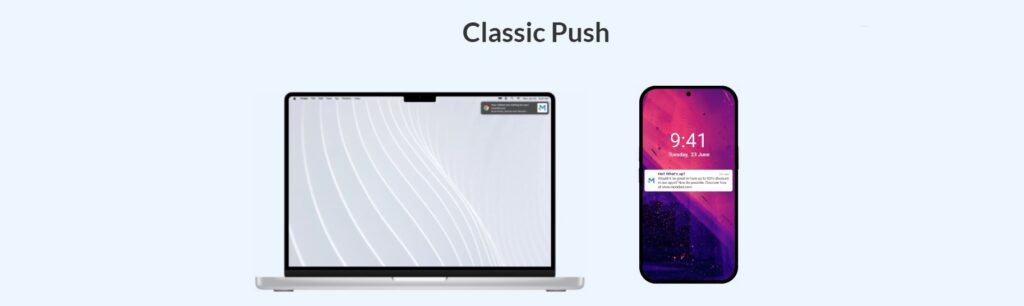
Classic push ads work best for:
- Retargeting and re-engagement campaigns.
- Subscription-based offers
- Long-term user lifecycle marketing
- Offers with recurring value (e.g., finance, betting, utilities)
What Are In-Page Push Ads?
In-page push (IPP) ads are a newer format that mimics the look and feel of classic push notifications, but they are displayed directly within a webpage, no subscription required. What is great about them is that they are accessible to all users, including those on browsers or devices that don’t support traditional push notifications (like iOS).
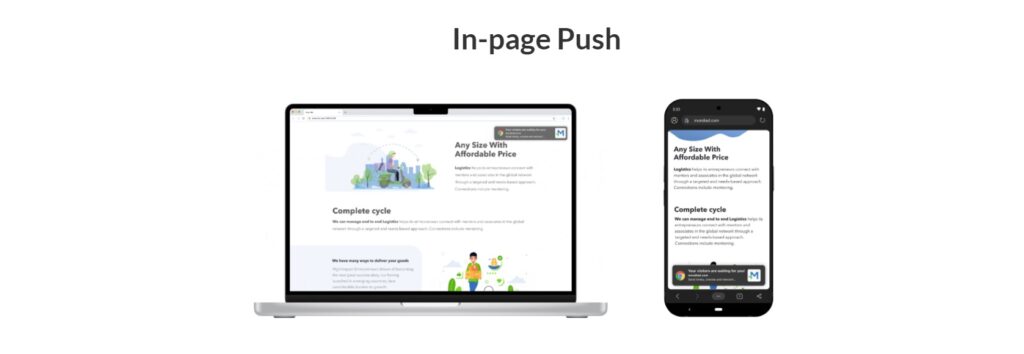
In-page push ads are ideal for:
- Scaling campaigns quickly
- Reaching new audiences
- Monetising all site visitors (not just subscribers)
- Testing creatives and angles before scaling to classic push
The best strategy isn’t choosing one over the other; it’s using both together. Use classic push for high-intent, long-term engagement. Use in-page push for scale, reach, and traffic coverage.
Push vs Traditional Ad Formats
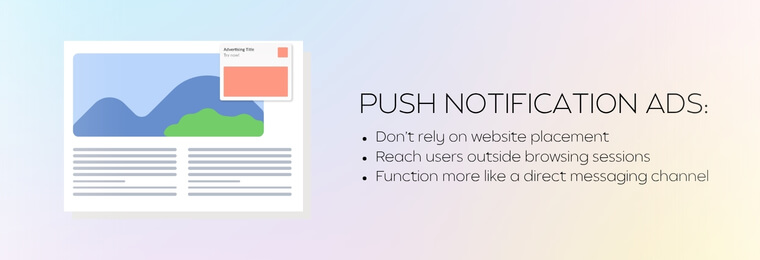
Compared to formats like banners or native ads, push notifications are widely used in performance marketing because they offer:
- High visibility: Delivered directly to the user’s screen
- Strong engagement: Often higher CTRs than traditional display ads
- Particularly effective for time-sensitive offers
- Function more like a direct messaging channel
- No personal data dependency: Works on anonymous subscription IDs
- Scalability: Large global reach through aggregated publisher traffic
- Reach users outside browsing sessions
- Don’t rely on website placement
Understanding Push Audiences
Push ads reach users in highly personal, distraction-filled environments, most often on mobile devices, where attention spans are short and decisions are made in seconds. Because of this, click behaviour is less about deep consideration and more about immediate emotional or practical triggers.
| User Type | Traits | Motivations to Click |
|---|---|---|
| Curious Explorers | Open-minded, impulsive, easily intrigued by new content | Desire to discover something new, satisfy curiosity, explore unknown offers |
| Deal Hunters | Price-sensitive, value-driven, actively looking for savings | Discounts, limited-time offers, coupons, “best deal” messaging |
| Entertainment Seekers | Desire to discover something new, satisfy curiosity, and explore unknown offers | Engaging content, viral stories, quizzes, videos, celebrity/news gossip |
| Impulse Clickers | Reactive, fast decision-makers, influenced by emotions | Urgency (FOMO), sensational headlines, “breaking news,” shocking or dramatic claims |
| Mobile-First Users | Heavy smartphone users, short attention span | Short, catchy messages, visual elements, easy-to-load landing pages |
| Gamblers/Risk Takers | Thrill-seeking, willing to take chances | Sweepstakes, casino offers, betting, “win big” messaging |
| Tech Enthusiasts | Interested in gadgets, apps, and digital trends | New apps, software tools, AI tools, tech news, product launches |
Understanding these user types allows advertisers to craft more relevant creatives, align messaging with user intent, and ultimately improve CTR and conversion performance across campaigns.
Why Publishers Love Push Ads Monetisation
Publishers have quickly embraced push ads monetisation because it offers a simple, scalable, and low-maintenance way to generate revenue from their traffic.
Not to mention, push ads also get bonus points for not disrupting the user experience on their site/app.
- Monetization beyond sessions: earn even after users leave the site
- Non-intrusive format: no clutter or impact on UX
- Easy integration: quick setup with minimal effort
- High engagement: strong CTRs from opt-in users
- Global reach: monetization of traffic from any GEO
- Cross-device coverage: works on desktop & mobile
- Passive revenue
Best Verticals For Push Notifications
Advertisers should choose push notification niches based on user intent, emotional triggers, and GEO behaviour.
The most effective verticals are those that create urgency (like finance), curiosity (dating), or instant gratification (gaming and sweepstakes).
It’s important to match the niche with the target audience’s mindset: what problem they want solved or what action they’re ready to take quickly.
| Niche | Push ads compatibility |
|---|---|
| 💰 Finance & Crypto | High urgency and FOMO drive quick decisions. |
| ❤️ Dating & Adult | Personal, curiosity-driven, and highly engaging. |
| 🎮 Gaming & Mobile Apps | Impulse-friendly with strong reward-based appeal. |
| 🛡️ Antivirus & Utilities | Fear-based messaging pushes immediate action. |
| 🎁 Sweepstakes & Lead Gen | Low commitment and “free” offers boost CTR. |
💡 Testing different angles within a vertical is key, because performance often depends more on the message and timing than the niche itself.
Ultimately, advertisers who focus on fast decision-making behaviours and mobile-first audiences see the best results with push traffic.
Mondiad traffic inventory:
Before creating your Mondiad ad campaign, it’s best to check out our traffic inventory. Find out Mondiad traffic volumes and rates using filters to browse through our latest inventory, according to your needs.

Mondiad marketplace:
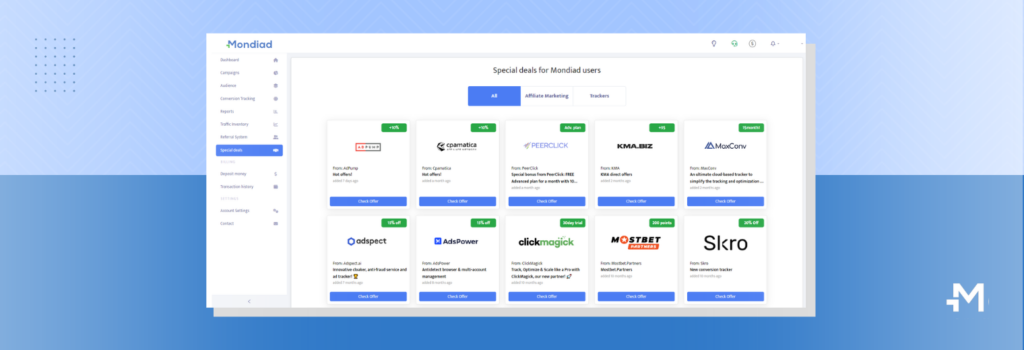
If you need a push(see what we did there) with choosing what to promote in your next Mondiad push ad campaign, we have a tip for you. Check out the Mondiad marketplace, a place dedicated to exclusive bonuses for Mondiad users, from our partners and industry leaders.
Push Notification Advertising FAQ
What is push advertising?
Push advertising is a performance marketing format where ads are delivered as clickable notifications directly to a user’s device or within a webpage. It includes both classic push notifications and in-page push ads.
How do push ads work?
Users first opt in (for classic push) or are exposed to ads within a webpage (in-page push). Advertisers then send campaigns through an ad network, and the ads are delivered via browser technology such as Google Chrome and Mozilla Firefox.
What is the difference between push ads and display ads?
Push ads appear as notifications (outside or within the browser).
Display ads appear as banners or visuals inside webpages.
Push ads tend to be more attention-grabbing and direct.
How much does push notification advertising cost?
Push ads are generally considered a cost-effective advertising format, but prices vary depending on targeting, competition, and GEO. They are typically sold on CPM and CPC models, however, Mondiad also selss them via TargetCPA.
Are push ads intrusive?
Not necessarily. Users choose to opt in (for classic push), and in-page push ads are designed to blend naturally into website content. However, frequency and relevance play a big role in user perception.
Are push ads still effective today?
Yes. Push notification advertising remains a popular and scalable channel due to its high visibility, strong engagement, and performance-driven nature, especially in affiliate and direct response marketing.
Time to Push A New Ad Campaign!
Get your Mondiad campaign up and running in less than 10 minutes. It’s that easy.