


Is your website not accepted by Google? Mondiad is here to help.

Among the many responsibilities of managing a website, from ensuring a seamless user experience to maintaining security, or providing valuable content, webmasters gain a profitable opportunity from these efforts: ad monetization.
Who would turn down a sustainable, passive and complementary income stream that can fund website maintenance and further improvements?
By effectively leveraging ad space, webmasters can turn their online platforms into thriving businesses by diversifying their income streams.
TLDR
- Mondiad approves publishers in under 1 hour with no minimum traffic requirement. AdSense requires consistent traffic and strictly family-friendly content.
- Mondiad minimum payout: $10 (daily). AdSense minimum payout: $100 (monthly, 21-day processing).
- AdSense publicly discloses a 68% revenue share. Mondiad operates with dynamic rates – test with real traffic to establish your baseline eCPM.
- Using Mondiad alongside AdSense (where policies allow) can increase total revenue per session without cannibalizing existing inventory.
Why is Ad Monetization Worth It
As a publisher, you’re responsible for maintaining quality content, driving traffic, ensuring user privacy, and integrating ads in a way that enhances, rather than disrupts, the user experience.
Typical costs include hosting, development, marketing, and compliance tools, along with any third-party services needed to run, secure, and monetize your website or app effectively.
Ad monetization is a solution as it allows publishers to generate passive revenue from their existing digital assets (websites or apps) without charging users directly.
To put it simply, ad monetization is the process of earning revenue by displaying advertisements on a website or an app.
By displaying ads from networks or partners, publishers can turn traffic into income, helping offset operational costs, support content creation, and grow sustainably, even during economic slowdowns or when other income streams are limited.
Your income is exponentially growing over time. As your website traffic grows, the potential ad revenue typically scales with it.
Compared to other monetization strategies, hosting ads doesn’t require an investment or any special technical skills to set it up. It’s a one-time setup og inserting a script into your website, and you are good to go.
Ad monetization is part of the modern digital era, data is king and having access to real-time insights into your audience’s behavior helps you optimize your website for better user engagement and increased revenue.
Modern Ad Monetization
The ad monetization market began to take shape in the early 2000s, as digital advertising emerged alongside the rise of web publishing.
Google AdSense (launched in 2003) played a key role in opening the door for independent website owners to earn money by displaying contextual ads. This marked the start of a scalable way for publishers to generate income from content.
As the digital ecosystem expanded, so did ad monetization strategies. The rise of mobile apps, programmatic advertising, real-time bidding (RTB), and user data targeting significantly boosted ad efficiency and revenue potential.
In-app advertising plays a crucial role in app monetization. According to most recent market data, it brings in two-thirds of global mobile app revenues and provides a lifeline for many media and games publishers.
Statista
Publishers began integrating diverse formats, display, native, video, push, and rewarded ads, tailored to both audience behavior and advertiser demand.

Today, ad monetization is now a mature, multi-billion-dollar global industry. It’s no longer limited to traditional media and gaming, but e-commerce platforms, utility apps, fintech tools, and even education platforms have adopted ad monetization as a core revenue stream.
Publishers have access to powerful tools to segment audiences, avoid ad fatigue, and comply with strict privacy laws like GDPR and CCPA. As the market diversifies, monetization is evolving toward quality, sustainability, and smarter user engagement over pure volume.
Google AdSense: From Pioneer to Pressured
Google AdSense revolutionised digital monetization by allowing publishers of all sizes to earn revenue through contextual ads displayed on their websites. Its easy integration, access to a vast pool of advertisers via Google Ads, and reliable payouts quickly made it the go-to platform for webmasters and bloggers looking to monetize their content.
Over the years, AdSense has evolved with features like responsive ad units, auto ads, and integration with Google Analytics. However, as the digital ad industry matured, so did the competition.
- Alternative ad networks offering specialized formats, better revenue shares, or faster approval emerged and started chipping away at AdSense’s dominance.
- Today, many publishers face market saturation. With millions of websites monetizing through similar means, CPMs and CPCs have become more competitive, especially in content-heavy niches.
- Furthermore, Google’s strict policies and automated enforcement systems often leave publishers feeling frustrated, especially when facing bans or revenue holds without adequate human support.
While AdSense remains a powerful tool, its appeal has waned for some as they seek more responsive support, better monetization rates, or greater control over their ad strategy.
Why Publishers Look Beyond AdSense
Publishers look for AdSense alternatives for a mix of practical, financial, and strategic reasons.
- Strict Approval and Policy Requirements
AdSense has a rigorous approval process, and many sites get rejected for reasons like insufficient content, site age, or design issues. Even after approval, publishers must constantly comply with Google’s content and traffic policies, or risk suspension. - Low RPMs for Certain Niches or Regions
AdSense doesn’t pay equally well across all niches, traffic sources, or countries. Publishers with traffic from lower-paying regions, or in niches Google doesn’t monetize aggressively, often find better rates elsewhere. - Traffic Threshold Requirements
Some alternative networks are more accessible to smaller publishers, while AdSense can feel restrictive for sites that haven’t yet built significant traffic volume. - Account Suspension Risk
A single policy violation (even accidental, like invalid click activity from someone else) can get an AdSense account banned – sometimes permanently, with earnings withheld. This “single point of failure” risk pushes publishers to diversify. - Limited Ad Formats and Customization
AdSense offers decent ad formats, but some alternatives provide more flexibility – native ads, higher-paying video units, in-image ads, header bidding setups, etc. – that can boost revenue or fit a site’s design better. - Desire for Revenue Diversification
Relying on one ad network is risky. Many publishers use multiple networks (or a mix of AdSense + alternatives) to reduce dependency, increase fill rates, and maximize revenue through competition between ad exchanges. - Payment Terms
Some alternatives offer more frequent payouts, lower payment thresholds, or additional payment methods compared to AdSense’s fixed schedule and $100 minimum threshold. - Better Support
AdSense support can be slow or largely automated for smaller publishers. Some alternative networks offer more responsive, personalized account management – especially valuable for larger publishers.
Mondiad vs Google AdSense at a Glance
With this in mind, selecting the right ad monetization platform involves balancing a plethora of factors, from revenue potential to ad types availability, customization options, and customer support quality or transparency.
If you fancy exploring an alternative to AdSense, keep reading to find out if we are what you’re looking for:
Approval requirements
| Approval Criteria | Mondiad | Google AdSense |
|---|---|---|
| Manual review | yes | yes |
| Approval requirements | To be eligible to become a Mondiad Publisher, websites must be content-based, functional at all levels, and in compliance with the applicable legislation. You can check what content is allowed in the Terms of Service. | Publishers need to have a fully functional website with family-friendly content and a consistent amount of traffic to be approved. |
| Minimum traffic requirement | No traffic minimum required. | Google does not publish a minimum traffic requirement |
| Typical review time | Under one hour during business hours* | Varies |
Publishers launching new websites often prioritize speed and accessibility. Established publishers with mature content libraries may place greater emphasis on advertiser demand, ecosystem integration, or existing Google products.
Rather than asking “Which platform approves more easily?”, a better question is: Which platform’s approval criteria better match my website today?
When it comes to onboarding publishers, Mondiad aims to cater to everyone in a timely manner and to maintain that close communication.
Accessibility
| Mondiad | AdSense | |
|---|---|---|
| Resources | Help Center Documentation | Help Center Documentation |
| Ease of use | Self-serve, intuitive platform | Self-serve, intuitive platform |
| Ad code integration | Quick and easy via an ad code integration into your website theme layout. | Quick and easy via an ad code integration into your website theme layout. |
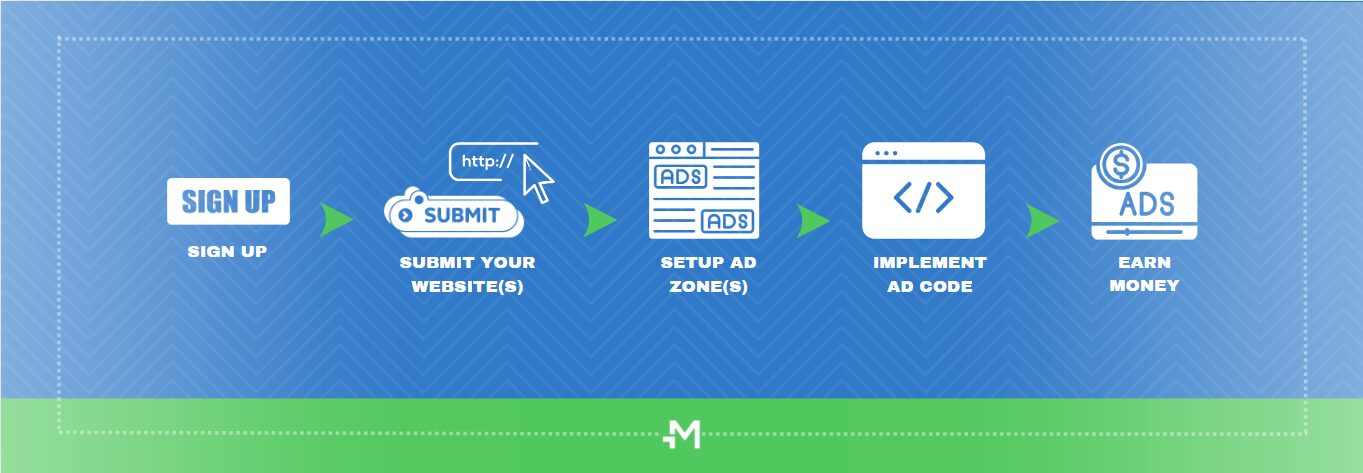
The Mondiad platform is easy to navigate and intuitive, with clear instructions(where needed) and easy processes with no tech skills required.
Supported Ad Formats
Different ad formats monetize different user behaviors. Diversifying formats can help increase overall revenue while avoiding excessive reliance on a single placement.
| Ad Format | Mondiad | Google AdSense |
|---|---|---|
| Banner | ✔ | ✔ |
| Native | ✔ | ✔ |
| Push Notifications | ✔ | ✖ |
| In-Page Push | ✔ | ✖ |
| Dynamic Ads | ✔ | Auto Ads |
| Interstitial | ✔ | ✔ |
| Search Ads | ✖ | ✔ |
| SDK / In-App | ✔ | Limited |
For example:
- Content-heavy blogs may prioritize native and banner ads.
- Affiliate landing pages may benefit from testing additional formats where appropriate.
- Mobile-focused publishers may experiment with interstitial or in-page formats while monitoring user experience metrics.
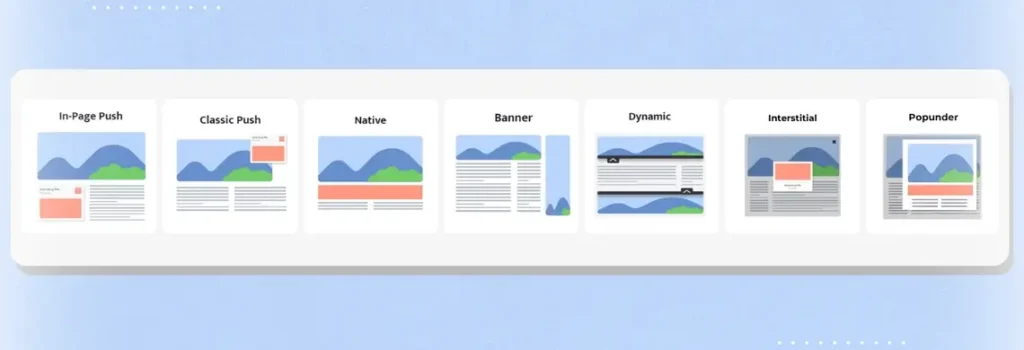
Mondiad monetization guides based on the ad format:
The best-performing mix depends on your audience, traffic sources, and testing strategy rather than on any single ad format.
Ad customizations
| Mondiad | AdSense | |
|---|---|---|
| Ad customizations | Configure supported formats to better match your website layout where applicable. | Customize display ad sizes, layouts, and some styling options for manual ad units. |
| Demo mode | Yes. Preview ad placements using Demo Ads before publishing changes. | No. No dedicated demo mode for publishers. |
Why Ad Customization Matters
Customizing ad placements isn’t just about appearance, it can influence viewability, user experience, and revenue. Creating separate ad zones for different page templates (such as the homepage, article pages, or category pages) allows publishers to test placements, compare performance, and optimize their monetization strategy over time.
Payments & Payout Thresholds
Cash flow matters, especially for newer publishers.
While revenue potential often gets the most attention, payment schedules and minimum payout thresholds can significantly affect how quickly publishers can reinvest in content, traffic acquisition, or website improvements.
| Payment Feature | Mondiad | Google AdSense |
|---|---|---|
| Minimum payout | $10 | $100 |
| Payment frequency | Daily, on request, Automatic payments(weekly & monthly).On average, payments usually take about 24-48 hours after the request was placed. | Monthly |
| Payment Processing | Usually 24-48 hours after request* | Monthly payment cycle after threshold is reached |
| Payment methods | Paypal, Paxum, Capitalist, Payoneer, Webmoney, Cryptocurrencies, Wire, + others, on demand. | Bank transfer, EFT, Wire, SEPA (availability depends on country) |
🎁 New Mondiad publishers get 100% revenue share for 20 days. 🎁
An additional income is also available through our referral system. Promote Mondiad using a referral link and earn 5% (up to 1000 dollars) from each referred publisher’s revenue or advertiser spent.
Which Payment Model Fits Different Publishers?
A lower payout threshold may benefit newer publishers, niche websites, publishers testing multiple traffic sources, and seasonal websites.
Publishers generating substantial monthly revenue may find payout frequency less important than advertiser demand, fill rate, or optimization tools.
Publisher Snapshot
| Feature | Mondiad | Google AdSense |
|---|---|---|
| Approval | Manual review, no minimum traffic requirement | Manual review, website must comply with Google Publisher Policies |
| Minimum payout | $10 | $100 |
| Payment frequency | Daily on request, weekly/monthly automatic | Monthly |
| Support | Live chat, Telegram, Skype, Email, Account Manager, Help Center | Help Center and support channels |
| Ad formats | Push, In-Page Push, Native, Banner, Interstitial, Dynamic, SDK | Display, Native, Auto Ads, Vignette, Search |
Which Publisher Should Choose Mondiad?
No monetization platform is the best choice for every website. The table below summarizes where Mondiad is likely to be a good fit.
| Publisher Type | Mondiad Fit | Why |
|---|---|---|
| New website | Excellent | No published minimum traffic requirement and fast manual review |
| Affiliate content site | Excellent | Multiple monetization formats and flexible implementation |
| Utility websites | Good | Supports additional ad formats beyond display |
| Download portals | Good | Flexible monetization options (subject to policy compliance) |
| Growing blogs | Good | Lower payout threshold may improve cash flow |
| Established media publisher | Depends | Compare advertiser demand, existing stack, and revenue performance |
Mondiad, your AdSense Alternative
There is life beyond AdSense. Mondiad is for you if:
- You were rejected or banned by AdSense;
- Your traffic is primarily Tier 2/3 or non-English;
- You’re in niches that AdSense limits (e.g., streaming, downloads, crypto, etc.);
- You want better monetization for mobile and high-frequency traffic: pop ads effectively monetize short sessions and low-engagement visitors, where AdSense underperforms on sites with high bounce rates;
- want to diversify beyond a single ad network;
- are looking for additional ad formats;
- prefer lower payout thresholds;
- value access to an account manager;
- want to begin testing monetization sooner.
Ad Monetization Best Practices
Prioritize user experience:
Too many ads can negatively impact user experience, leading to higher bounce rates and lower user engagement. Balancing monetization with user satisfaction is crucial.
Optimize ad placement:
Test different ad placements to find the most effective spots that generate clicks without compromising user experience.
Diversify income Streams: Don’t rely solely on ad revenue but explore other monetization methods such as sponsored content, digital products, or memberships.

Add value consistently:
High-quality, engaging content is key to attracting and retaining visitors. Invest time in creating valuable content that meets the needs and interests of your audience.
SEO and marketing matters:
Implement strong SEO and digital marketing strategies to drive organic traffic. Utilize social media, email marketing, and other channels to promote your website.
Monitor and adapt:
Regularly review your analytics to understand what’s working and what isn’t. Be prepared to adapt your strategies based on performance data.
The Takeaway
Google Adsense is popular for a reason; however, like any platform, it has its own drawbacks:
- Strict policies and less flexibility regarding your account.
- Hard to reach a live support team.
- Higher cash-out threshold and longer payment deliveries.
For some publishers, these aspects are not compatible with their views, thus the search for another AdSense alternative. Fortunately, as the market evolved, there are new players that cater to the publishers’ needs, and we hope we can be one of them.
FAQ
Is Mondiad a good alternative to Google AdSense?
Mondiad can be a good alternative for publishers looking for faster approvals, a lower minimum payout threshold, multiple ad formats, and dedicated support. The best choice depends on your website’s traffic quality, audience, niche, and monetization goals rather than on a single platform feature.
Can I use Mondiad and Google AdSense at the same time?
In many cases, publishers can use multiple ad monetization platforms on the same website, provided they comply with each platform’s policies and avoid conflicting ad implementations. Always review the latest Google Publisher Policies and Mondiad’s Terms of Service before combining ad networks.
How long does it take to get approved by Mondiad?
During business hours, Mondiad typically reviews publisher applications in less than one hour per domain. Reviews submitted outside business hours, on weekends, or during holidays may take longer, as every website is manually verified for policy compliance.
What types of websites can monetize with Mondiad?
Mondiad works with content-based websites that comply with its Terms of Service and applicable legislation. Approval is based on a manual review to ensure the website meets the platform’s quality and policy requirements.
How can I increase my website’s ad revenue?
Improving ad revenue involves more than switching ad networks. Publishers should focus on creating high-quality content, increasing qualified traffic, optimizing ad placements, testing different ad formats, improving page speed and Core Web Vitals, and regularly reviewing performance data to identify optimization opportunities.
Monetize with Mondiad!
Learn more about your revenue potential, and let’s grow together! 🚀
