



In programmatic advertising, success is not just about launching campaigns, it’s about winning the right ad auctions, reaching valuable audiences, and making every impression count. Your advertising win rate plays a key role in determining how often your ads are displayed and how effectively your budget is used.
A low win rate can limit your campaign reach, while an optimized win rate can help you secure better traffic opportunities, improve campaign performance, and scale more efficiently. However, winning more impressions does not always mean better results. The goal is to find the right balance between competitive bidding, high-quality traffic, and profitable conversions.
In this guide, we’ll explain what ad campaign win rate means, how it is calculated, and the strategies advertisers can use to improve it—from smarter bidding and targeting optimization to automation and data-driven campaign adjustments.
TL;DR
- A high advertising win rate means your campaigns are successfully winning more ad auctions and getting your ads in front of the right audience. In programmatic advertising, improving win rate requires more than simply increasing bids, it involves strategic bidding, precise targeting, optimization, and continuous data analysis.
- Advertisers can increase their win rate by adjusting bids based on traffic quality, optimizing by GEO and traffic source, using frequency caps, managing blacklists and whitelists, automating optimization rules, and analyzing campaign reports regularly.
- The goal is not just to win more impressions, but to win valuable impressions that generate conversions and improve ROI.
What Is an Advertising Win Rate in Programmatic Advertising?
To understand fully how the win rate works, we must first take a look at the real-time bidding(RTB) system used in programmatic advertising. Overall, RTB has revolutionized the digital advertising industry by making the buying and selling of ad inventory more efficient and data-driven.
RTB allows advertisers to target their ads to specific audiences, optimize their ad spend, and achieve better ad campaign efficiency, leading to more relevant and personalized ads for users and thus improved ROI for advertisers.
In simpler words, programmatic advertising uses a real-time, automated, auction-based bidding system that allows advertisers to bid on ad impressions. And here is where the win rate enters the picture.
The ad campaign win rate is a metric or key performance indicator (KPI) measuring the percentage of ad auctions that an advertiser wins, resulting in their ad being displayed to viewers.
More precisely, it measures the number of impressions won over the number of impressions bid.
As an advertiser, you’ll want to get high win rates, indicating that you are consistently winning bids and getting your ads in front of your target audience.
How Is Ad Campaign Win Rate Calculated?
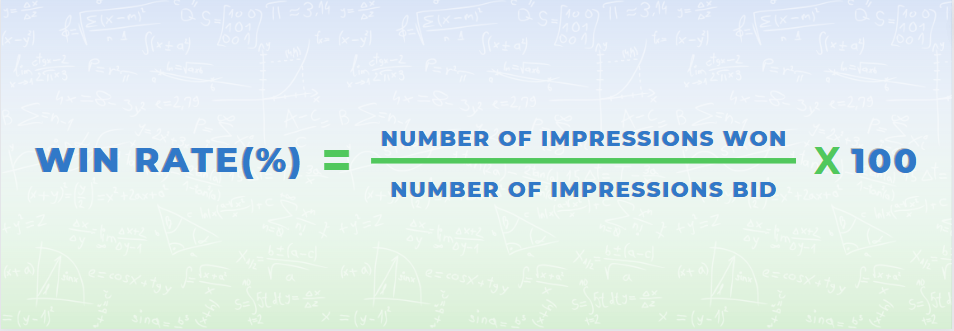
So far so good, but how can we define high and low win rates? Easy… through math. To calculate the ad campaign win rate, you typically use the following formula:
Win Rate(%) = (Number of Impressions Won/Number of Impressions Bid) x 100
For example, if a company has run 20 ad campaigns in a year and 16 of them were successful in achieving their intended goals (e.g., increased sales, brand awareness, etc.), then the win rate would be:
Win Rate (%) = (16 / 20) x 100 = 80%
In this case, the ad campaign win rate is 80%, indicating that 80% of the company’s ad campaigns were successful. 👍
How to Increase Your Ad Campaign Win Rate Step by Step
But sometimes, it’s not as easy as it seems. The advertising landscape is dynamic and competitive, so naturally, as an advertiser, you’ll want to be a bidding winner to put your ads out there. So here are some ideas to increase your win rate for your campaign:
🔹 When deciding on your bids, always check the current traffic inventory available, looking at the average bid price of your targeted GEOs. Your starting bids should be lower than the average but don’t shy away from increasing them later, for specific zoneids/subids showing potential, to get more of that traffic.
🔹 Increasing bid amounts can give advertisers a competitive advantage in ad auctions. When advertisers bid higher, they are more likely to outbid competitors and secure ad placements, resulting in a higher win rate for those auctions.
This is especially important in highly competitive markets where ad inventory is limited. Bidding higher allows advertisers to secure better ad placements, positively impacting the quality of ad impressions, user engagement, conversions, and ultimately the win rate.
When you decide it’s time to increase your bids, make sure you do so little by little(for example, with 15%), based on your win rate score, so your ad spent won’t be consumed very quickly. At this phase, it is also advised to check your reports on a daily basis.
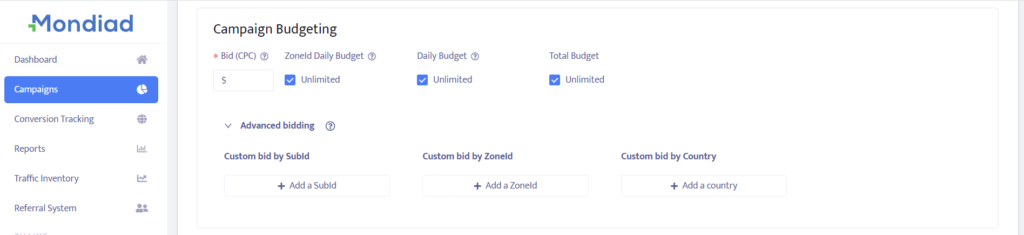
🔹 By experimenting with different bids, advertisers can identify the bid amounts that yield the best results, such as higher click-through rates or conversion rates which can lead to improved win rates over time.
🔹 We suggest working as granularly as possible by using Mondiad’s custom bidding by SubID, ZoneID, and Country(in this priority) to fine-tune your campaign results by increasing the bid on the converting zones you identify, to get more traffic.
🔹 Frequency caps determine how often a specific ad is shown to the same user within a given time period.
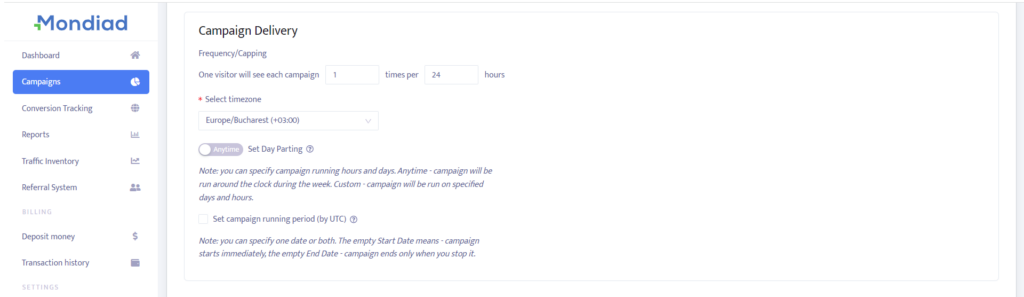
By implementing appropriate frequency caps, advertisers can improve campaign performance, budget efficiency, and the overall win rate by ensuring that their ads are displayed to a diverse and engaged audience while avoiding ad fatigue and negative user experiences.
🔹 Ad campaign blacklists/whitelists can also have a significant impact on an advertiser’s win rate by filtering and bringing in traffic only from desired sources, if the bidding is right. Blacklists protect brands and budgets by excluding undesirable traffic while whitelists prioritize relevant inventory.
🔹 Smart optimization rules in programmatic advertising are designed to maximize the effectiveness of ad campaigns. By using data-driven rules and automation, advertisers can make real-time adjustments to their bidding, targeting, and creative strategies, ultimately increasing their win rate by ensuring their ads are displayed to the right audience at the right time and price.
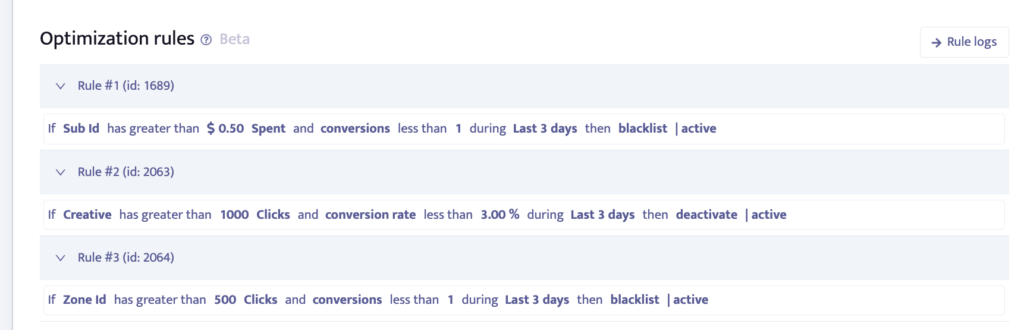
Mondiad’s optimization rules are an in-house technology using smart algorithms for automating the disabling of low-performing creatives, subids, zoneids and campaigns.
🔹 Compared to traditional advertising, programmatic advertising operates digitally, in real-time, which can be easily monitored.
As a Mondiad advertiser, your campaign reports can significantly impact your advertising win rates by providing immediate insights into campaign performance and allowing you timely, data-driven adjustments to bidding, ad delivery, targeting strategies, ad quality or market conditions as they change.
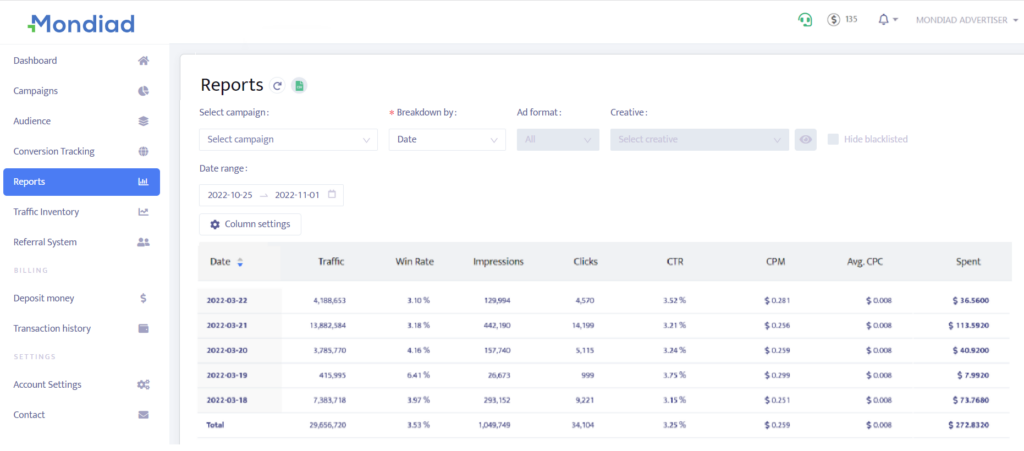
Thus, by leveraging real-time data and insights, advertisers can fine-tune their strategies and allocate resources more effectively, ultimately increasing their win rates and achieving better campaign results.
What to do if you don’t want any headaches?
🔹 Use our TargetCPA feature, which is a smart algorithm that automatically optimizes your campaign performance, including your win rate by blacklisting sources and looking for the most conversion-friendly traffic.
FAQ
What is an advertising win rate?
An advertising win rate measures the percentage of ad auctions an advertiser wins compared to the number of auctions they bid on. A higher win rate means your ads are being displayed more frequently to your target audience.
How can I improve my ad campaign win rate?
You can improve your win rate by optimizing your bids, targeting high-performing GEOs and traffic sources, adjusting frequency caps, using automation rules, and analyzing campaign reports to make data-driven decisions.
Does increasing my bid guarantee a higher win rate?
Increasing your bid can improve your chances of winning ad auctions, but it does not guarantee better results. Advertisers should balance bid increases with traffic quality, conversion rates, and overall campaign profitability.
Is a higher win rate always better?
Not necessarily. A high win rate only shows that you are winning more impressions. The real goal is to win valuable traffic that generates conversions and improves ROI, rather than simply increasing the number of impressions purchased.
Improve Your Win Rate With Mondiad!
All in all, It’s important to note that what constitutes a “successful” campaign can vary depending on the specific objectives set for each campaign and that success can be measured in many forms, including return on investment (ROI), increased sales, lead generation, brand engagement, or any other relevant metrics depending on the campaign’s purpose.

If you’re ready to get started with your marketing campaigns and you are looking for a reliable platform to help your brand grow, we are here.
