



Pop ads are still one of the fastest ways to put an offer directly in front of a visitor, which is exactly why they remain a staple traffic source for affiliates and performance marketers running sweepstakes, software, dating, finance, and iGaming campaigns.
But not every pop network sends the same quality of traffic, and the format itself has real trade-offs worth understanding before you commit budget.
This guide breaks down the best pop ad networks for advertisers in 2026, what to look for before you fund an account, and how pop traffic actually compares to its close relative, the popunder.
TL;DR
- Pops guarantee a viewable impression by opening on top of the page, but that same interruption causes more reflexive closes and more browser blocking than popunders.
- Ten networks are worth testing for pop traffic in 2026: Mondiad, PopCash, PropellerAds, Adsterra, ExoClick, PopAds, Clickadu, HilltopAds, EvaDav, RichAds.
- PopCash and PopAds have the lowest barrier to entry ($5 and $10 minimum deposit), making them the cheapest way to test the format before scaling.
- Before funding any account, check a network’s GEO coverage, anti-fraud filtering, targeting depth, bidding flexibility, vertical restrictions, and payout speed.
- Popunders generally outperform pop-ups on click quality because the ad only appears once the visitor closes or minimizes their active tab, rather than interrupting them mid-task.
- Best-performing verticals for pop traffic: sweepstakes, software downloads, iGaming, dating, finance/crypto, and e-commerce flash sales.
What Are Pop Ads?
A pop ad is a secondary browser window that opens on top of/below the page a visitor is currently viewing, forcing it into focus before the user can keep browsing.
Pops have been part of the web advertising stack since the late 1990s, and despite ad blockers and browser restrictions, they’re still sold at scale by dozens of self-serve networks because they guarantee a viewable impression, the user has to interact with (or close) the window before continuing.
Advertisers buy pop traffic mainly for offers that need a fast, undivided moment of attention: sweepstakes, software downloads, subscription trials, and some finance and gaming offers. The format is cheap on a CPM basis and scales quickly, which is why it remains popular with affiliate marketers running high-volume, low-cost-per-click campaigns.
How Pop Ads Work
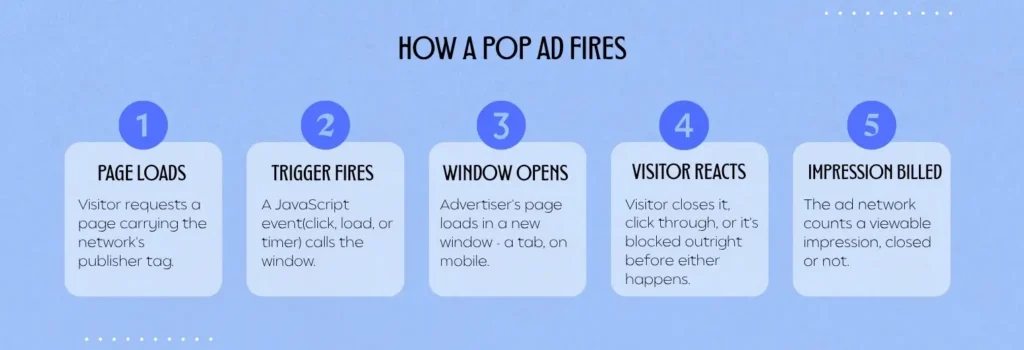
When a site running pop ad code loads, JavaScript triggers a new browser window (or tab, on mobile) that opens in front of the original page. The visitor sees the advertiser’s landing page immediately and has to actively close it or interact with it to get back to the content they wanted. Most networks let advertisers control:
- Frequency capping: how many times the same visitor sees the pop per day/session
- Targeting: GEO, device, OS, browser, connection type, and carrier
- Bidding model: CPM, CPC, or Smart/CPA-target bidding that adjusts bids toward a target cost-per-acquisition
- Creative rotation: split-testing multiple landing pages against the same traffic source
Because the window steals focus, pops tend to have higher visibility rates than banner or native ads, but they also carry a higher rate of accidental closes and, on some browsers and devices, get blocked outright.
What to Look for in a Pop Ad Network
Not every network sends the same traffic. Before committing budget, check a network against these criteria:
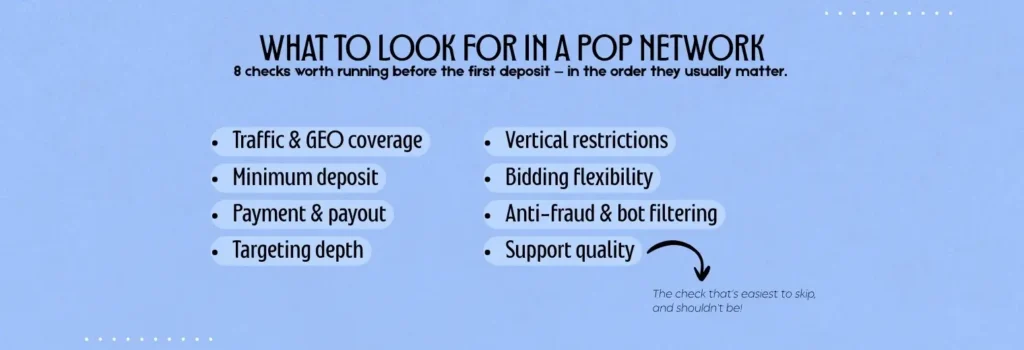
- Traffic volume and GEO coverage: daily impression volume and which countries are Tier 1 vs. Tier 2/3, since CPMs and conversion rates vary widely by GEO
- Minimum deposit: ranges from $5-$25 low-entry networks up to $250+ for premium, managed-service platforms
- Anti-fraud and bot filtering: automated traffic quality systems that filter non-human impressions before you’re billed for them.
- Targeting depth: GEO, device, browser, OS, carrier, connection type, and dayparting at minimum
- Bidding flexibility: CPM, CPC, and automated/Smart bidding toward a target CPA
- Vertical restrictions: some networks are adult-only, others mainstream-only, others mixed; compliance rules vary by vertical (gambling, dating, nutra, finance, crypto)
- Payment methods and payout speed: card, wire, crypto, and processors like Paxum or Capitalist are standard; check minimums and processing time
- Support: a dedicated account manager matters more at scale, when you need whitelist/blacklist optimization fast
Best Pop Ad Networks for Advertisers in 2026
Mondiad
Best for: advertisers who want popunder traffic alongside many other formats.
Mondiad is a self-serve network built in 2019 by the team behind PopCash, so popunder experience is part of its foundation. However, Mondiad it goes well beyond popunders, with push, in-page push, native, banner, Telegram*, parked-domain* and video* formats across 250+ GEOs. You can test and scale across traffic types without opening a new account on another platform.
Control is where it stands out. You can bid on CPM, CPC or TargetCPA, and target by country, carrier, device type, OS and OS version, browser, browser language, subscriber age, traffic type, zone ID, sub ID, IP and ISP. Day parting and custom date ranges let you run each campaign exactly when you want.
A $50 minimum deposit is enough to test several formats and GEOs properly, and campaigns are typically approved in under an hour (during working hours).
Strengths: every major format under one roof, granular targeting down to zone and sub ID, and built-in optimization tools (custom bidding, rules, audiences, TargetCPA) that let you refine results without leaving the platform.
PopCash
Best for: smallest-budget popunder tests.
PopCash is a self-serve network focused entirely on popunders. It runs on a CPM model, with targeting by GEO, device, browser, OS and connection type. Its $5 minimum is the lowest on this list, and approval takes less than an hour (during working hours), so you can go from sign-up to live traffic the same day. That makes it an easy first step for testing an offer or landing page before you commit a real budget.
Strengths: almost no risk to start, a simple popunder-only setup, and fast feedback on whether an offer gets traction. Once it does, you can move to a multi-format platform like Mondiad to scale.
PropellerAds
Best for: advertisers who want scale without managing bids by hand.
PropellerAds is a multisource performance advertising platform built for advertisers, media buyers, agencies and brands looking to scale beyond saturated acquisition channels.
The platform combines multiple traffic sources, including social, in-app, Telegram Mini Apps, interactive, premium web and programmatic inventory, in one account. Its AI-powered optimization engine continuously filters and adjusts the traffic mix to help advertisers reach incremental audiences and improve campaign performance.
Strengths: volume, format variety, and automated bid optimization that shortens the setup phase.
Adsterra
Best for: affiliates testing new offers across many GEOs.
Adsterra is a self-serve network with popunders, social bar, push, native and direct links. Campaigns can run on CPM or CPA, with targeting by GEO, device, OS, browser and carrier. Its anti-fraud checks and personal manager support are useful when you’re testing several GEOs or verticals. It suits advertisers who want a large, global popunder inventory without a fully hands-off interface.
Strengths: mixed pop-up and popunder inventory lets you split-test both formats on one platform, and wide GEO coverage suits offers you haven’t proven yet.
ExoClick
Best for: advertisers running mainstream and adult verticals together.
ExoClick is one of the largest ad exchanges, selling popunders, banners, native, push and video. Its detailed targeting and real-time bidding give precise control over who sees your ads. It also offers conversion tracking and automated rules for pausing or adjusting underperforming zones. It’s a strong pick for experienced media buyers who plan to scale and optimize at the traffic-source level.
Strengths: long track record, deep reporting, CPM, CPC and CPA options, and a low $20 minimum in your table.
PopAds
Best for: low-budget popunder tests with keyword control.
PopAds is a self-serve network dedicated to popunders on a CPM model. Its focused setup is easy to launch and manage, with GEO, device and OS targeting plus automated bidding to keep costs in check. The low complexity is its appeal. You get popunder traffic without the learning curve of a multi-format platform, which helps for quick tests and repeatable campaigns.
Strengths: cheap entry and hands-on control, which suits advertisers who like to adjust things manually.
Clickadu
Best for: gambling and sweepstakes advertisers optimizing toward CPA.
Clickadu is a self-serve network known for popunders, push, in-page push and interstitials. It filters traffic through anti-fraud and quality checks, and offers targeting by GEO, device, OS, browser and connection type. It also supports CPM and CPA-style buying. Advertisers who care about traffic quality and consistent results often use it once they have a validated offer and a larger budget.
Strengths: automated CPA-target bidding and mixed pop and popunder inventory.
HilltopAds
Best for: broad GEO coverage with minimal setup.
HilltopAds is a self-serve network offering popunders, in-page push, push notifications and banners. It supports CPM and CPA models and targeting by GEO, device, OS, browser and connection type, with anti-fraud protection and optimization tools. Its accessible entry point and varied formats make it a good place to test a new offer across traffic types without a big commitment.
Strengths: wide reach and hands-on support once spend grows.
EvaDav
Best for: advertisers who want high publisher volume with CPA-target bidding.
Ad network EvaDav offers popunders, push, in-page push and native ads. Targeting covers GEO, device, OS and browser, with CPM and CPC-style bidding. As a newer platform it can offer less saturated inventory and competitive pricing in some regions, which is useful when you want to diversify beyond the biggest networks.
Strengths: scale and CPA-target bidding.
RichAds
Best for: advertisers who want managed-service support.
RichAds focuses on push and pop traffic, both pop-up and popunder, across 200+ GEOs from Tier 1 to Tier 3. It offers CPM, CPC and CPA pricing with granular targeting by GEO, device, OS and carrier. Its optimization tools and manager support help with scaling, and its offer-friendly traffic suits affiliate and lead-gen campaigns. It’s a good choice when you want to scale a proven offer across several formats.
Strengths: support-led onboarding, and automated list management that saves optimization time.
Pop Ad Networks Compared
| Network | Formats | Min. Deposit | Bidding Models | Best For |
|---|---|---|---|---|
| Mondiad | Classic push, in-page push, native, banner, telegram, domain ads, popunder | $50 | CPM, CPC, TargetCPA | Performance based campaigns |
| PopCash | Popunder | $5 | CPM | Smallest entry budgets |
| PropellerAds | Pop-up, push, native, interstitial | $100 | CPM, CPC, Smart CPM | Scale + automated optimization |
| Adsterra | Pop-up/popunder, social bar, native, video | $100 | CPM, CPA | Testing offers across GEOs |
| ExoClick | Popunder, native, video, push, direct link | $20 | CPM, CPC, CPA | Mainstream + adult verticals |
| PopAds | Popunder | $10 | CPM | Low-budget testing |
| Clickadu | Pop-up/popunder, push, native | $50 | CPM, CPA Goal² | Gambling & sweepstakes |
| HilltopAds | Pop, in-page | $100 | CPM, CPC | Broad GEO scale |
| EvaDav | Pop-up/popunder | $100 | CPM, CPA-target | High publisher volume |
| RichAds | Push, pop-up/popunder | $200 | CPM, CPC | Managed-service support |
Minimum deposits and terms change frequently, confirm current figures on each network’s site before funding an account.
Pop-up vs. Popunder: Which Should You Actually Run?
The pop-up vs popunder battle is worth pausing on, because the two formats get lumped together constantly and they don’t perform the same way.
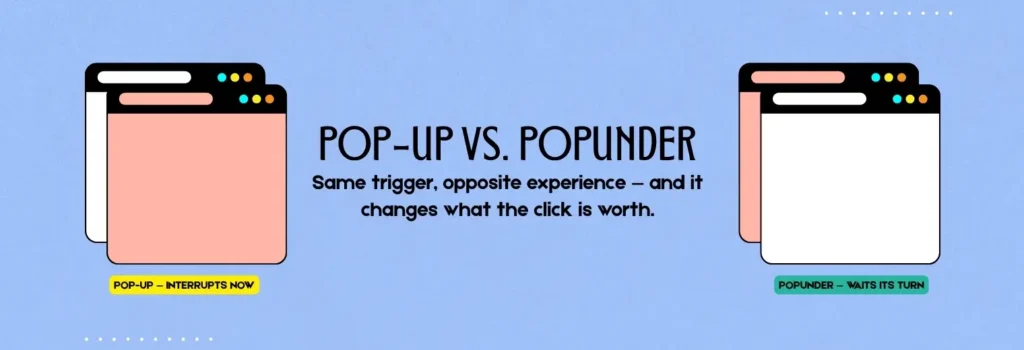
A pop-up opens in front of the current page and interrupts whatever the visitor was doing.
That guarantees visibility, but it also means a share of users close it immediately out of reflex, before ever registering the offer, and pop-ups are more aggressively targeted by browser pop-up blockers than popunders are.
A popunder opens behind the active browser window.
The visitor doesn’t see it until they close or minimize their current tab, at which point they’re looking at your landing page with nothing else competing for attention. Because the interruption happens on the user’s own terms rather than mid-task, popunders generally see fewer reflexive closes and steadier click-through quality, which is a big part of why the pop-traffic industry has been shifting inventory toward popunders over the past few years.
This is also why Mondiad doesn’t sell pop-up inventory at all, only popunders. If you’re evaluating this list because you want pop traffic that converts rather than pop traffic that just registers an impression, it’s worth testing a popunder-only source like Mondiad’s popunder inventory alongside the pop-up networks above and comparing results directly.
That said, this guide is about pop-up ad networks specifically, since that’s still the format some campaigns and some publisher inventory are built around, so use the list and comparison table above to pick a pop-up source, and treat the popunder option as a benchmark to test against.
Verticals That Perform Best With Pop Traffic
Pop-up and popunder traffic tends to perform best in verticals where a single fast decision drives the conversion.
Current ad network Mondiad data consistently identifies iGaming/casino, dating, apps & utilities, gaming, and e-commerce among the strongest popunder verticals. CPMs vary substantially by GEO, device, traffic quality, and seasonality.
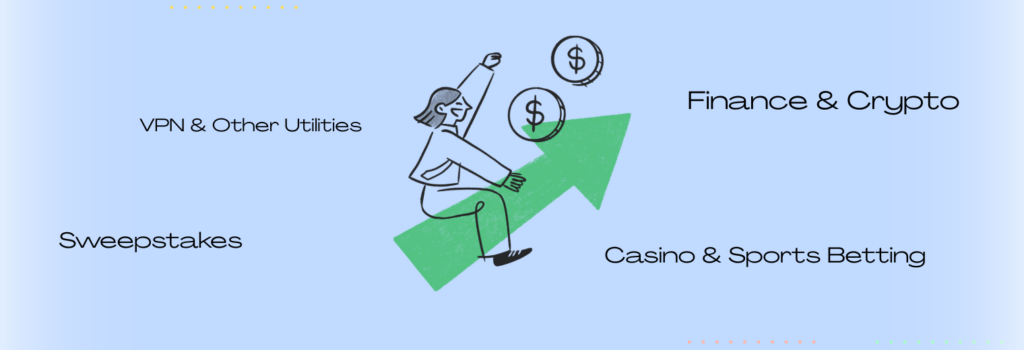
- Sweepstakes and giveaways: low-friction, high-volume conversions
- Software downloads and utilities: VPNs, cleaners, antivirus trials
- iGaming and betting: where local regulations permit
- Dating: especially in mixed and adult-friendly networks
- Finance and crypto offers: sign-up and lead-gen campaigns
- E-commerce flash sales: time-limited discount codes
FAQ: Pop-up Ad Networks for Advertisers
What is the cheapest pop ad network to start with?
PopCash has the lowest entry point on this list at a $5 minimum deposit, just ahead of PopAds’ $10 minimum, making either a common first stop for advertisers testing small budgets before scaling to larger networks.
Are pop ads still effective in 2026?
Yes, for specific verticals and use cases, sweepstakes, downloads, and fast-decision offers still perform well with pop-up traffic. However, click quality is generally lower than popunder traffic because the interruption happens mid-task rather than when the user is already leaving the page.
What’s the difference between a pop-up and a popunder ad?
A pop-up opens on top of the active browser window and interrupts the visitor immediately. A popunder opens behind the active window and is only seen once the visitor closes or minimizes their current tab, which tends to produce steadier engagement and fewer reflexive closes.
Do pop-up ads get blocked by browsers?
Most modern browsers block unsolicited pop-up windows by default, which is part of why many networks have shifted their default pop inventory toward popunders, which are less commonly targeted by blocker rules.
Which ad networks offer both pop-up and popunder formats?
Adsterra and Clickadu both run mixed pop-up/popunder inventory, letting advertisers split-test the two formats within the same platform. ExoClick and PopAds are popunder-focused, while Mondiad’s pop inventory is popunder-only.
How much should I budget to test a pop-up ad network?
Industry rule of thumb is $200-$300 minimum, though the real figure depends on vertical and GEO. Entry-level networks like PopCash and PopAds let you start much smaller, from $5-$10, if you just want to validate an offer before committing to a larger test budget.
Ready, Set, Advertise!
Here’s the honest truth: there’s no single “best” pop ad network. However, choosing the right pop ad network comes down to more than just traffic volume or the lowest CPM. A succesfull marketer would look at GEO coverage, targeting options, traffic quality, bidding flexibility, and specific verticals needed, all play a role in whether a campaign actually delivers profitable results.
If you’re testing pop traffic for the first time, start small, compare networks, and give popunder traffic a fair test alongside traditional pop-ups. The numbers will tell you which format and traffic source work best for your offer.
Ready to see what pop traffic can do for your campaign? Start with Mondiad’s popunder traffic, test your offer, and once something works, that’s when it makes sense to widen the net: more formats, more GEOs, more control over who sees your ads.
